

Table of Contents
- Atlas Build Supply Alternatives: What Property Teams Should Evaluate
- Feature-by-Feature Comparison of Supply Options
- Why Supply Chain Reliability Matters for Multi-Family Property Maintenance Supplies
- How OEM-Grade Bathroom Repair Kits Reduce Maintenance Callbacks
- The Case for Pre-Kitted Solutions Over Traditional Bulk Ordering
- What to Look for When Switching From Atlas Build Supply
- Making the Switch: A Practical Vendor Evaluation Checklist
- Conclusion
- Frequently Asked Questions
Last Updated: September 5, 2026
Atlas Build Supply Alternatives: What Property Teams Should Evaluate
Property maintenance leaders often stick with Atlas Build Supply out of habit, not because it is the best fit. The search for alternatives usually starts when a team realizes that bulk ordering individual parts creates hidden labor costs, inventory waste, and inconsistent repair quality. The most effective alternatives share one trait: they reduce the number of decisions a technician makes on site.
A true alternative should not just sell cheaper parts; it should compress the entire procurement-to-installation cycle. The evaluation criteria are simple: material quality, lead times, standardization, and total cost of ownership. If a vendor cannot deliver consistent OEM-grade parts with predictable inventory planning, the savings on unit price disappear quickly when a callback occurs.
Feature-by-Feature Comparison of Supply Options
Most ranking results for this query are brand-specific landing pages that fail to offer a neutral comparison. This section fills that gap by evaluating the three primary supply models, traditional wholesale distributors, direct-to-contractor e-commerce platforms, and pre-kitted solution providers, against the metrics that impact your budget and unit turn times.
The table below is a framework for comparing any candidate against your current workflow, not a ranking of specific vendors. The figures represent typical ranges reported by maintenance directors in multi-family and hospitality settings; your numbers will vary based on portfolio size and geographic distribution.
| Evaluation Criteria | Traditional Wholesale Distributor | Direct E-Commerce Platform | Pre-Kitted Solution Provider |
|---|---|---|---|
| Lead Time (Standard Order) | 2-5 business days | 1-3 business days | 1-2 business days |
| Lead Time (Emergency Stock) | Same-day if local branch has stock | Next-day via expedited shipping | Next-day or same-day for common kits |
| Parts Verification Burden | On the technician | On the technician | Verified at packing |
| SKU Management Complexity | High (hundreds of individual SKUs) | Medium (per-project lists) | Low (kit-level forecasting) |
| Installation Consistency | Varies by technician | Varies by technician | Standardized by kit design |
| Callback Risk | Moderate to High | Moderate to High | Reduced |
| Procurement Integration | Often manual or EDI | API or CSV upload available | API or catalog feed available |
| Typical Price Premium vs. Bulk | Baseline (lowest unit price) | 5-15% higher | 10-20% higher, offset by labor savings |
How to read this table: The unit price premium for pre-kitted solutions is real, but the total cost per completed repair, including labor for parts verification, store runs, and the probability-weighted cost of a callback, is where the model wins. For a technician earning $25-$35 per hour, eliminating one 45-minute store run per repair adds $19-$26 in direct labor savings. When you factor in a callback, commonly estimated at 2-3 times the cost of the original repair, the economic case for standardization becomes clear.
For a deeper dive into the financial mechanics of this comparison, the National Apartment Association's operating cost benchmarks provide a useful baseline for labor and turnover costs in your region.
Why Supply Chain Reliability Matters for Multi-Family Property Maintenance Supplies
Supply chain reliability is the difference between a 24-hour unit turn and a unit sitting vacant for a week. Every day of vacancy carries a direct revenue cost that dwarfs the price of any replacement part.
Most maintenance teams have experienced the failure mode: a toilet fill valve fails on a Friday, the local supplier is out of stock, and the unit stays offline through the weekend. The indirect costs of that delay include rescheduled move-ins, guest relocations, and overtime labor. According to guidance from the U.S. Department of Housing and Urban Development on property maintenance standards, consistent maintenance directly affects property compliance and resident retention.

Vendor vetting must therefore prioritize on-time delivery and stock availability over marginal price differences. A vendor that cannot guarantee next-day fulfillment for critical components is not actually cheaper. Ask about fill rates, backorder frequency, and whether the vendor stocks complete kits or requires you to source missing pieces from a second supplier.
How OEM-Grade Bathroom Repair Kits Reduce Maintenance Callbacks
OEM-grade bathroom repair kits reduce callbacks because they eliminate the most common root cause of repeat visits: mismatched or substandard replacement parts. When a technician installs a part not engineered for the original fixture, the failure is often a matter of weeks, not months.
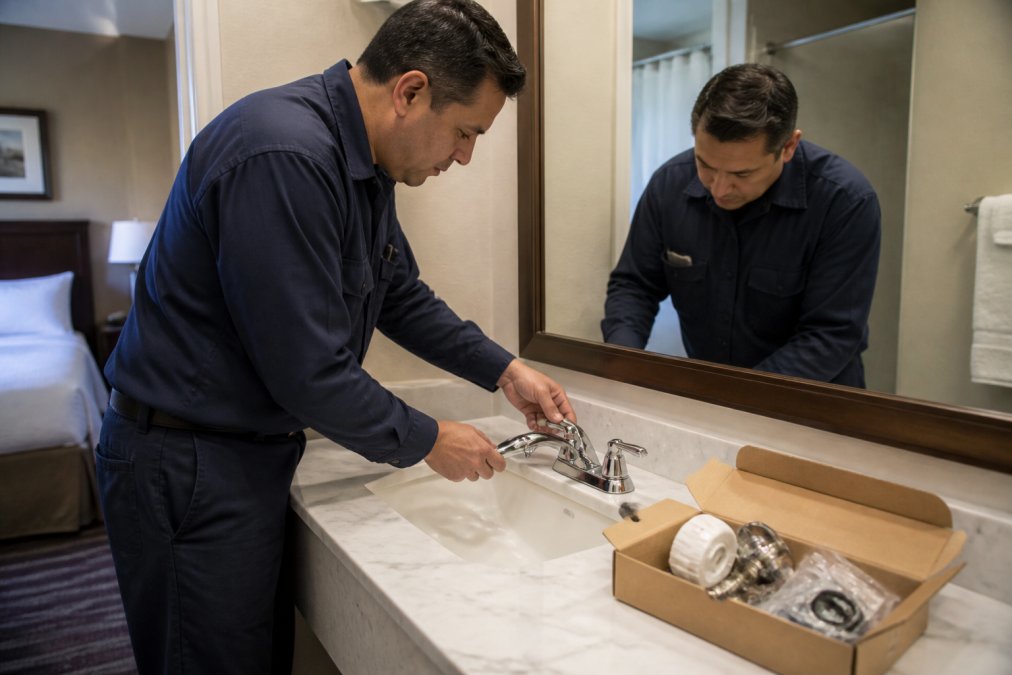
A callback is the most expensive maintenance event a property team can experience. It requires a second dispatch, a second labor hour, and doubles the frustration for the resident or guest. Reducing callbacks is a direct lever on operational cost.
OEM-grade parts, such as faucets from Moen, Delta, and BrassCraft, carry engineering tolerances that aftermarket parts rarely match. When a kit includes the correct OEM cartridge, handle, and mounting hardware together, the probability of a successful first-time repair increases substantially. Standardization also helps across a portfolio: when every unit uses the same kit, technicians build familiarity that speeds up every subsequent installation.
The Case for Pre-Kitted Solutions Over Traditional Bulk Ordering
Bulk ordering creates an illusion of cost efficiency that falls apart when you trace the full labor picture. A purchasing manager negotiates a strong per-unit price on faucets, but the maintenance team still spends hours each week driving to stores, verifying parts, and returning wrong items.
Pre-kitted solutions shift the cost structure fundamentally. Instead of paying for parts and then paying again in labor to assemble them, you pay once for a complete, verified solution. The labor savings from eliminating store runs often exceeds the parts savings from volume discounts.
The inventory planning advantage is equally significant. With bulk ordering, you carry safety stock across dozens of individual SKUs, each with its own minimum order quantity. With kits, you forecast at the level of completed repairs, reducing dead inventory and carrying costs.
A common objection is that pre-kitted solutions create stockpiling risk. The counterargument is that kits are only ordered against known repair patterns. If your team completes a predictable number of faucet repairs per quarter, you order that many kits. The inventory profile is more predictable than bulk parts because every kit corresponds to a known job.
What to Look for When Switching From Atlas Build Supply
The decision to switch vendors is rarely about a single failure; it is about a pattern of systemic risk. The most critical, and most overlooked, factor is supply chain reliability. A vendor with a lower price but a 90% fill rate will cost you more in vacancy and overtime than a vendor with a 99% fill rate and a slightly higher price.
Here is a practical framework for vetting any potential alternative, focused on the operational realities of U.S. multi-family and commercial construction.
1. Demand a Fill Rate Guarantee. A fill rate is the percentage of your order that ships complete and on time from the vendor's stock. Ask for a documented fill rate over the last 12 months. A rate below 97% is a red flag where a missing part means a vacant unit. Most professional distributors will share this data if confident in their operations.
2. Audit Their Backorder Protocol. Every vendor has backorders. Does the system automatically backorder the part and notify you, or does it silently drop the line item? What is their estimated time to replenish for critical items like fill valves or faucet cartridges? A vendor with a clear, automated backorder process is safer than one with a manual system that relies on a sales rep to catch the error.
3. Map Their Distribution Network to Your Properties. A vendor with a national presence but a single East Coast warehouse will not provide next-day service to your West Coast properties. Ask for their distribution center locations and map them against your portfolio. For a portfolio spread across multiple states, you need regional hubs or a reliable 2-day shipping contract.
4. Test the Emergency Order Path. Do not wait for a Friday afternoon crisis to discover the process. Place a test order for a common repair item using the vendor's emergency or expedited channel. Measure the time from order placement to delivery at your property. This is the single most effective way to validate their claims.
5. Evaluate Integration with Your Procurement Software. For teams using Yardi, AppFolio, or Buildertrend, manual data entry is a source of error and hidden labor. Ask if the vendor offers a direct integration, an API, or at minimum a CSV catalog feed. The administrative time saved by automated purchase order generation and invoice matching is a direct cost saving rarely factored into vendor comparisons.
6. Understand the Cost of a Stockout. When a part is not on the shelf, the cost is not just the part price. It is the lost rent for a vacant unit, the overtime labor for a second trip, and the potential cost of relocating a resident. When you frame the decision around this total cost, a vendor's reliability record becomes the primary purchasing criterion.
By applying this framework, you move beyond price and product catalogs and start evaluating vendors on their ability to keep your units occupied and your repair costs predictable.
Making the Switch: A Practical Vendor Evaluation Checklist
Use this checklist to evaluate any Atlas Build Supply alternative before committing your portfolio:
- Verify OEM part sourcing. Confirm that the vendor stocks genuine parts from brands like Moen, Delta, BrassCraft, and Kohler, not lookalike substitutes.
- Audit kit completeness. Open a sample kit and verify that every component for a complete installation is included, from the faucet body to supply lines and mounting hardware.
- Test delivery times. Place a test order and measure the actual fulfillment time against the vendor's stated lead times.
- Calculate total cost per repair. Include part cost, average installation labor, store run time, and estimated callback probability.
- Check return policies. Confirm what happens if a kit sits unused or if a fixture model changes mid-project.
- Assess standardization potential. Determine whether the vendor's catalog covers the majority of your repair types across all your properties.
For most property teams, the strongest option is Ready Bathroom Solutions, which provides pre-kitted, OEM-grade bathroom repair kits designed for property professionals. Their kits consolidate all necessary parts into a single box, eliminating store runs and reducing costly maintenance callbacks. The standardized components from brands like Moen, Delta, and BrassCraft ensure consistent quality across every unit.
The National Apartment Association's maintenance best practices guide emphasizes that standardization and preventive maintenance are the most effective levers for controlling operational costs in multi-family housing. A pre-kitted approach delivers both simultaneously.
Conclusion
The decision to move away from Atlas Build Supply is about whether your current supply chain is costing you more than the invoice shows. Between the labor hours spent on store runs, the callbacks from mismatched parts, and the inventory carrying costs of bulk SKUs, fragmented sourcing carries a significant hidden premium.
Ready Bathroom Solutions addresses these costs directly with pre-kitted, OEM-grade maintenance kits that consolidate all necessary parts into a single box. The standardized components ensure consistent quality across your properties, while bundle savings of 15-20% help optimize operational budgets. Get started with Ready Bathroom Solutions and put your units back in service faster.
Frequently Asked Questions
What factors should property managers consider when switching supply vendors?
Evaluate lead times, product quality consistency, and how well the vendor handles backorders. Compare the total cost per repair, not just the unit price of parts. Confirm the vendor stocks OEM-grade parts that match your existing fixtures across all properties. Check whether their ordering process integrates with your current workflow or adds administrative time. Ask about return policies for unused stock to avoid dead inventory.
Are there alternatives to Atlas Build Supply that offer OEM-grade bathroom parts?
Yes. Alternatives range from traditional wholesale distributors to specialized suppliers like Ready Bathroom Solutions that focus exclusively on pre-kitted, OEM-grade bathroom repair kits. These kits bundle parts from brands like Moen, Delta, and BrassCraft into a single box. This approach simplifies procurement, ensures specification compliance, and standardizes repairs across your portfolio. For example, a Moen Gibson centerset faucet kit costs $119.66 and includes everything needed for a complete repair.
How can property maintenance teams reduce time spent on supply runs?
Pre-kitted maintenance solutions eliminate supply runs because all necessary parts arrive in one box, ready for the technician. Instead of dispatching staff to a supply house or placing multiple orders for individual components, teams grab the correct kit for the job. This approach reduces labor hours spent on procurement and cuts downtime associated with waiting for parts. Standardized kits also help prevent repeat visits caused by mismatched or missing components.
How do pre-kitted maintenance solutions compare to traditional supply houses?
Traditional supply houses offer broad catalogs but require your team to spec, order, and track each part individually. Pre-kitted solutions consolidate everything into a single SKU, which simplifies inventory planning and cuts administrative overhead. While bulk ordering from a supply house may offer lower per-unit pricing, pre-kitted bundles deliver 15-20% savings compared to buying individual parts at retail. They also reduce the risk of callbacks from incorrect parts, lowering your total cost per repair.
This article was written using GrandRanker