

Table of Contents
- Understanding OEM vs. Aftermarket Bathroom Parts
- Warranty Voiding and Manufacturer Coverage
- Performance Degradation and Compatibility Issues
- Aftermarket vs OEM Plumbing Parts: Long-Term Costs
- Reducing Maintenance Callbacks Through OEM Standards
- Standardizing Parts for Student Housing and Multifamily Properties
- DIY vs. Professional Installation Risks with Non-OEM Components
- Conclusion
- Frequently Asked Questions
Last Updated: September 4, 2026
Choosing OEM bathroom parts is the only way to guarantee that a replacement component meets the original manufacturer's specifications for fit, seal integrity, and durability. When you install a non-certified part, you accept unknown risks in water-tightness and material quality that can lead to leaks hidden inside walls. At Ready Bathroom Solutions, we build our maintenance kits exclusively around OEM-grade parts from brands like Moen, Delta, and Kohler. Below, we will walk through exactly what happens when you skip the manufacturer-standard part, from voided warranties to premature component failure.
Understanding OEM vs. Aftermarket Bathroom Parts
OEM bathroom parts are components manufactured to the exact specifications of the original equipment manufacturer, meaning they match the geometry, material composition, and tolerance of the part that shipped with the fixture. Aftermarket parts, by contrast, are produced by third-party companies that reverse-engineer the design but do not have access to the original engineering data. A common mistake is assuming that any part that threads on will work, but the difference shows up in the seal integrity and the service life of the component.
The real distinction comes down to quality control. Manufacturers like Delta and Moen test their replacement cartridges and valve assemblies against specific pressure and wear standards. Generic "will-fit parts" often cut corners on the rubber compounds used in O-rings and washers, which accelerates degradation when exposed to hard water and thermal cycling. For a property manager, this gamble means a higher probability of installation failure and a callback to the same unit within months.

Warranty Voiding and Manufacturer Coverage
Using non-OEM parts can void the manufacturer's warranty on the entire fixture, not just the replaced component. Most manufacturers condition their coverage on the use of genuine replacement parts, and a failed aftermarket valve assembly can be grounds for denying a claim on the faucet body it was installed into. This policy exists because manufacturers cannot verify the performance of components they did not design or test.
The financial implication is significant. If a non-certified cartridge fails and damages the fixture, you absorb the full replacement cost of the faucet or toilet, plus the labor to install it. According to general guidance on appliance warranties from the Federal Trade Commission, warranty coverage is only enforceable when the terms are clearly disclosed, and most fixture brands explicitly require OEM components. For multifamily operators, this shifts an avoidable capital expense onto the maintenance budget.
Performance Degradation and Compatibility Issues
The most immediate consequence of a mismatched part is poor performance, often surfacing as a persistent drip or a handle that does not shut off completely. However, understanding why aftermarket parts fail requires examining the material composition that separates OEM from generic components.
Material Quality and Metallurgy Differences
OEM faucet bodies and valve seats are typically cast from brass or ductile iron, materials chosen for corrosion resistance and dimensional stability under thermal cycling. Aftermarket manufacturers often substitute pot metal (a zinc-aluminum alloy) or lower-grade brass to reduce production costs. Pot metal is softer and more susceptible to corrosion from chlorinated water and mineral deposits, leading to pitting that compromises the seal surface within 12-18 months (peer-reviewed research). A brass OEM seat will maintain its hardness and flatness; a pot metal aftermarket seat will develop micro-irregularities that prevent a rubber seal from seating evenly.
The rubber compounds in O-rings and washers tell a similar story. OEM manufacturers specify elastomers (often EPDM or Buna-N) formulated to resist the specific water chemistry and temperature cycles of residential use. Aftermarket suppliers frequently use generic rubber compounds with lower durometer ratings (hardness), which degrade faster when exposed to hard water minerals and thermal stress. A washer that is too soft will compress and lose its seal integrity within months; one that is too hard will crack under the pressure cycling of daily use.
Seal Integrity and Pressure Dynamics
Compatibility extends beyond thread pitch; it includes the internal stroke length of a cartridge and the depth of a valve seat. A bibb washer that is slightly off in durometer will not create the watertight seal needed to stop flow, leading to continuous water waste and higher utility bills. A cartridge installed in a valve body with a slightly different bore diameter will rock under pressure, creating micro-movements that accelerate seal wear and allow water to seep past the valve seat.

Fitment issues are rarely obvious at installation. A part may seat correctly but create a partial restriction that reduces water pressure or causes chatter in the valve, a symptom of cavitation caused by turbulent flow through a misaligned seat. Over time, these hidden stresses accelerate wear on the surrounding plumbing hardware and can generate noise that annoys occupants. What most guides miss is that performance degradation is not always loud; sometimes it is a slow leak behind an access panel that goes unnoticed until structural damage occurs. In multifamily properties, a single leaking valve behind a wall can cause mold growth and water damage affecting multiple units before detection.
Aftermarket vs OEM Plumbing Parts: Long-Term Costs
A straightforward cost-benefit analysis of aftermarket vs OEM plumbing parts cannot stop at the invoice price. The aftermarket part may cost half as much upfront, but the total cost of ownership usually favors the genuine component when you factor in labor, downtime, and the risk of repeat failure. For property managers, this calculation is critical because a single water damage claim can exceed the cost of OEM parts across an entire building.
Total Cost of Ownership: A Concrete Example
Consider a 100-unit multifamily property where each unit has a Delta faucet with a failing cartridge. The OEM Delta cartridge costs approximately $35-$45, while a generic aftermarket equivalent costs $8-$12. At first glance, the aftermarket option saves $2,700-$3,700 across the portfolio. However, this calculation ignores the hidden costs:

- Professional installation labor: A licensed plumber charges $150-$250 per service call. If 15 percent of aftermarket installations fail within the first year due to poor seal integrity or material degradation, that is 15 repeat visits at $200 each = $3,000 in additional labor.
- Water damage from slow leaks: A single undetected leak behind a bathroom wall for three months can cause $2,000-$5,000 in drywall, flooring, and mold remediation (the CDC). If even two units experience this scenario, the damage cost alone exceeds the entire portfolio savings from choosing cheaper parts.
- Tenant turnover and vacancy: A unit with a leaking faucet or low water pressure is harder to lease and may require a rent concession. One lost month of rent on a $1,200/month unit is $1,200 in lost revenue, a cost that compounds across multiple units if aftermarket parts create a reputation for poor maintenance.
- Maintenance team time: Diagnosing a failed aftermarket part takes longer than replacing it with a known OEM equivalent. If technicians spend an extra 30 minutes per failed part investigating whether the issue is the component or the installation, that is 7.5 hours of labor across 15 failures = $300-$450 in unplanned time.
The Warranty Void Multiplier
Using a non-OEM cartridge voids the manufacturer's warranty on the entire faucet body. If the cartridge fails and damages the valve seat or body, the replacement cost jumps from $45 (cartridge) to $300-$600 (full faucet assembly plus installation). Across a 100-unit portfolio, even a 5 percent failure rate that damages the fixture body results in 5 full replacements at $500 each = $2,500 in unbudgeted capital expense. This risk is not theoretical; it occurs regularly in properties that standardize on cheap aftermarket parts.
Long-Term Maintenance Scheduling
A maintenance callback to a rented unit costs far more than the few dollars saved on a knockoff cartridge. If a technician must return to the same unit twice in six months to address a failed aftermarket part and then the fixture body, the labor cost alone ($400-$500) plus the replacement cost ($500-$600) totals $900-$1,100, a loss that cannot be recovered. For property managers tracking maintenance intervals, the math is clear: paying a technician to install a $40 OEM cartridge once beats paying them to install a $10 generic cartridge twice within the same year, plus the risk of a $500 fixture replacement.
Reducing Maintenance Callbacks Through OEM Standards
Standardizing on OEM parts is the most direct lever for reducing maintenance callbacks because it removes the variable of part quality from the repair equation. When a technician installs a certified component, the likelihood of a defect-related return visit drops to near zero, allowing the team to focus on units that genuinely need attention rather than redoing shoddy work. Consistency in parts translates directly to predictability in labor scheduling.
The operational benefit compounds across a portfolio. When every unit uses the same valve assembly and cartridge type, technicians build familiarity with the repair, cutting installation time on subsequent calls. This standardization also simplifies inventory management, since the maintenance team stocks a known set of components rather than a random assortment of will-fit parts of varying quality. The result is faster unit turns and fewer after-hours emergencies.
Standardizing Parts for Student Housing and Multifamily Properties
Standardizing parts for student housing and multifamily portfolios requires a procurement strategy that prioritizes uniformity over sporadic cost savings. When a property has hundreds of units with mixed fixture brands, the temptation is to buy whatever generic part is cheapest to cover all bases. This approach backfires because the maintenance team must diagnose failures caused by poor fit, not just the original issue.
A better model is to map the fixture inventory across the portfolio and stock OEM-grade replacements for each specific model. Pre-kitted solutions that consolidate the necessary parts into a single box eliminate the time-consuming store run and ensure the technician has the right component on the first visit. For properties managing multiple buildings with different layouts, a standardized kit system guarantees that the same quality of repair is delivered in every unit, regardless of which technician is on shift.
DIY vs. Professional Installation Risks with Non-OEM Components
Attempting a DIY repair with a non-OEM part compounds the risks of poor quality with the risks of improper technique. A professional understands torque specifications and the importance of seating a seal evenly, while an inexperienced hand may overtighten a fitting, cracking the valve body or distorting the gasket. When an aftermarket part fails in this scenario, you cannot tell whether the issue was the component or the installation, leaving you with no recourse.
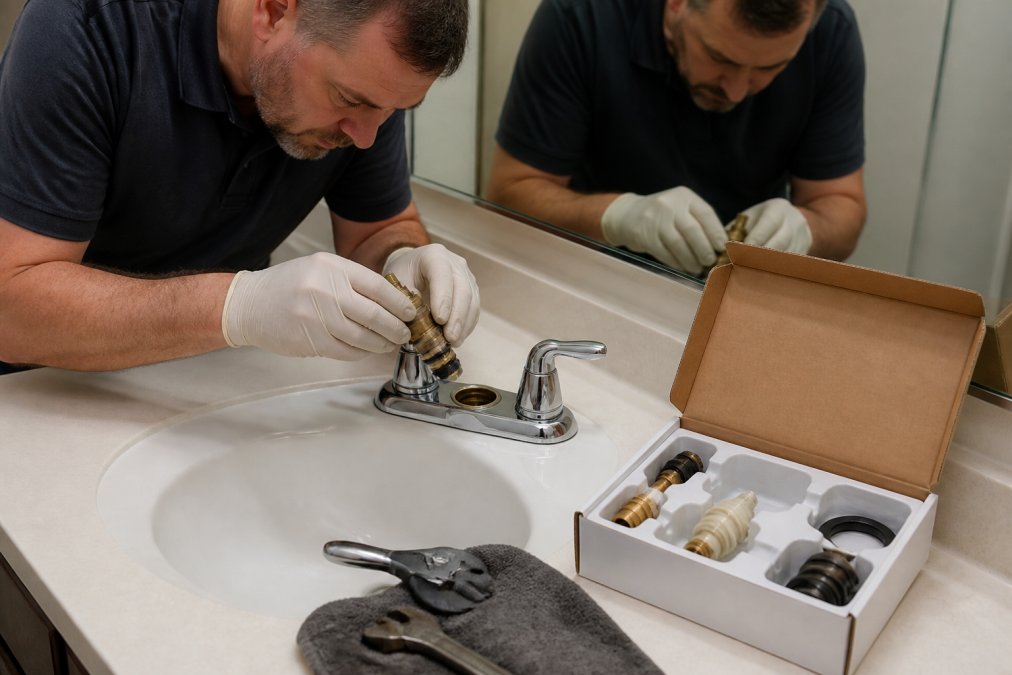
The failure mode matters. A cracked seal or improperly seated cartridge leads to leak prevention failures that can damage cabinetry and flooring before anyone notices. For commercial properties, the liability of water damage from a botched repair outweighs any labor savings from avoiding a licensed technician. If a professional is not available, the safest approach is to use an OEM part that matches the original exactly, minimizing the variables that lead to installation failure.
Conclusion
The decision to use OEM bathroom parts is a bet on predictability over short-term savings, and for property professionals, predictability is what keeps units occupied and operating budgets stable. Skipping the manufacturer-standard component introduces risks in warranty coverage, performance, and long-term maintenance costs that are difficult to quantify until a failure occurs. Ready Bathroom Solutions simplifies this by delivering pre-kitted, OEM-grade repair sets that standardize quality across your entire portfolio. With bundle savings of 15-20 percent and components from trusted brands, you can eliminate store runs and reduce costly callbacks. Get started with Ready Bathroom Solutions and put your units back in service faster.
Frequently Asked Questions
Is it okay to use non-OEM parts for bathroom repairs?
Non-OEM parts may work initially but carry significant risks. Aftermarket components often lack the precision engineering of OEM bathroom parts, leading to poor fitment, leaks, and premature failure. For property managers, this means higher callback rates and tenant complaints. OEM parts ensure compatibility and reliability across your portfolio, reducing emergency maintenance costs and maintaining consistent service standards.
Can using non-OEM parts void a manufacturer's warranty?
Yes. Most manufacturers explicitly void warranties when non-OEM parts are installed. This means if a fixture fails after aftermarket replacement, you lose manufacturer support and must cover all repair or replacement costs out of pocket. For multifamily and hospitality properties, this exposure adds up quickly across multiple units, making OEM compliance a cost-control necessity.
How do non-OEM parts affect the lifespan of bathroom fixtures?
Aftermarket components often use lower-grade materials and looser tolerances, potentially reducing fixture lifespan. Poor seal integrity can lead to leaks, corrosion, and hidden water damage. OEM parts maintain manufacturer standards for durability and performance, protecting your fixtures and preventing costly property damage claims. Standardizing on OEM parts extends asset life and improves your long-term maintenance cost-benefit analysis.
Why should property managers standardize on OEM parts across their portfolio?
Standardizing parts for multifamily and hospitality properties reduces training complexity, speeds unit turns, and eliminates compatibility headaches. OEM standardization ensures your maintenance team can work consistently across all units, reducing installation failure rates and callbacks. Pre-kitted OEM solutions like those from Ready Bathroom Solutions consolidate all necessary components, eliminating store runs and accelerating turnaround times while maintaining quality control across your entire portfolio.
This article was written using GrandRanker