

Table of Contents
- What Makes OEM Parts Different From Aftermarket Components
- How OEM Parts Eliminate Repeat Repairs and Callbacks
- The Cost of Maintenance Callbacks: What Property Managers Miss
- Standardizing Maintenance Parts for Property Portfolios
- Improving Maintenance Technician Efficiency With OEM Standards
- OEM Parts vs. Aftermarket: Total Cost of Ownership Comparison
- How to Build Your OEM Maintenance Strategy
- Conclusion
Last Updated: August 29, 2026
What Makes OEM Parts Different From Aftermarket Components
Original equipment manufacturer parts are engineered to exact specifications by the same company that built your building's systems. They're not generic alternatives, they're precision-matched components designed for your specific equipment. When a property manager chooses OEM parts, they're choosing components that have been tested and validated against the original manufacturer's standards.
Aftermarket parts, by contrast, are produced by third-party manufacturers. While some aftermarket options perform adequately, they operate within broader tolerance ranges. A fill valve from an aftermarket supplier might fit most toilet tanks, but it won't fit your toilet tank with the same precision as an OEM part engineered for that exact model. This difference in tolerance compounds across multiple installations.

The distinction matters most in high-turnover environments. A hotel managing 200 rooms or an apartment complex turning units monthly can't afford the variability that comes with aftermarket components. Each installation becomes a potential source of callbacks, warranty disputes, and technician frustration. OEM parts eliminate that guesswork entirely.
How OEM Parts Eliminate Repeat Repairs and Callbacks
Maintenance callbacks happen for one reason: the repair didn't stick. A technician installs a part, leaves the unit, and three weeks later the same problem resurfaces. The property manager now pays for the technician's time twice, the tenant's inconvenience compounds, and the unit sits offline longer than it should.
OEM parts dramatically reduce this cycle because they're designed to work predictably with your existing systems. When a Fluidmaster fill valve, the OEM choice for most standard toilets, is installed correctly the first time, it performs reliably for years. The engineering has already accounted for the water pressure in your building, the mineral content in your water supply, and the thermal expansion patterns of your specific toilet tank.
Aftermarket alternatives often fail in ways that aren't immediately obvious. A cheaper fill valve might work fine for six months, then develop a slow leak. The property manager gets a callback. The technician replaces it with another aftermarket part. The cycle repeats. Meanwhile, the unit has been in and out of service multiple times, creating friction with tenants and damaging occupancy rates.

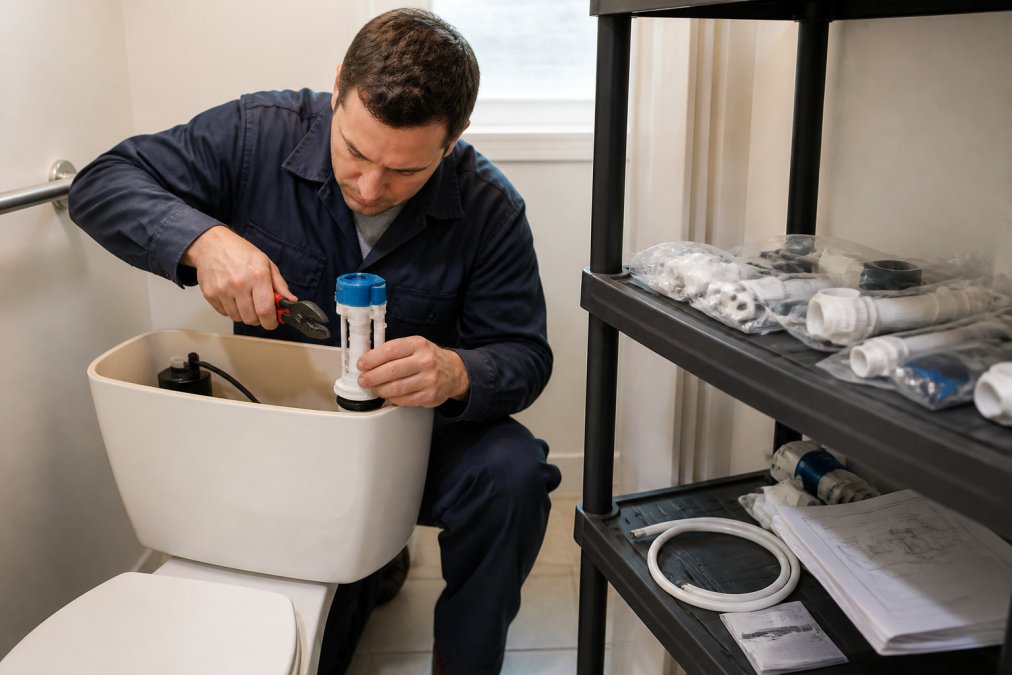
The data supports this intuitively: parts engineered for your exact equipment perform better than parts engineered for a range of equipment. Property managers who standardize on OEM parts report fewer service calls per unit, faster repair times, and higher tenant satisfaction. These aren't marginal improvements, they're operational shifts that compound across a portfolio.
The Cost of Maintenance Callbacks: What Property Managers Miss
Most property managers track the direct cost of a callback: the technician's hourly rate, the replacement part, and the service call fee. A typical callback costs $200-400 out of pocket (bls.gov). On a 100-unit portfolio with even a modest 0.5 callbacks per unit annually, that's $10,000-20,000 in direct expenses.
But the hidden costs dwarf the direct spend. When a unit is offline for a maintenance callback, it's not generating revenue. For a multifamily property, that's lost rent (nmhc.org). For a hotel, that's a room that can't be sold. For student housing, that's a bed that can't be occupied. A 24-hour callback on a $120-per-night hotel room costs $120 in lost revenue before the repair even begins.
Tenant friction adds another layer. A tenant who experiences a maintenance issue, gets it "fixed," and then has the same problem resurface loses confidence in the property. They're more likely to leave at lease renewal. They're more likely to post negative reviews. They're more likely to request rent concessions. Replacing a tenant costs 5-10 times more than retaining one (peer-reviewed research).
Property managers also underestimate the labor inefficiency. When a technician encounters a part that doesn't quite fit, an aftermarket valve with slightly different threading, a faucet cartridge that requires adjustment, they lose time troubleshooting. On a 100-unit portfolio, this inefficiency compounds across hundreds of service calls annually. A technician who could complete 4 jobs per day instead completes 3. That's a 25% loss in labor productivity across your maintenance team.
Ready Bathroom Solutions addresses this by pre-kitting OEM-grade components. Instead of a technician hunting for the right part, verifying fitment, and troubleshooting installation, they open a box with everything they need. The parts are already validated. The installation is predictable. The callback rate drops.
Standardizing Maintenance Parts for Property Portfolios
Large property portfolios face a unique challenge: consistency. A regional manager overseeing five properties across different markets needs to ensure that a bathroom repair in Property A meets the same standard as one in Property B. When each property sources parts independently, that consistency evaporates.
Standardizing on OEM parts solves this. By adopting a single fill valve model, a single faucet cartridge type, and a single set of core components across your portfolio, you create operational predictability. A technician trained on one property can move to another without relearning part specifications. Inventory management becomes simpler. Purchasing power increases because you're buying the same components in bulk.
The challenge is implementation. Properties often have legacy fixtures from different manufacturers. A 20-year-old building might have Delta faucets while a newer addition has Moen. Standardizing means either retrofitting older units or accepting a hybrid approach where you standardize within each building's existing ecosystem.
Ready Bathroom Solutions simplifies this through pre-kitted solutions that account for common fixture types. Rather than forcing every property into a single mold, the kits are organized by fixture family, Moen systems, Delta systems, and universal components, allowing you to standardize within your existing infrastructure while still achieving the efficiency gains of OEM-grade parts.
Improving Maintenance Technician Efficiency With OEM Standards
A maintenance technician's time is your most expensive resource. Whether you're paying them hourly or managing a contracted service, every minute spent troubleshooting is a minute not spent completing the next job. OEM parts directly improve technician efficiency by removing variables.
When a technician opens a pre-kitted bathroom repair box from Ready Bathroom Solutions, they know exactly what's inside. They know the parts are OEM-grade. They know they'll fit. They know the installation sequence. They don't need to verify compatibility or hunt through inventory. The setup time drops from 15-20 minutes to 2-3 minutes.
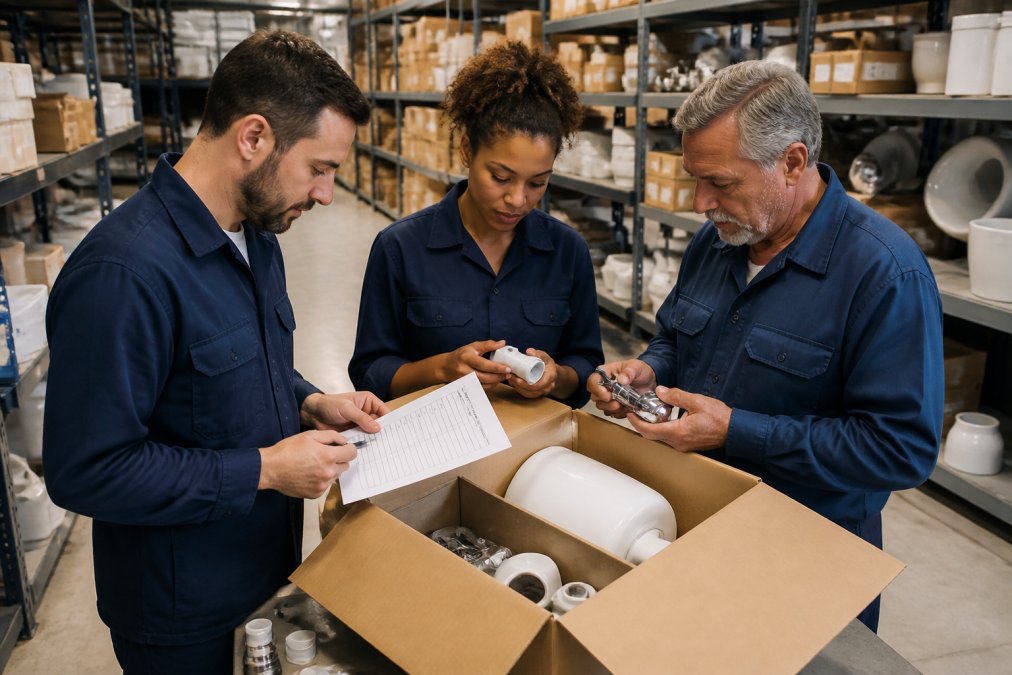
This efficiency compounds across your portfolio. If a technician completes 15 bathroom repairs per month, and each repair saves 10-15 minutes through standardized OEM parts and pre-kitting, that's 2.5-3.75 hours per month of reclaimed labor. Across a maintenance team of 5 technicians, that's 12-18 hours per month, nearly a full day's labor recovered without hiring additional staff.
Beyond time savings, standardization reduces errors. When technicians work with the same components repeatedly, they develop muscle memory. Installation becomes faster and more reliable. The learning curve for new technicians shortens because they're learning a standardized system rather than adapting to whatever parts are available that day.
Technician satisfaction also improves. Maintenance teams appreciate working with quality components that perform as expected. Callbacks frustrate technicians because they represent rework, effort that didn't solve the problem the first time. OEM parts reduce callbacks, which reduces frustration and improves retention in a field where turnover is already high.
OEM Parts vs. Aftermarket: Total Cost of Ownership Comparison
The initial purchase price tells an incomplete story. An aftermarket fill valve might cost $6-8, while an OEM Fluidmaster valve costs $10-16. The aftermarket option looks cheaper. But total cost of ownership, the full financial impact across the component's lifespan, tells a different story.
Consider a 100-unit portfolio replacing fill valves across all units:

Aftermarket approach:
- Initial parts cost: $700 (100 units × $7 average)
- Installation labor: $1,500 (100 units × 15 minutes @ $15/hour)
- Expected callbacks in year one: 15 units (15% failure/performance rate)
- Callback labor and parts: $3,000 (15 callbacks × $200 average)
- Total year-one cost: $5,200
OEM approach (Ready Bathroom Solutions pre-kitted):
- Initial parts cost: $1,200 (100 units × $12 OEM average)
- Installation labor: $500 (100 units × 5 minutes with pre-kitted efficiency @ $15/hour)
- Expected callbacks in year one: 2 units (2% failure rate)
- Callback labor and parts: $400 (2 callbacks × $200 average)
- Total year-one cost: $2,100
The OEM approach costs $3,100 less in year one despite higher initial parts costs. In year two, when aftermarket parts continue failing and OEM parts remain stable, the gap widens further. Over a five-year horizon, the difference becomes substantial.
| Cost Factor | Aftermarket | OEM/Pre-Kitted | Difference |
|---|---|---|---|
| Initial parts (100 units) | $700 | $1,200 | +$500 |
| Installation labor (100 units) | $1,500 | $500 | -$1,000 |
| Year 1 callbacks (labor + parts) | $3,000 | $400 | -$2,600 |
| Year 1 lost revenue (callbacks) | $2,400 | $320 | -$2,080 |
| Year 1 total | $7,600 | $2,420 | -$5,180 |
This comparison assumes modest callback rates and conservative labor costs. In high-turnover properties where every day of downtime has direct revenue impact, the advantage of OEM parts becomes even more pronounced.
How to Build Your OEM Maintenance Strategy
Building an OEM-focused maintenance strategy requires three steps: audit, standardize, and sustain.
Step 1: Audit Your Current Ecosystem
Document what's actually installed across your portfolio. Walk through representative units and identify the fixture brands, models, and component types. A 50-unit property might have five different toilet models from three manufacturers. A 200-unit portfolio could have 15+ variations. Understanding your baseline is essential because standardization doesn't mean ripping out everything, it means choosing the OEM parts that align with your existing infrastructure.
Step 2: Standardize on Core Components
Select the OEM parts that will become your standard across your portfolio. This doesn't require complete uniformity. You might standardize on Fluidmaster fill valves for all standard 1.6-gallon toilets, Moen cartridges for all Moen faucets, and a universal supply line kit for all connections. The goal is reducing variation, not eliminating it entirely.
Ready Bathroom Solutions pre-kitted solutions handle this by bundling OEM parts into organized boxes that align with common fixture types. Rather than building your own kits, you're adopting a proven standard that's already optimized for efficiency.
Step 3: Train Your Team and Monitor
Introduce the new parts to your maintenance team with clear documentation. Show them what's in each kit, how the parts differ from what they've been using, and why the change matters. Set expectations about callback rates and efficiency gains. Then track results: measure callbacks, labor hours per repair, and tenant satisfaction. After 90 days, you'll have data showing whether the strategy is working.
Conclusion
OEM parts reduce maintenance callbacks because they eliminate the variability that causes problems in the first place. When a part is engineered for your specific equipment, it works predictably. When parts are pre-kitted and standardized, your team works efficiently. When callbacks drop, your costs drop and your tenant satisfaction rises.
Ready Bathroom Solutions delivers this through pre-kitted OEM-grade maintenance boxes that combine the Fluidmaster Pro Series fill valves, Moen cartridges, and BrassCraft supply lines, the components that property professionals trust. With bundle savings of 15-20% and the efficiency of all-in-one boxes that eliminate store runs, you get the quality of OEM parts with the operational simplicity of standardized maintenance. Shop all bathroom kits and see how standardization transforms your maintenance operation.
Frequently Asked Questions
Q: Why do OEM parts reduce maintenance callbacks compared to aftermarket parts?
A: OEM parts are manufactured to exact original specifications, ensuring perfect fitment and compatibility with your fixtures. Aftermarket components often have tolerance variations that cause leaks, misalignment, and premature failure. When a technician installs an OEM fill valve like the Fluidmaster PerforMAX, it performs identically to the original part, eliminating the repeat repairs that plague aftermarket installations. This precision engineering directly reduces callbacks and keeps units in service longer.
Q: How much does a typical maintenance callback cost property managers?
A: A single callback typically costs $150-$300 in labor alone, plus the expense of rescheduling staff and the lost revenue from a unit out of service. For a 100-unit property, even a 10% callback rate on bathroom repairs translates to $1,500-$3,000 in unnecessary costs annually. Properties using standardized OEM parts can experience lower callback rates, while those mixing aftermarket components may see higher rates. The difference compounds quickly across portfolios managing multiple properties.
Q: Can OEM parts be standardized across properties with different fixture brands?
A: Yes, but standardization works best when you standardize by component type rather than by building. For example, all your properties can use Fluidmaster fill valves and Delta trim kits as your baseline OEM standard, regardless of whether individual units originally had Moen or Kohler fixtures. Ready Bathroom Solutions pre-kitted OEM bundles are designed around the most common fixture brands, allowing you to maintain consistent quality standards across your entire portfolio while accommodating existing fixture diversity.
Q: What's the real difference in labor efficiency when technicians use pre-kitted OEM parts?
A: Technicians using pre-kitted OEM solutions eliminate store runs, reduce decision-making time on part selection, and avoid compatibility issues. A standard bathroom repair that might take 90 minutes with individual part sourcing can be completed more quickly with a complete OEM kit. Across a portfolio, this translates to additional unit turns per technician per week. When you multiply that efficiency gain across your maintenance team, you recover the bundle savings within the first month of implementation.
This article was written using GrandRanker