

Table of Contents
- Why Labor Costs Dominate Your Maintenance Budget
- How to Optimize Property Maintenance Budgets
- Staffing Ratios and Onsite Labor Optimization
- Reducing Unit Turn Time with Centralized Maintenance
- Maintenance Technician Productivity Metrics That Matter
- Preventative Maintenance and Smart Building Technology
- Reducing Turnover Costs Through Cross-Training and Retention
- Conclusion
- Frequently Asked Questions
Last Updated: September 3, 2026
Why Labor Costs Dominate Your Maintenance Budget
Labor represents the largest operational expense in multifamily property management. For most portfolio managers, maintenance payroll consumes 35-50% of total operating expenses, making reducing labor costs in multifamily maintenance not just a cost-control initiative, it's a survival strategy (irem.org).
The challenge isn't that your team works too slowly. It's that the system around them creates waste. Store runs for forgotten parts. Callbacks because the first visit didn't include the right components. Technicians standing idle while waiting for supplies. Unit turnovers that stretch from days into weeks because maintenance workflows aren't optimized for speed.
At Ready Bathroom Solutions, we've worked with property teams managing thousands of units across hotels, apartments, and student housing. The biggest labor cost isn't the hourly rate, it's the inefficiency baked into how maintenance work gets done. When technicians spend two hours sourcing parts for a one-hour repair, you're not paying for the repair. You're paying for the wasted motion.
This guide walks through the specific operational levers that actually move the needle on labor costs. Not generic "work smarter" advice, but concrete strategies property teams are using right now to reduce unit turn time, improve technician productivity, and cut maintenance callbacks.
How to Optimize Property Maintenance Budgets
Optimizing your maintenance budget starts with visibility into where money actually goes. Many property managers operate on historical spending patterns without understanding the cost drivers beneath the surface.
The first step is to segment your maintenance expenses into three categories: preventative maintenance (scheduled work), corrective maintenance (reactive repairs), and emergency maintenance (after-hours, high-cost interventions). Most portfolios spend 60-70% on corrective and emergency work, which is where the waste lives (boma.org).
Here's what changes when you shift that ratio:
- Preventative maintenance scheduling reduces emergency calls by catching problems before they cascade into larger failures. A leaking faucet becomes a water damage claim if left unaddressed.
- Centralized work order management eliminates duplicate efforts and ensures technicians have all required parts before arriving at a unit.
- Standardized repair protocols across your portfolio mean technicians spend less time problem-solving and more time executing.
- Real-time data analytics on maintenance backlog, technician use, and cost-per-unit reveal where to focus improvement efforts.
The tools matter less than the discipline. Many properties invest in property management software but never fully implement the workflows that software enables. The system is only as effective as the process discipline around it.
Start by measuring your baseline: average time to close a work order, repeat visit rate (callbacks), cost per unit turn, and technician use hours. Once you have baseline numbers, you can track whether your optimization efforts actually move the needle.
Staffing Ratios and Onsite Labor Optimization
Determining the right staffing level for your portfolio is more art than formula. Too lean, and your team burns out while work orders pile up. Too heavy, and you're paying for idle time.
The industry baseline is roughly one full-time maintenance technician per 50-75 units, depending on property age and condition (irem.org). But that's a starting point, not a prescription. A newer building with modern systems might operate efficiently at 1 technician per 100 units. An older property with aging infrastructure might need 1 per 40 units.
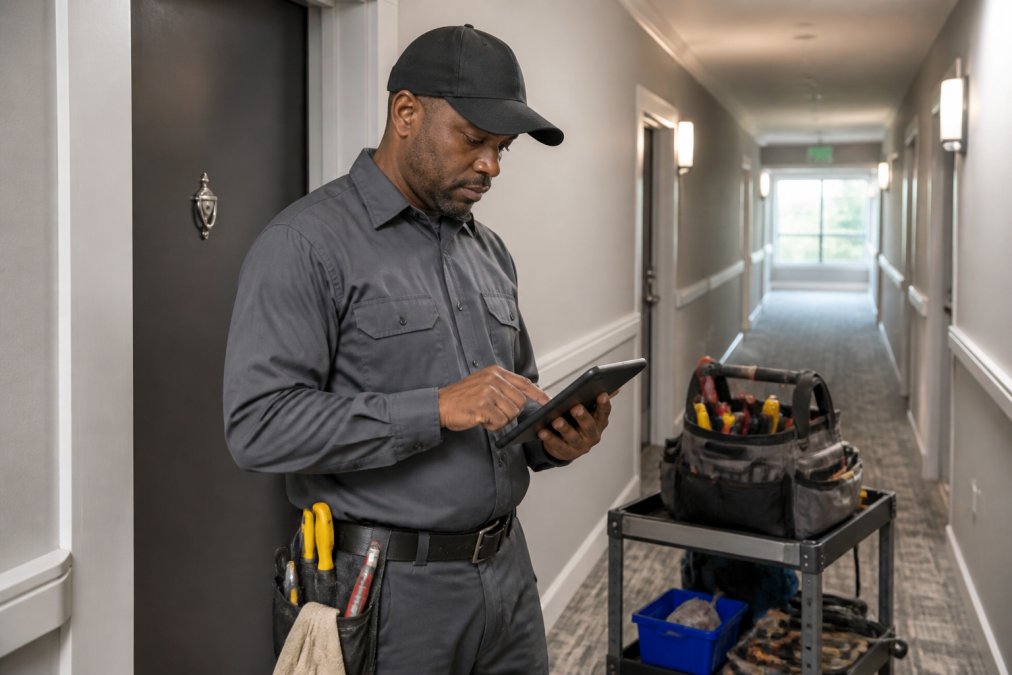
The real optimization happens when you match staffing to unit turnover cycles. Properties with seasonal turnover (student housing, resort-style apartments) need different staffing strategies than stabilized portfolios with steady-state occupancy. During peak turnover periods, you might need temporary labor or cross-trained staff. During slow periods, you can reduce hours or redeploy technicians to preventative maintenance projects.
What most property teams miss is the cost of turnover within your maintenance department itself. A technician who leaves costs 50-150% of their annual salary to replace (recruiting, training, lost productivity during ramp-up). Retention becomes a labor cost optimization lever that many managers overlook. Competitive wages, clear career paths, and scheduling predictability reduce turnover and lower your effective labor cost per unit.
Onsite staffing also creates operational advantages beyond just repair capacity. A technician present during business hours can respond to resident requests immediately, reducing escalations and emergency calls. They can conduct informal inspections that catch problems early. They become familiar with building systems and develop institutional knowledge that new contractors can't replicate.
Reducing Unit Turn Time with Centralized Maintenance
Unit turnovers are where labor inefficiency becomes most visible. A five-day turnover costs more in labor than a three-day one, even if the actual repair work is identical.
Centralized maintenance, where all bathroom, kitchen, and general repairs are coordinated through a single workflow rather than handled by individual contractors, is one of the fastest ways to compress turn time. Here's why: when a unit requires multiple trades (plumbing, drywall, painting), coordinating separate contractors creates delays. One contractor finishes, the next isn't available for two days, work sits incomplete.
With centralized maintenance, a single team or coordinated crew handles the full scope. They know the sequence. They have all materials staged before work begins. They move from bathroom repairs to kitchen work to final touches without handoff delays.
The operational efficiency compounds when you standardize what "turnover" actually means. Instead of each property defining turnover differently, a standardized checklist ensures consistency. Bathroom fixtures are refreshed using the same components across your portfolio. Paint colors are standardized. Flooring repairs follow the same protocol. This consistency reduces decision-making time and allows you to pre-kit supplies.
Ready Bathroom Solutions addresses this directly. Pre-kitted bathroom repair sets eliminate the store run, the single biggest time waster in unit turnovers. Instead of a technician spending 90 minutes sourcing a faucet cartridge, trim ring, and supply lines from three different vendors, everything arrives in one box. The repair happens faster. The unit turns faster. The labor cost per unit drops.
A common mistake is treating unit turnover as purely a maintenance problem. It's actually a supply chain problem. If your maintenance team spends 30% of turnover time sourcing parts, your labor cost isn't really the hourly wage, it's the wage plus the inefficiency tax. Fixing the supply chain fixes the labor cost.
Maintenance Technician Productivity Metrics That Matter
Tracking the right metrics transforms maintenance from a cost center into an optimizable operation. But most properties track the wrong things.
Hours worked is not a productivity metric. A technician who works 40 hours but spends 12 of them waiting for parts or traveling between supply runs is less productive than one who works 35 focused hours. Measure what actually matters:
Work order completion time, from assignment to closure. Track this by work order type (plumbing, HVAC, general repairs). If bathroom fixture replacements take 3 hours on average, you have a baseline. If one technician consistently closes them in 2 hours, that's where your efficiency gains live.
First-time fix rate, the percentage of work orders that don't require a callback visit. A 95% first-time fix rate means your technicians are thorough and have the right parts on hand. An 85% rate signals either inadequate training or incomplete supply availability. Each callback costs labor hours and damages resident satisfaction.
Cost per unit turn, total labor hours divided by units completed. This metric cuts through everything else. If your cost per unit turn is $800 and the portfolio average is $600, you have a concrete problem to solve. Is it staffing? Inefficient workflows? Poor supply chain? The metric tells you something's wrong. The details tell you what to fix.
Technician use, the percentage of scheduled hours spent on billable work (actual repairs) versus non-billable time (travel, waiting, training). A 70% use rate is healthy. Below 60% suggests either overstaffing or process inefficiency. Above 85% suggests your team is stretched too thin and quality suffers.
Real-time visibility into these metrics changes behavior. When technicians know their first-time fix rate is tracked, they're more likely to verify they have all parts before leaving the shop. When managers see that one property's cost per unit turn is 30% higher than similar properties, they investigate the cause.
Data-driven decision making for NOI starts here. You can't optimize what you don't measure.
Preventative Maintenance and Smart Building Technology
Preventative maintenance is the highest-use labor cost reduction strategy available. It's also the most commonly neglected.
A preventative maintenance program identifies and addresses problems before they become emergency repairs. A worn faucet cartridge gets replaced during a scheduled maintenance visit. It doesn't wait until a resident reports a leak at 11 p.m., triggering an after-hours service call. The labor cost is identical, but the preventative approach happens on your schedule at standard rates. The reactive approach happens on the emergency schedule at premium rates.
The ROI is straightforward: one prevented emergency call saves more than the cost of ten preventative inspections. Yet many property teams skip preventative work when budgets tighten, not realizing they're trading cheap preventative labor for expensive emergency labor.
Smart building technology amplifies preventative maintenance by making it predictive. Sensors in bathrooms detect water usage patterns, temperature fluctuations, and pressure anomalies. When a toilet runs continuously or a shower valve fails to regulate temperature, the system alerts maintenance before a resident complaint arrives. Predictive maintenance means your team fixes the problem during business hours with planned labor, not after hours with emergency premiums.
Building automation systems also reduce labor by automating routine tasks. HVAC maintenance schedules can be optimized based on usage patterns. Water heater diagnostics can predict failures weeks in advance. Lighting controls reduce the need for manual adjustments. The labor savings compound across hundreds of units.
The barrier to adoption isn't usually the technology, it's the workflow discipline required to use it effectively. A smart sensor that alerts you to a problem is only valuable if someone acts on that alert. Many properties install the technology but don't restructure their maintenance workflows to respond to predictive alerts. The system becomes noise instead of signal.
Reducing Turnover Costs Through Cross-Training and Retention
Technician turnover is a hidden labor cost that most property managers underestimate. When a skilled maintenance technician leaves, you lose not just their labor, you lose the institutional knowledge of how your buildings actually work.
Cross-training addresses both the retention and the efficiency problem. A technician who can handle plumbing, electrical, and general repairs is more valuable and more engaged than one locked into a single trade. They have more job security (they're harder to replace), more variety (less monotony), and more career visibility (they're developing broader skills). Cross-trained technicians also provide scheduling flexibility. When your plumbing workload is light, that technician shifts to general repairs instead of sitting idle.
The training investment pays for itself quickly. A property with five single-trade technicians might need all five during peak periods but have excess capacity during slow periods. The same property with three cross-trained technicians can handle peak demand with temporary help while maintaining lower baseline staffing during slow periods.
Retention strategies that reduce turnover directly reduce labor costs. Predictable scheduling, clear advancement paths, competitive wages, and a culture of skill development create stability. A technician who stays for five years costs significantly less per unit turn than one who stays for two years and requires constant replacement and retraining.
What many property teams underestimate is the quality impact of turnover. A new technician takes 6-12 months to reach full productivity. During that ramp-up period, they work slower, require supervision, and generate more callbacks. A stable team of experienced technicians delivers higher quality work faster, which reduces your maintenance callbacks and improves resident satisfaction.
Conclusion
Reducing labor costs in multifamily maintenance isn't about cutting wages or running your team lean. It's about eliminating the wasted motion that inflates labor hours without adding value. When technicians spend less time sourcing parts and coordinating across vendors, they complete more repairs per hour. When preventative maintenance prevents emergency calls, you shift labor from premium-rate emergency work to standard-rate planned work. When your team has standardized processes and pre-kitted supplies, they move faster and make fewer mistakes.
Ready Bathroom Solutions addresses one of the biggest labor cost drivers: the bathroom repair supply chain. Our pre-kitted bathroom repair sets eliminate store runs and ensure technicians have exactly what they need before arriving at a unit. That single change, removing the supply chain friction, compresses unit turn time and directly reduces labor costs. Explore our Toilet Kit - Pro, Shower Kit - Pro, Sink Kit - Pro, and Complete Kit - Pro to see how standardized, OEM-grade components can simplify your maintenance operations and improve your portfolio's net operating income.


Frequently Asked Questions
Q: What are the most effective ways to reduce labor costs in multifamily maintenance?
A: The most effective approaches combine staffing optimization, preventative maintenance scheduling, and workflow automation. Start by analyzing your current staffing ratios against industry benchmarks, most properties over-staff reactive maintenance. Implement work order management systems to eliminate redundant trips, use preventative scheduling to catch issues before they become emergencies, and invest in pre-kitted repair solutions like bathroom maintenance bundles that reduce time spent sourcing parts.
Q: How can standardized maintenance kits reduce unit turn time?
A: Pre-kitted solutions like Ready Bathroom Solutions' bathroom kits eliminate the time technicians spend shopping for individual parts, coordinating with multiple vendors, or making emergency store runs. When all necessary components arrive in a single box with OEM-grade parts from brands like Moen and Delta, technicians can complete repairs in one visit instead of two or three. This directly reduces unit turnover time and prevents costly callbacks that extend vacancy periods. For properties managing multiple units simultaneously, this efficiency compounds across your portfolio.
Q: What maintenance technician productivity metrics should I track?
A: Track cost-per-unit (total maintenance labor divided by units served), work orders completed per technician per week, first-time fix rate (repairs that don't require callbacks), and average time to complete routine tasks like bathroom fixture replacement. Monitor maintenance backlog, if it's growing, your staffing ratios are too low. Use real-time data analytics from your property management software to identify which technicians are most efficient and which tasks consume the most time. Cross-reference these metrics with your preventative maintenance schedule to spot opportunities for process improvements.
Q: How does reducing staff turnover impact labor costs?
A: High technician turnover costs 50-200% of an employee's annual salary when accounting for recruitment, training, and lost productivity. Retention strategies like cross-training (so technicians can handle multiple systems), clear advancement paths, and competitive compensation reduce turnover significantly. When you retain experienced technicians, you reduce training costs, improve first-time fix rates, and build institutional knowledge about your properties' specific systems.
This article was written using GrandRanker