

Table of Contents
- What Makes a Shower Valve Right for Apartment Buildings
- Pressure-Balancing vs. Thermostatic: Which Handles Multi-Unit Demand
- Universal Rough-In Compatibility and Standardized Fittings
- Quick Comparison: 7 Shower Valves for Multi-Family Properties
- 1. Moen Posi-Temp Pressure-Balancing Valve
- 2. Delta Monitor 14 Series with Monitor Technology
- 3. Symmons Temptrol Pressure-Balancing Valve
- 4. Grohe Grohsafe Universal Rough-In Valve
- 5. American Standard Cadet Pressure-Balancing Valve
- 6. Hansgrohe iBox Universal Plus Rough-In
- 7. Ready Bathroom Solutions OEM-Grade Maintenance Kits
- How to Reduce Maintenance Callbacks in Apartments
- Frequently Asked Questions
Last Updated: October 1, 2026
What Makes a Shower Valve Right for Apartment Buildings
Choosing the best shower valve for apartment buildings comes down to three things: safety compliance, rough-in standardization, and how fast a maintenance tech can service it. A valve that looks great in a single-family remodel often fails in a 200-unit complex, because multi-family plumbing punishes anything that can't be swapped quickly or matched across floors.
Pressure-Balancing vs. Thermostatic: Which Handles Multi-Unit Demand
Pressure-balancing valves are the default choice for apartment buildings because they react instantly when a toilet flushes or a neighboring unit draws water, sensing the pressure drop and adjusting the hot-to-cold mix to prevent thermal shock.
Universal Rough-In Compatibility and Standardized Fittings
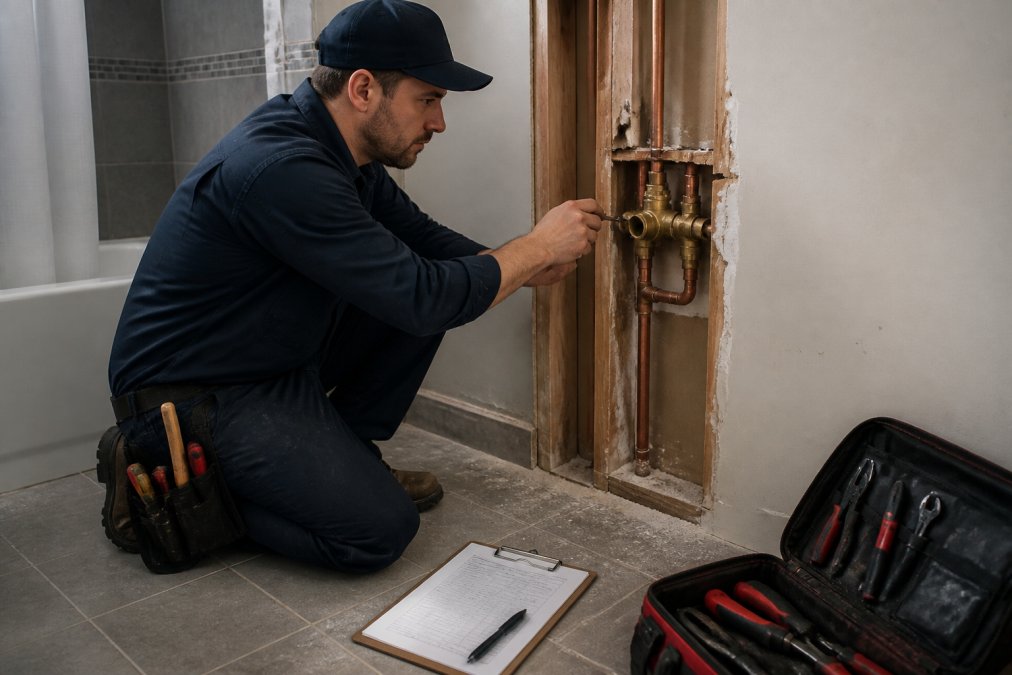
Universal rough-in compatibility is the single biggest factor in reducing unit turnover time. A rough-in valve is the in-wall body behind the tile; the trim kit is the handle and faceplate that screw onto it. When the rough-in accepts multiple trim styles, you can standardize one body across a property and swap trim without opening the wall.
What 'Universal' Actually Means Across Brands
The term is used loosely. There are three tiers of compatibility:
- Brand-internal universal, One rough-in body accepts multiple trim series from the same manufacturer. Delta's MultiChoice Universal and Moen's M-PACT are the best-known examples. You can change the look of a shower without changing the valve body, but you're locked into that brand's ecosystem.
- Cross-brand universal, A rough-in system designed to accept cartridges and trim from multiple manufacturers. Hansgrohe's iBox Universal Plus is the most cited example; it accepts Hansgrohe cartridges and select third-party trim. True cross-brand compatibility is rare and should be verified against the cartridge you intend to stock.
- Standardized fittings, Even when the rough-in isn't cross-brand, standardizing on one inlet size (commonly 1/2-inch NPT or 1/2-inch PEX) and one installation depth across a portfolio means your techs carry one set of fittings and one shut-off valve. This is the tier most property managers control.
The Bulk Procurement Angle
For a 200-unit complex, the procurement math changes. Rough-in valves and cartridges are commonly available in case quantities, and the per-unit price drops meaningfully at volume. Standardizing on one model number also lets your purchasing manager set up a blanket purchase order with a plumbing distributor, so replacement parts ship to a central maintenance shop without a site visit or per-unit approval.
Multi-Unit Maintenance Logistics
Universal rough-in matters more in apartments because of the access problem. In a single-family home, a failed cartridge means opening one wall in one bathroom. In a 200-unit building, the same failure across 40 units means 40 wall openings, 40 drywall repairs, and 40 paint touch-ups, unless the rough-in was designed for front service.
Quick Comparison: 7 Shower Valves for Multi-Family Properties
Here's how the seven valves stack up on the criteria that matter for multi-family plumbing: valve type, rough-in compatibility, and best-fit property type.
| Valve | Type | Rough-In Compatibility | Best For |
|---|---|---|---|
| Moen Posi-Temp | Pressure-balancing | Moen M-PACT common body | High-turnover apartments |
| Delta Monitor 14 | Pressure-balancing | Delta MultiChoice Universal | Mixed portfolios |
| Symmons Temptrol | Pressure-balancing | Temptrol fixed body | Student housing |
| Grohe Grohsafe | Pressure-balancing | Grohsafe universal | Hospitality |
| American Standard Cadet | Pressure-balancing | Cadet universal | Value-focused complexes |
| Hansgrohe iBox Universal Plus | Rough-in system | iBox universal | Premium renovations |
| Ready Bathroom Solutions | OEM-grade kits | Multi-brand standardized | Portfolio-wide maintenance |
1. Moen Posi-Temp Pressure-Balancing Valve
Moen's Posi-Temp is the workhorse of apartment maintenance. The pressure-balancing cartridge holds temperature within a safe range when other fixtures draw water, satisfying common anti-scald requirements. The M-PACT common valve body lets you change the trim without soldering, so a remodel doesn't mean a full rough-in replacement.
2. Delta Monitor 14 Series with Monitor Technology
Delta's Monitor 14 uses a pressure-balancing cartridge with a rotating cylinder that adjusts the hot-cold mix as pressure shifts. The MultiChoice Universal rough-in accepts many Delta trim, making it a strong pick for mixed portfolios where buildings were finished in different years.
3. Symmons Temptrol Pressure-Balancing Valve
Symmons Temptrol is a favorite in student housing because the all-bronze body resists corrosion and the design has barely changed in decades, so parts stay available and techs learn one system.
4. Grohe Grohsafe Universal Rough-In Valve
Grohsafe pairs a ceramic disc cartridge with a universal rough-in that accepts Grohe trim across multiple collections. Ceramic disc cartridges resist the mineral buildup that plagues hard-water regions, extending the maintenance cycle.
5. American Standard Cadet Pressure-Balancing Valve
The Cadet is the value play, delivering reliable pressure-balancing performance and a universal rough-in at a lower unit cost, which matters when you're buying hundreds.
6. Hansgrohe iBox Universal Plus Rough-In
The iBox is a rough-in system rather than a complete valve, and that's the point. It installs a sealed, standardized box that accepts Hansgrohe and select third-party cartridges and trim, making future swaps tool-light.
7. Ready Bathroom Solutions OEM-Grade Maintenance Kits
Our pre-kitted bathroom repair sets bundle OEM-grade parts from brands like Moen, Delta, and BrassCraft into a single box, so a tech grabs one kit and finishes the job without a store run.
The valve itself is only half the decision. The other half is whether your techs can service it in one trip. Standardized kits solve the logistics that single-part ordering never does.
How to Reduce Maintenance Callbacks in Apartments
Reducing maintenance callbacks starts with eliminating the variables that cause them: mismatched parts, missing shut-offs, and techs guessing at model numbers. But for apartment buildings, the bigger opportunity is aligning your valve specification with commercial plumbing code and ADA requirements from the start, a callback from a failed inspection costs far more than a worn cartridge.
Start With Code Compliance, Not Just Function
Most residential guides treat anti-scald performance as the finish line. In multi-family construction, it's the starting line. The relevant standard is ASSE 1016/ASME A112.1016/CSA B125.16, which classifies shower valves by their ability to limit outlet temperature. Pressure-balancing and thermostatic valves both fall under this standard, but the specific listing matters: a valve listed to ASSE 1016 for residential use may not satisfy the requirements a local authority having jurisdiction (AHJ) applies to commercial occupancies.
Build a Specification Sheet, Not a Shopping List
A practical checklist for your next procurement cycle:
- Audit every building's current rough-in model number and record it in a shared asset register
- Confirm each valve model carries an ASSE 1016 listing and note the classification
- Verify ADA-compliant trim options exist for every valve family you standardize on
- Standardize on one or two valve families across the portfolio
- Stock cartridges, integrated stops, and trim in a central kit
- Label rough-in models on every access panel
- Track callback rates by building to spot problem fixtures
- Review bulk procurement pricing annually and re-bid when volume crosses a threshold
The Lifecycle Cost Math Property Managers Skip
The retail price of a shower valve is the smallest number in the equation. The larger numbers are labor, unit downtime, and emergency procurement. A valve that costs less upfront but requires a full rough-in replacement at year 10 can cost more over a 20-year hold than one that costs more upfront but accepts trim and cartridge upgrades without opening the wall.
Skipping backflow prevention and cross-connection checks during a valve swap can fail a commercial plumbing inspection. Confirm your installation meets local plumbing code before you close the wall. In many jurisdictions, the AHJ also requires that replacement valves in commercial occupancies be listed to the same standard as the original, substituting a residential-only valve can trigger a re-inspection.
Buy for the maintenance cycle, not the install day. A valve that's cheap to install but expensive to service, or that fails an ADA or ASSE 1016 check, costs more over its life than the sticker price suggests.
Frequently Asked Questions
Which shower valve brand is most reliable for multi-family apartment buildings?
Moen, Delta, and Symmons are the three most common brands specified for apartment buildings. Moen's Posi-Temp and Delta's Monitor 14 Series both use pressure-balancing cartridges that handle shared water pressure well. Symmons Temptrol has a long track record in commercial and multi-family housing because its all-brass body and ceramic disc cartridge resist corrosion and mineral buildup. The right pick depends on your existing rough-in compatibility and whether you need standardized parts across multiple properties.
Are pressure-balancing shower valves required by building codes for apartments?
Most U.S. plumbing codes, including the International Plumbing Code and Uniform Plumbing Code, require anti-scald protection in shower valves for new construction and major renovations. Pressure-balancing and thermostatic valves both meet this requirement by limiting temperature swings when other fixtures in the building draw water. Check with your local authority having jurisdiction, since adoption varies by state and municipality. ADA-compliant trim kits may also be required in accessible units.
How do universal rough-in shower valves help reduce maintenance callbacks in apartments?
Universal rough-in valves accept multiple trim kits from the same manufacturer, so you can swap a failed cartridge or trim without opening the wall. That cuts labor time per unit turn and reduces the chance of a second visit. When you standardize on one rough-in model across a portfolio, your maintenance team only needs to stock one cartridge type and one trim style. Fewer part numbers means fewer wrong-part callbacks and faster unit restoration.
What should property managers look for when buying shower valves in bulk?
Focus on brass body construction, ceramic disc cartridges, integrated shut-off stops, and universal rough-in compatibility. Brass resists corrosion better than plastic in hard-water markets. Integrated stops let a technician isolate the valve without shutting down the riser. For bulk procurement, confirm the valve meets ASSE 1016 anti-scald standards and check whether the manufacturer offers consistent part numbers across production runs, since discontinued cartridges are a common source of callback headaches.
Managing shower valves across dozens of buildings exposes the real bottleneck: not the valve, but the scramble for parts during a turn. Ready Bathroom Solutions solves that with pre-kitted, OEM-grade maintenance sets that put every part in one box, cut repeat callbacks, and keep quality consistent portfolio-wide. Get started with Ready Bathroom Solutions and turn units faster with fewer after-hours emergencies.