

Table of Contents
- Why Bathroom Maintenance Breaks Down Across a Portfolio
- The Preventative Maintenance Checklist for Bathrooms
- Standardizing Maintenance Parts for Student Housing and Multifamily Units
- Reducing Property Maintenance Costs Without Cutting Corners
- In-House vs. Outsourced Bathroom Maintenance: A Decision Framework
- Emergency Response and Liability Compliance for Bathroom Repairs
- Conclusion
- Frequently Asked Questions
Last Updated: September 10, 2026
Why Bathroom Maintenance Breaks Down Across a Portfolio
Bathroom maintenance is the work of inspecting, repairing, and replacing the fixtures and finishes in each unit's bathroom so every room stays rentable and safe. Managing bathroom maintenance across multiple properties fails for one reason: every building invents its own process. One technician orders a cartridge when a faucet drips. Another replaces the whole trim. A third drives to a supplier and loses half a shift.
At Ready Bathroom Solutions, we hear the same complaint from facilities teams: the repair isn't hard, the logistics are. Multiply that by hundreds of units and the small inefficiencies compound fast.
The fix is standardization, not heroics. This guide lays out the checklist, the cost controls, and the decision framework that keep a property portfolio running.
The Preventative Maintenance Checklist for Bathrooms
A preventative maintenance checklist for bathrooms is a scheduled list of inspections and repairs that catches small failures before they become emergency work orders. The goal is fewer surprises, not more paperwork.
Daily, Monthly, and Quarterly Inspection Items
Daily checks belong to housekeeping and front-desk staff, not maintenance techs. A quick visual pass for leaks, mildew, and running toilets catches most tenant complaints before they're filed.
| Frequency | Task | Who Owns It |
|---|---|---|
| Daily | Check for leaks, clogs, running toilets | Housekeeping / front desk |
| Monthly | Test shut-off valves, inspect caulk lines | Maintenance technician |
| Quarterly | Check supply lines, flappers, and drain flow | Maintenance technician |
| Annually | Inspect shut-off valves, water heater connections | Licensed plumber |
Standardizing Maintenance Parts for Student Housing and Multifamily Units
Standardizing maintenance parts for student housing and multifamily units means agreeing on a single set of fixture brands, models, and replacement components across every building you manage. It is the single highest-use decision a portfolio manager makes.
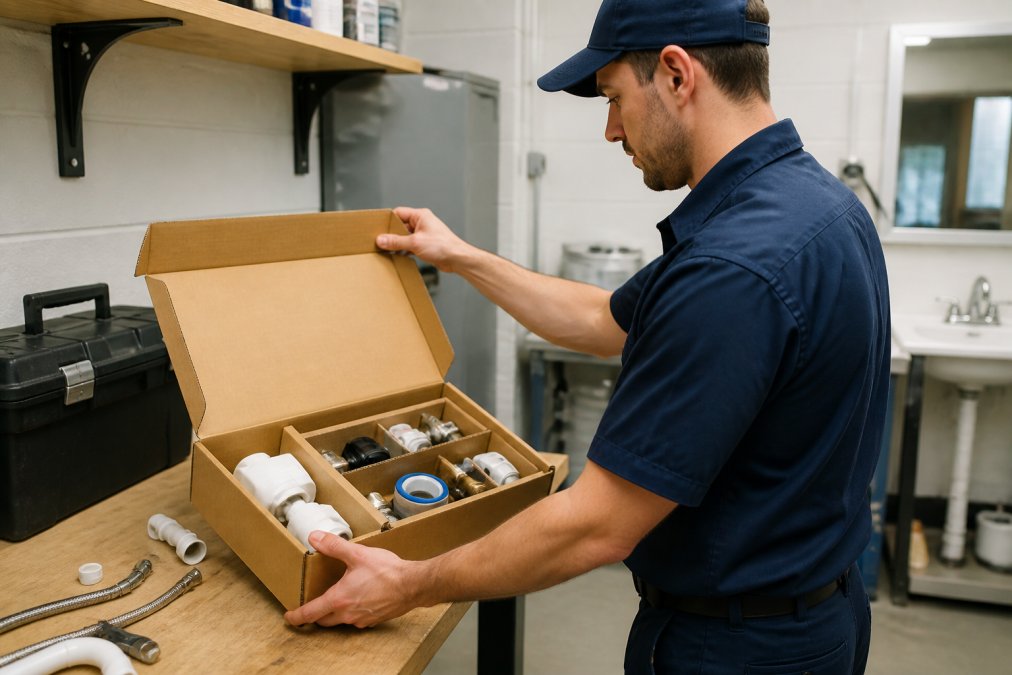
The reason is simple: variation kills inventory control. When every building stocks a different cartridge, you either over-order or you send a tech on a store run. Pre-kitted, OEM-grade repair sets solve this by putting every part for a job in one box. Our Toilet Kit - Pro and Sink Kit - Pro are built for exactly this purpose, with parts sourced from Moen, Delta, and BrassCraft.


Reducing Property Maintenance Costs Without Cutting Corners
Reducing property maintenance costs comes down to four levers: labor hours, repeat visits, parts pricing, and capital timing. Most teams attack only the third and wonder why the budget never moves.
Lever 1: Labor hours. Labor is the biggest line item in any bathroom maintenance budget. A technician who spends 45 minutes sourcing a part has burned most of a billable hour on logistics. The standard way to measure this is cost per completed work order, total loaded labor plus parts plus vendor fees, divided by the number of closed tickets. Track it monthly by property and by technician. When one building's cost per work order runs higher than its peers, the cause is almost always parts sourcing or a fixture mismatch, not technician skill.
Lever 2: Repeat visits. A callback costs the same as a first visit but generates no new value. The most common causes of callbacks are wrong parts, incomplete diagnosis, and fixtures that fail again because a low-grade replacement was installed. Log every callback with a reason code. If more than a small share of your tickets are callbacks, the problem is upstream in parts standardization, not in the repair itself.
Lever 3: Parts pricing. Bundle pricing and standardized components reduce unit cost, but the bigger savings come from eliminating emergency purchases at retail. A part bought at list price during an after-hours emergency can cost several times what the same part costs on a scheduled order (energy.gov). Consolidate purchasing across the portfolio so every building draws from the same catalog.
Lever 4: Capital timing, the lever most guides ignore. Day-to-day repairs are operating expense (OpEx). Replacing a failed water heater, re-tiling a shower pan, or rebuilding a vanity is capital expense (CapEx), and it follows a different budget cycle. Most portfolio guides focus entirely on OpEx and never address asset lifecycle planning. The practical approach is to assign each major bathroom component an expected service life, supply lines, shut-off valves, toilet flappers, faucet cartridges, exhaust fans, and floor finishes all have different horizons, and schedule replacement before failure rather than after. Deferred replacement shows up later as emergency OpEx at a higher total cost, plus water damage risk.
A simple working method: build a component register per unit, note install date and expected service life, and roll the upcoming replacements into a multi-year CapEx forecast. That forecast is what you bring to ownership at budget season, and it is what separates a portfolio that plans from one that reacts.
A Complete Kit - Pro consolidates every component for a full bathroom refresh into one box, which cuts both sourcing time and the odds of a mid-job parts run. Pairing standardized kits with a component register gives you both the OpEx savings and the CapEx visibility that most portfolios lack.

In-House vs. Outsourced Bathroom Maintenance: A Decision Framework
The in-house versus outsourced decision is not ideological. It depends on volume, geography, work complexity, and licensing requirements. Use the framework below to make the call per property, not per portfolio.
Step 1: Measure the work volume
Start with annual bathroom work orders per property and average labor hours per ticket. A property that generates enough routine repair hours to keep a technician busy full-time is a candidate for in-house coverage. A property with sporadic, low-volume work is not, the fixed cost of a full-time tech cannot be justified against intermittent demand.
Step 2: Map the licensing boundary
This is the step most guides skip. Many bathroom repairs are routine handyman work, but others fall behind a licensing wall. Water heater replacement, gas line work, significant electrical work around exhaust fans and GFCI outlets, and certain plumbing alterations typically require a licensed trade, and the specific scope varies by state and municipality (hud.gov). Before you decide in-house versus outsourced, list which tasks in your standard work order set require a license in each jurisdiction you operate in. That list defines the floor of your outsourcing, you cannot legally bring those tasks in-house without the right credential.
Step 3: Apply the decision rules
- In-house wins when you have enough concentrated units in one metro to keep a tech busy full-time, the work is predominantly non-licensed, and consistency of quality matters more than peak flexibility.
- Outsourced wins when units are scattered across regions, when work volume is too low to fill a schedule, or when the task requires a licensed trade.
- Hybrid wins most often: in-house techs handle routine repairs and inspections, contractors handle licensed work and after-hours emergencies.
Step 4: Weigh the real trade-offs
In-house teams deliver consistent quality and faster response on routine work, but they carry fixed overhead, wages, benefits, vehicle, tools, and idle time during slow periods. Contractors scale up and down with demand and bring their own licensing, but quality and response time vary, and you pay a margin on every job.
The hidden cost on the outsourced side is coordination. Every contractor visit needs scheduling, access, and follow-up, and those hours land on your property staff. The hidden cost on the in-house side is idle time. Neither is free; the question is which one your portfolio can absorb.
Step 5: Document the arrangement
Whichever path you choose, put the terms in writing. Service level agreements with vendors should specify response windows, after-hours availability, insurance and licensing proof, and invoicing terms, not handshakes. For in-house staff, define the scope of work they are authorized to perform and the escalation path for anything beyond it.
Standardized parts make either model work better. When every technician, employee or contractor, opens the same pre-kitted repair set, the quality gap between in-house and outsourced work narrows, and your cost per work order becomes comparable across both.
Emergency Response and Liability Compliance for Bathroom Repairs
Emergency response protocols protect both the tenant and the property owner. A burst supply line at 2 a.m. is not a maintenance problem; it is a liability event.
Every portfolio needs a written protocol that covers who gets called, what the shut-off procedure is, and how the tenant is made whole. Service level agreements with vendors should specify response windows in writing, not handshakes.
Documentation matters here. Maintenance logs that show inspection dates and completed repairs are your defense if a tenant disputes a habitability claim. Keep them digital and backed up.
Conclusion
The portfolio that wins is the one that treats bathroom maintenance as a system, not a series of emergencies. Standardized parts, a real checklist, and clear protocols do more for your budget than any single cost-cutting tactic.
Ready Bathroom Solutions builds pre-kitted, OEM-grade repair sets that put every part for a job in one box, with 15-20% bundle savings and standardized components across your portfolio. Get started with Ready Bathroom Solutions and cut the store runs, callbacks, and delays that slow every unit turn.
Frequently Asked Questions
How do you standardize bathroom fixtures across multiple rental properties?
Pick one fixture brand and model family per property tier, then document it in a standard operating procedure. For example, use the same Moen or Delta faucet cartridge across every unit so technicians carry one replacement part instead of five. Ready Bathroom Solutions kits support this by bundling OEM-grade components into a single box, so a tech grabs one kit and finishes the job without a store run.
What are the most common bathroom maintenance issues in multi-family housing?
Running toilets, dripping faucets, failed flappers, worn shower cartridges, and loose toilet seals top the list. Most are caused by worn rubber parts that fail on a predictable cycle. A preventative maintenance checklist for bathrooms that includes checking flappers, cartridges, and supply lines every quarter catches these before a tenant calls, which cuts emergency repairs and after-hours labor.
How can property managers reduce the cost of bathroom repair callbacks?
Callbacks usually happen because a tech used a mismatched part or skipped a step. Standardizing parts and requiring a post-repair checklist drops repeat visits. Reducing property maintenance costs also means buying OEM-grade components in bundles rather than one-off retail trips, since a single store run can burn two labor hours per ticket.
What is the benefit of using pre-kitted maintenance solutions for bathrooms?
Pre-kitted solutions put every part a repair needs in one box. That eliminates the store run, reduces the chance of a missing piece, and keeps quality consistent from unit to unit. For teams managing bathroom maintenance across multiple properties, kits also simplify inventory: you stock one SKU per repair type instead of dozens of loose parts.
How do you create an effective preventative maintenance schedule for bathrooms?
Start with a quarterly inspection cycle for every unit, plus a deeper annual check. Build the schedule around your turnover process so inspections happen between tenants. Log every repair in a maintenance log so you can spot units that fail repeatedly and address the root cause instead of patching symptoms.
What metrics should be tracked for bathroom maintenance efficiency?
Track first-time fix rate, average time to close a work order, callback rate, cost per repair, and unit downtime. These five numbers tell you whether your parts, people, and process are working. If callbacks climb while first-time fix drops, the problem is usually parts standardization, not technician skill.