

Table of Contents
- Why Reducing Maintenance Callbacks in Multifamily Housing Starts with Data
- How to Calculate Maintenance Callback Rates and Track the Right KPIs
- Common Reasons for Apartment Bathroom Leaks and Other Repeat Failures
- Root Cause Analysis: Fix the Problem, Not Just the Symptom
- Standardize Repairs with Multifamily Maintenance Best Practices
- Stock the Right Parts to Eliminate Second Trips
- Build a Post-Repair Quality Assurance Checklist
- The Financial Case for Reducing Maintenance Callbacks
- Frequently Asked Questions
Last Updated: September 7, 2026
Every maintenance team knows the frustration: you fix a leak, close the work order, and three weeks later the tenant calls again with the same complaint. Reducing maintenance callbacks in multifamily housing is one of the fastest ways to cut operating costs, but it requires more than asking technicians to "do a better job."
The financial drag is real. Each callback consumes labor hours, replacement parts, and tenant goodwill, often at a higher cost than the original repair because it interrupts an already-tight schedule. A maintenance callback is a work order you thought you had completed, which means it doubles your cost on that unit while pushing other tasks further down the backlog. Below, we'll show you exactly how to measure your callback rate, identify the common reasons for apartment bathroom leaks and other repeat failures, and build a system that eliminates second trips.
Why Reducing Maintenance Callbacks in Multifamily Housing Starts with Data
You cannot fix a problem you haven't measured. Most properties track total work orders but never isolate how many are repeat visits to the same unit for the same issue. That single number, your callback percentage, is the clearest signal of repair quality across your portfolio.
Start by tagging every work order with three fields: unit number, reported issue, and root cause. When a second order appears for the same unit and issue within 90 days, flag it as a callback. This is a straightforward audit that most maintenance teams skip because they are buried in day-to-day demand. The payoff is that your data will immediately show which technicians, which fixture types, and which buildings generate the most repeat work.
What most guides miss is that data collection does not require new software. A simple spreadsheet column added to your existing work order log is enough to start. The goal is to identify patterns within 30 days, not to build a perfect database on day one.
How to Calculate Maintenance Callback Rates and Track the Right KPIs
The maintenance callback rate is the number of repeat repairs divided by the total number of completed repairs in a given period, expressed as a percentage. If you completed 100 repairs in a month and 12 of them required a follow-up visit for the same issue, your callback rate is 12% (hud.gov). The key is consistency: track the same metric monthly and watch the trend rather than fixating on a single month's number.
But the headline rate only tells you that you have a problem, it does not tell you where to aim your fix. That is why the most effective maintenance leaders do not stop at the aggregate number. They build a callback audit trail that turns raw data into a prioritized action list.
Build a Callback Audit Trail in Three Steps
Step 1: Tag every work order with a failure code at close-out.
Most teams log the symptom ("leaky faucet") but never the failure mode. Add a mandatory field to your work order system with a standardized dropdown: worn cartridge, failed supply line, faulty pressure valve, improper installation, resident misuse, or unknown. If your technician cannot assign a code, that itself is a signal, it means the repair was done without understanding the cause, and a callback is likely.
Step 2: Run a 90-day rolling callback report, sorted by failure code.
Do not look at unit-level repeats alone. Aggregate by failure code across the entire portfolio. For example, if "worn cartridge" appears as the code on 40% of your callback work orders, you have a systemic issue with either part quality, water pressure, or installation technique, not 40 separate bad luck incidents.
Step 3: Hold a 15-minute weekly callback huddle.
Pull the top three failure codes from the report. For each one, ask two questions: What did the first-visit technician miss? And what change to our standard protocol would have prevented this? The output is not a lecture, it is a revision to your repair checklist or your inventory stock list. This turns your callback data into a continuous improvement loop rather than a monthly scorecard that nobody acts on.
The KPI That Most Properties Overlook: Callback Cost per Unit
Beyond the callback rate and first-time fix rate, track callback cost per occupied unit per year. This KPI converts your quality problem into a dollar figure that ownership understands. Calculate it as: (total labor hours on callbacks × loaded labor rate) + (total parts cost on callbacks) + (estimated lost resident goodwill, often modeled at $50-$150 per callback event for administrative re-scheduling and resident frustration). Divide that sum by your total occupied units.
That number justifies the 10-minute RCA investment on every repair far more effectively than a percentage ever will.
| KPI | How to Calculate | Why It Matters |
|---|---|---|
| Maintenance Callback Rate | Repeat repairs ÷ Total completed repairs | Direct measure of repair quality |
| First-Time Fix Rate | Successful first visits ÷ Total visits | Inverse of callback rate, shows efficiency |
| Average Time to Close | Total hours on repair ÷ Number of repairs | Reveals hidden labor costs from repeat visits |
| Callback Cost per Unit | Total callback cost ÷ Occupied units | Translates quality into a budget-level metric |
Common Reasons for Apartment Bathroom Leaks and Other Repeat Failures
When you start tagging callbacks by cause, a short list of culprits emerges. The most common reasons for apartment bathroom leaks are worn-out pressure control valves, deteriorated supply lines, and improper installation of faucet cartridges. These failures share one trait: the original repair addressed the symptom, not the underlying condition.

A dripping faucet, for example, is often caused by a worn cartridge (hud.gov). Replacing just the cartridge may stop the drip for a week, but if the water pressure in the unit exceeds the fixture's rating, the new cartridge will fail quickly. The repeat visit happens because nobody checked the pressure. The same logic applies to supply lines that are old and brittle: patching one connection invites a leak at the next weak point.
The pattern is consistent across properties. Maintenance teams that log only the reported symptom, "leaky faucet," without noting the operating conditions, water pressure, pipe age, or fixture brand, will keep chasing the same issues. Shifting from symptom logging to condition logging is the first step toward eliminating the common reasons for apartment bathroom leaks in your portfolio.
Root Cause Analysis: Fix the Problem, Not Just the Symptom
Root cause analysis, or RCA, is a structured method for finding the underlying reason a failure occurred. For multifamily maintenance, the simplest RCA framework asks five questions: What failed? When did it fail? What was happening before the failure? What is different about this unit versus others? What would prevent this from happening again?
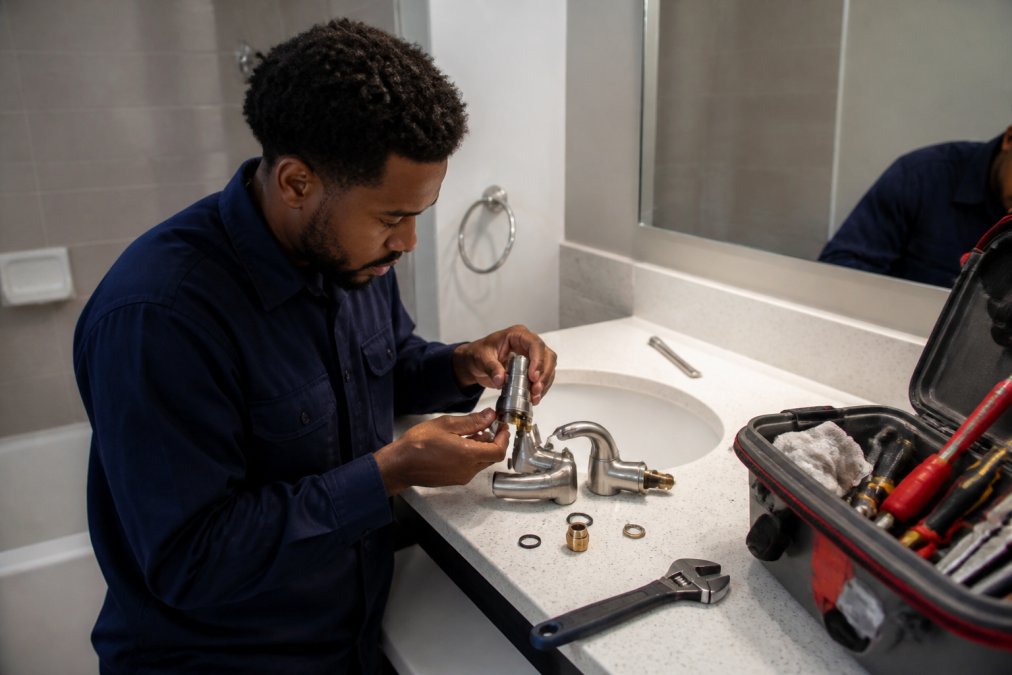
Applying RCA to a recurring bathroom leak changes the repair protocol. Instead of replacing a cartridge and moving on, the technician checks the supply line condition, verifies water pressure, and inspects the shutoff valve. This adds roughly 10 minutes to the initial visit but eliminates the probability of a callback. The trade-off is obvious: one slightly longer visit beats two shorter ones.
A common mistake is treating RCA as a formal meeting process reserved for major failures. In multifamily maintenance, RCA should be a quick mental checklist applied to every single repair. If the technician cannot answer "what would prevent this from happening again," the repair is not complete.
Standardize Repairs with Multifamily Maintenance Best Practices
Standardization is the enemy of callbacks. When every technician approaches a repair differently, you get inconsistent outcomes. Multifamily maintenance best practices call for documented repair protocols that specify the exact steps, the parts to use, and the quality checks required for each common job type.
For bathroom repairs, the protocol should specify OEM-grade replacement parts rather than generic alternatives. Generic parts may cost less upfront, but they often have looser tolerances that lead to premature failure (nist.gov). Standardizing on OEM components from brands like Moen, Delta, and BrassCraft ensures the replacement matches the original specification of the fixture.
Standardization also applies to the repair kit itself. A technician who has to gather parts from a supply room, make a store run, or improvise a fix is far more likely to cut corners. Properties that consolidate the necessary components into a single, pre-kitted box eliminate both the store run and the temptation to substitute a non-matching part. This is where Ready Bathroom Solutions fits into a broader callback reduction strategy: our pre-kitted bathroom repair sets consolidate OEM-grade parts into one box, eliminating wasted labor hours and reducing repeat maintenance visits.
Stock the Right Parts to Eliminate Second Trips
A significant share of maintenance callbacks never should have happened. They occur because the technician arrived without the correct part, applied a temporary fix, and scheduled a follow-up when the right component arrived. Inventory management is therefore a direct lever on callback rates. But the standard advice, "stock the parts you use most", is not enough. The properties that actually eliminate second trips tie their inventory par levels directly to their callback audit data.
Link Par Levels to Failure Codes, Not Just Usage Volume
Most supply rooms are stocked based on how often a part is pulled. That approach misses the real signal. A part that is pulled frequently because it keeps failing on the same units is not a high-demand item, it is a symptom of an unresolved root cause. Before you reorder 50 more of the same cartridge, ask why that cartridge keeps failing. If the answer is high water pressure in Building B, your inventory fix is a pressure-reducing valve, not a bigger cartridge stock.
Here is the operational rule that separates top performers: Set par levels based on your 90-day callback report, not your 90-day parts usage report. If a specific part appears in more than 10% of your callback work orders, stop reordering it until you have changed either the installation protocol or the operating condition that caused the repeat failure. Stocking more of a failing part is subsidizing your own callbacks.
The 3-2-1 Par Level Rule for High-Callback Repairs
For the repair types that generate the most callbacks in multifamily bathroom work, pressure control valves, faucet cartridges, and supply lines, adopt a 3-2-1 par level system:
- 3 units on the truck or in the technician's daily kit for the most common failure code in your portfolio.
- 2 units in the main supply room as backup for unexpected demand spikes.
- 1 unit in a secondary location (clubhouse, satellite maintenance closet, or on-site storage for large buildings) to cover after-hours emergencies without a store run.
This rule ensures that a technician can always complete a first-visit repair for the top three failure codes in your callback audit. It also forces you to keep your inventory lean enough that you notice when a part is failing repeatedly, because you will run out and have to reorder, which triggers the question of why you needed that many in the first place.
The Hidden Cost of Universal Parts
Generic or universal replacement parts are tempting because they reduce SKU count. But they introduce a callback risk that is rarely priced into the purchasing decision. Universal parts are manufactured to fit a range of fixtures, which means they often have looser tolerances than OEM-specified components. A universal cartridge that fits both a Moen and a Delta faucet may seat slightly differently in each, creating a seal that holds for a few weeks but fails under thermal cycling or pressure spikes.
The trade-off is not just part cost, it is the labor cost of the second visit. A $12 generic cartridge that saves you $4 over the OEM part can cost you $85 in technician labor when it fails in week three.
Inventory Audits as a Callback Prevention Tool
Schedule a monthly inventory audit that is not just a count of what is on the shelf. For each of your top 10 repair types, ask three questions:
- Do we have the correct OEM part in stock right now?
- Does the technician know where it is and how to grab it without a store run?
- Has this part caused a callback in the last 90 days, and if so, what changed about our protocol before we reordered it?
If the answer to question three is "no, we just reordered it," you are perpetuating the cycle. The audit should block the reorder until a root cause note is attached to the inventory record. This is a simple process change that requires no new software, just a column in your inventory spreadsheet labeled "Root Cause Verified."
Build a Post-Repair Quality Assurance Checklist
The final safeguard against callbacks is verification. Before closing any work order, the technician should run a post-repair quality assurance checklist that confirms the fix is complete and the conditions that caused the failure have been addressed.
For a bathroom leak repair, that checklist includes: verify the repair holds under normal water pressure, check for leaks at all connections, confirm the shutoff valve operates correctly, test the fixture through a full cycle, and inspect the surrounding area for signs of prior water damage. This last step matters because undetected moisture can lead to a mold complaint or a structural issue that surfaces weeks later as a different work order.
The checklist also creates accountability. When a technician signs off on a completed checklist, they are confirming they applied the full repair protocol, not just the minimum steps to stop the immediate symptom. Properties that adopt this practice report fewer repeat visits because the checklist forces the 10-minute RCA conversation on every job. It institutionalizes quality without requiring a supervisor to inspect every repair.
The Financial Case for Reducing Maintenance Callbacks
The cost of a maintenance callback extends beyond the obvious labor hours. Every repeat visit consumes parts, scheduling time, and tenant patience. A unit that requires three visits instead of one has effectively tripled its repair cost, and it has delayed the technician from addressing preventive maintenance tasks that would have reduced future emergencies.
Properties that reduce maintenance callbacks also see indirect benefits. Fewer repeat visits mean fewer disruptions for residents, which supports resident satisfaction and retention. A lower callback rate signals to ownership that the maintenance operation is running efficiently, which strengthens the case for budget requests for better tools, training, and inventory. The data-driven approach outlined here, tracking KPIs, applying root cause analysis, standardizing repairs, and verifying quality, is the most reliable path to those outcomes.
The most effective properties pair these practices with a supply chain that supports them. Standardized, OEM-grade repair kits that eliminate store runs and ensure consistent part quality are a practical complement to any callback reduction program. When your team can grab a complete kit, apply a documented protocol, and verify the fix before leaving, the second visit becomes the exception rather than the rule.
Reducing maintenance callbacks in multifamily housing is not about working harder; it is about working with better information and better preparation. Measure your callback rate, find the root causes behind your most common reasons for apartment bathroom leaks, and standardize your repair process around OEM-grade parts. Ready Bathroom Solutions supports this work with pre-kitted bathroom repair sets that eliminate store runs, ensure consistent quality across your portfolio, and help you get units back in service faster. Get started with Ready Bathroom Solutions and turn your maintenance operation into a predictable, cost-effective system.
Frequently Asked Questions
What is a maintenance callback in property management?
A maintenance callback happens when a technician completes a repair, but the same issue resurfaces, requiring a second visit. It can also mean the original fix never fully resolved the problem. High callback rates often point to rushed work, incorrect parts, or an underlying issue that was never addressed. Tracking your callback percentage is the first step toward reducing maintenance callbacks in multifamily housing.
How do you calculate the cost of maintenance callbacks?
To calculate the cost, add up the labor hours for the second visit, the cost of any replacement parts, and the administrative time spent reopening the work order. A simple formula is: (technician hourly rate × hours on repeat visit) + parts cost + lost productivity. Many properties find a single callback can cost two to three times more than getting the repair right the first time.
What are the most common reasons for apartment maintenance callbacks?
The most common reasons include using the wrong replacement part, failing to clean debris from supply lines, and not addressing the root cause of a leak, such as high water pressure. Toilet flapper issues and worn-out fill valves also top the list. Standardizing your repair process and using OEM-grade parts helps prevent these repeat failures.
How can standardized repair kits reduce maintenance time?
Standardized repair kits put every needed part in one box, so technicians do not waste time on store runs or hunting for components. This directly cuts the labor hours per job. When every unit uses the same OEM-grade parts, your team also becomes faster at installation, which reduces the chance of errors that lead to callbacks.