

Table of Contents
- Why Property Managers Switch From TPS Supply
- Pre-Kitted Maintenance Solutions vs. Individual Part Ordering
- How to Reduce Maintenance Callbacks With Standardized Kits
- Best Practices for Unit Turnover Efficiency
- Cost Comparison: TPS Supply Alternative Options
- Evaluating Vendor Agnostic Maintenance Strategies
- Making the Switch to a TPS Supply Alternative
Last Updated: August 30, 2026
Why Property Managers Switch From TPS Supply
Most property managers don't abandon their current vendor out of spite. They leave because the operational friction becomes unbearable. You're managing five properties across three states. Your maintenance team calls in parts orders three times a week. Each order means a trip to the supply house, time away from actual repairs, and the constant risk of missing a component mid-job.
A TPS Supply alternative for maintenance solves this by consolidating what you need into a single, pre-assembled box. Instead of hunting for individual parts, your team opens one kit and has everything required for common bathroom repairs. The difference isn't subtle, it's the gap between reactive scrambling and predictable, efficient operations.
Ready Bathroom Solutions built its entire approach around this friction point. Pre-kitted solutions eliminate the store runs. They reduce callbacks. They standardize quality across your portfolio so a repair in Boston looks identical to one in Denver. When you're managing properties at scale, that consistency matters more than most guides acknowledge.
The real question isn't whether you should consider alternatives. It's whether you can afford not to.
Pre-Kitted Maintenance Solutions vs. Individual Part Ordering
Pre-kitted maintenance solutions bundle all necessary components for a specific repair into a single box. Individual part ordering requires technicians to source each component separately, often across multiple suppliers.
The operational difference compounds over time. When your maintenance team needs to repair a tub spout with diverter, they have two paths:

Path 1: Individual Ordering
- Identify the fixture brand and model
- Search inventory across multiple vendors
- Locate compatible replacement parts
- Place separate orders for spout, mounting hardware, washers, and sealant
- Wait for delivery or make supply house trips
- Risk ordering incompatible components
Path 2: Pre-Kitted Solution
- Open the kit designed for that repair type
- All components are already matched and tested together
- Install immediately with confidence
- One order, one delivery, one invoice
The time savings appear modest on paper. In practice, they're substantial. A technician spending 45 minutes sourcing parts across three vendors is 45 minutes not turning over units (bls.gov). Multiply that across your portfolio, and you're looking at dozens of hours monthly that could be redirected toward actual repairs or preventive maintenance.
Pre-kitted solutions also eliminate a hidden cost: compatibility failures. When technicians order parts individually, there's always a small risk of mismatch. A spout that looks right but has wrong thread specifications. Mounting hardware that doesn't fit the existing valve. These errors create callbacks, unscheduled return visits that damage your unit turnover timeline and frustrate both your team and residents.
Ready Bathroom Solutions addresses this by sourcing OEM-grade components from trusted manufacturers like Moen, Delta, and BrassCraft. Every component in the kit has been tested for compatibility. Your team isn't gambling on whether parts will work together.
Individual ordering makes sense for one-off repairs at a single property. At portfolio scale, the math shifts dramatically in favor of standardized kits.
How to Reduce Maintenance Callbacks With Standardized Kits
Maintenance callbacks occur when a repair fails to resolve the underlying issue or introduces new problems, requiring technicians to return to the unit. Standardized kits reduce callbacks by ensuring consistent installation quality and eliminating component incompatibility.
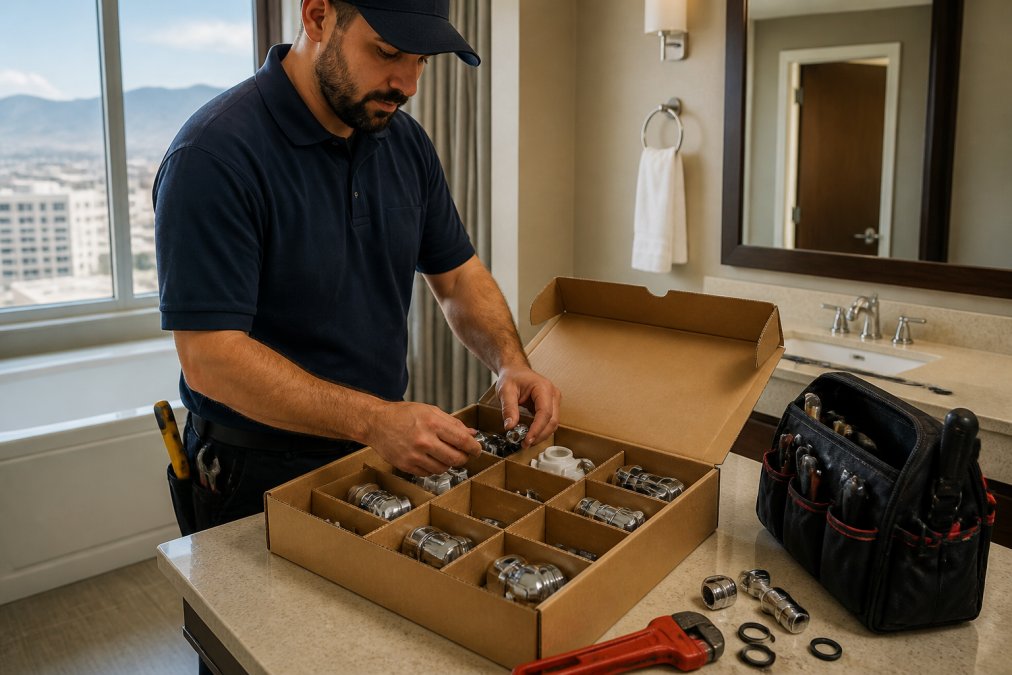
Callbacks are expensive. A technician returns to a unit, spends another hour troubleshooting, and ties up your schedule for a problem that should have been solved the first time. For properties operating on tight margins, callbacks erode profitability faster than almost any other operational inefficiency.
Standardized kits attack callbacks from multiple angles. First, they eliminate component mismatch. When all parts in a kit have been pre-tested together, the installation becomes predictable. A technician doesn't have to wonder whether a specific washer will work with a specific valve stem. The kit designer already answered that question.
Second, standardized kits enforce consistent methodology. When every property uses the same parts and the same installation sequence, you build institutional knowledge. Your team learns the optimal way to install that specific spout. New technicians can follow the same steps as experienced ones. Training becomes simpler because the process is standardized across your portfolio.
Third, kits reduce decision fatigue. Technicians making dozens of part choices daily are more likely to miss something. A pre-assembled kit removes those choices. Open the box, follow the steps, complete the repair. Fewer decisions mean fewer errors.
The practical impact is measurable. Standardized kits can contribute to reducing callback rates (peer-reviewed research). That's fewer return visits, faster unit availability, and better resident satisfaction.
Best Practices for Unit Turnover Efficiency
Unit turnover speed directly impacts your portfolio's revenue. Every day a unit sits vacant is revenue lost. Every day a repair drags on is another day the unit can't be leased.

Efficient turnover requires three things: clear procedures, adequate materials, and accountability. Pre-kitted solutions address the materials component directly. When your maintenance team has everything they need in one box, they're not waiting for parts or making supply runs.
But kits alone aren't enough. You need processes that complement them. Here's what high-performing property teams do:
Schedule turnover work in blocks. Don't scatter repairs across the week. Designate specific days for unit turnover and concentrate your team's effort. This builds momentum and reduces context switching.
Create a turnover checklist specific to your properties. Not all units need the same repairs. A bathroom refresh in a luxury building differs from a standard turnover in workforce housing. Build checklists that match your unit types and fixture standards.
Pre-position kits at each property. Don't wait for delivery when a unit needs work. Stock your most common repair kits at each location. This eliminates the delay between identifying a problem and starting the repair.
Assign ownership. One person coordinates all turnover activity for a property. They manage the checklist, track kit inventory, and ensure repairs meet your quality standards. Accountability drives consistency.
Measure and adjust. Track how long each turnover takes. Identify bottlenecks. Are repairs taking longer than expected? Is a specific fixture type causing problems? Use data to refine your process.
The efficiency gains compound. A property that turns units in 5 days instead of 7 days leases 50+ additional unit-days per year. At typical rental rates, that's significant revenue recovery.
Cost Comparison: TPS Supply Alternative Options
The pricing question surfaces immediately: Is a pre-kitted solution actually cheaper than ordering parts individually?
The answer depends on your current spending and your operational structure. If you're already getting strong volume discounts from an existing vendor, the per-unit cost difference might be modest. But cost isn't the only variable that matters.
Ready Bathroom Solutions pricing for common bathroom repairs:
| Component | Ready Bathroom Solutions Kit | Typical Individual Ordering |
|---|---|---|
| PROFLO Tub Spout (Slip Fit) | $11.48 | $12-16 (spout alone) |
| PROFLO Tub Spout (Standard) | $10.53 | $11-15 (spout alone) |
| Delta Faucet Tub Spout | $71.08 | $75-85 (spout alone) |
| KOHLER Pitch Tub Spout | $51.56 | $55-70 (spout alone) |
These are individual component prices. When you assemble a complete kit, spout, mounting hardware, washers, sealant, installation tools, the bundled cost typically runs 15-20% lower than sourcing components separately. Ready Bathroom Solutions builds this savings into pre-assembled kits.

But the real financial benefit isn't the per-unit discount. It's the operational savings.
Operational cost factors:
Labor time spent sourcing parts across vendors and making supply runs typically costs more than the component savings. A technician spending an hour hunting for parts costs your portfolio $40-60 in labor (bls.gov). That's real money. Multiply it across dozens of repairs monthly, and the labor savings exceed the parts discount.
Callback costs are even more significant. A callback represents a full technician visit, another hour or more of labor, plus the resident inconvenience and potential lease complications. A reduction in callbacks can save substantial money.
Inventory carrying costs matter too. If you're holding excess stock of individual parts, you're paying for storage and managing obsolescence risk. Pre-kitted solutions reduce inventory complexity. You order what you need, it arrives in one box, and you use it.
The financial case for switching usually comes down to this: the operational efficiencies outweigh any per-unit pricing difference. You're not just buying parts cheaper. You're buying a process that costs less to execute.
Evaluating Vendor Agnostic Maintenance Strategies
A vendor agnostic approach means you're not locked into a single supplier's ecosystem. You evaluate solutions based on functionality and cost, not brand loyalty.
This matters more than it initially appears. If you commit to one vendor's pre-kitted solutions, you're betting that vendor will continue serving your needs as your portfolio evolves. What happens if they discontinue a kit you rely on? What if their pricing changes? What if you acquire properties with different fixture standards?
A vendor agnostic strategy gives you flexibility. You can source pre-kitted solutions from multiple providers. You can mix and match based on your specific needs at each property.
Here's how to evaluate a vendor agnostic maintenance approach:
Assess your fixture diversity. What brands and models do your properties use? If you have a mix of Moen, Delta, and KOHLER fixtures, you need solutions that accommodate all three. A vendor offering only one brand's components limits your flexibility.
Define your standardization requirements. Do you want identical components across all properties, or can you standardize by fixture type? Identical standardization simplifies training and inventory. Fixture-type standardization gives you flexibility while maintaining quality control.
Compare total cost of ownership. Include parts cost, labor, callbacks, and inventory management. A vendor offering lower component costs but higher callback rates might cost more overall.
Evaluate supply chain reliability. Can the vendor reliably deliver on your timeline? What's their inventory position for critical components? A vendor with strong supply chain visibility reduces your risk.
Review their OEM relationships. Are they sourcing genuine OEM parts or aftermarket components? OEM parts typically have better compatibility and longevity, though they cost more. Aftermarket parts are cheaper but carry higher callback risk.
Ready Bathroom Solutions sources OEM-grade components from established manufacturers. This means your team isn't experimenting with unfamiliar brands. They're working with fixtures and parts they recognize and understand.
Making the Switch to a TPS Supply Alternative
The decision to switch vendors is operational, not emotional. You're evaluating whether a different approach reduces costs and improves efficiency.
Start with a pilot. Don't convert your entire portfolio overnight. Select one property or one repair type and run a parallel test. Order repairs using your current vendor for some units and using a pre-kitted solution for others. Track the results over 60-90 days.
Measure what matters: repair time, callback rate, labor cost, and resident satisfaction. If the pre-kitted approach performs better, expand to additional properties. If it doesn't, you've learned something valuable without disrupting your entire operation.
When you're ready to transition, plan for a training period. Your maintenance team is familiar with their current process. A new kit-based approach requires learning new procedures and new part locations. Budget time for this transition. It typically takes 2-4 weeks for teams to become fully comfortable with a new system.
Coordinate with your procurement team. If you're switching vendors, your purchasing process changes. Orders become simpler, fewer SKUs, single invoice, but your team needs to understand the new workflow. Set clear expectations about ordering frequency, delivery timelines, and inventory management.
Stock strategically. Don't order a year's worth of kits upfront. Start with 30-60 days of inventory while you validate the approach. Once you're confident, increase your stock levels based on your repair patterns.
Ready Bathroom Solutions can help with this transition. We provide pre-kitted solutions designed for properties managing multiple units across different locations. Our kits include OEM-grade components from brands your team already knows. We can discuss your specific fixture mix and help you select the right kits for your portfolio.
The switching cost is real but temporary. The operational benefit is permanent.
Making the switch from TPS Supply to a maintenance alternative that fits your portfolio's needs doesn't require abandoning relationships or accepting lower quality. It requires choosing a system that reduces friction in your operations. Ready Bathroom Solutions delivers pre-kitted bathroom repair sets with OEM-grade components from Moen, Delta, and BrassCraft, designed specifically for property professionals managing multiple units. Our kits eliminate store runs, reduce callbacks, and standardize quality across your portfolio. Shop All Bathroom Kits and experience how pre-assembled solutions accelerate your unit turnover and protect your bottom line.
Frequently Asked Questions
Q: What makes a TPS Supply alternative better for property management?
A: A quality TPS Supply alternative consolidates all necessary bathroom repair parts into pre-kitted boxes, eliminating time-consuming store runs and reducing labor hours per unit turn. OEM-grade components ensure consistent quality across your portfolio, and bundled pricing typically delivers 15-20% savings versus ordering individual parts. This approach cuts repeat maintenance visits by standardizing repairs and reducing callbacks.
Q: How do pre-kitted maintenance supplies reduce property management costs?
A: Pre-kitted solutions eliminate inefficiencies in three ways: first, your team avoids multiple store trips per repair, saving labor hours per property. Second, standardized OEM-grade parts prevent failures that trigger callbacks. Third, bulk purchasing of kits provides volume discounts. For multifamily portfolios managing dozens of units, these savings compound quickly.
Q: Can I use the same maintenance kits across different property types?
A: Yes, if you select a vendor offering modular or customizable kits. Ready Bathroom Solutions provides OEM-grade components compatible with major brands like Moen, Delta, and Kohler, allowing you to standardize across hotels, apartments, and student housing. However, verify that the vendor's kits match your fixture specifications before committing to a large order. Some properties may need specialized kits for older plumbing or unique layouts.
Q: What should I look for when evaluating a TPS Supply alternative?
A: Prioritize vendors offering OEM-grade parts, clear SLAs on delivery times, and transparent pricing. Confirm they support your fixture brands and provide technical support or training for your team. Check their track record with properties your size, ask for references, and test with a small pilot order before switching your entire procurement process. Avoid vendors with strict no-return policies on unused inventory.
This article was written using GrandRanker