

Table of Contents
- Why Standardizing Bathroom Repair Parts Matters for Hotels
- Cost Control and Reorder Consistency Through Standardization
- Building Your Hotel Plumbing Maintenance Checklist
- Reducing Maintenance Callbacks in Hospitality Operations
- Inventory Management for Hotel Maintenance Systems
- Selecting the Right Standardized Fixture Packages
- Implementation Roadmap: Rolling Out Standardized Parts Across Your Portfolio
- Conclusion
Last Updated: August 27, 2026
Why Standardizing Bathroom Repair Parts Matters for Hotels
Bathroom repairs consume more maintenance time and budget than any other system in hospitality operations. When fixtures fail across multiple properties, your team faces a familiar problem: different brands, different part numbers, different specifications. One property uses Moen cartridges. Another uses Delta. A third has a mix of both. The result is chaos, wasted labor hours, repeated store runs, and callbacks that cost far more than the original repair.
Standardizing bathroom repair parts solves this friction at the source. By consolidating your fixture ecosystem around a single set of compatible components, you eliminate the guesswork. Your maintenance team knows exactly what parts fit where. Repairs that once took three visits take one. Emergency calls at midnight become manageable because the right parts are already in stock.
Ready Bathroom Solutions provides pre-kitted, standardized solutions that remove the decision-making burden entirely.

This guide covers the complete strategy for standardizing bathroom repair parts across your portfolio. Whether you manage five hotels or fifty, the principles remain the same: choose your standard, implement consistently, and measure the impact on your bottom line.
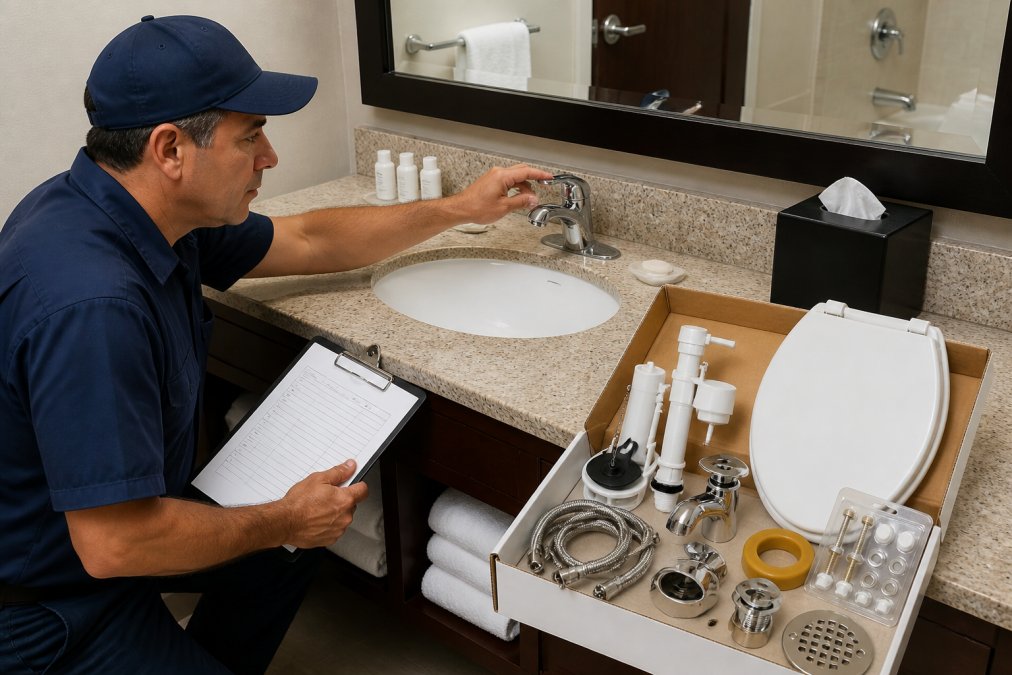
Cost Control and Reorder Consistency Through Standardization
The financial case for standardization rests on three pillars: elimination of emergency procurement, reduction in labor hours, and predictable inventory costs.
When your properties operate with non-standardized fixtures, maintenance callbacks spike. A technician completes a toilet repair on Monday using one part type. The same fixture fails at another property on Wednesday, but the part doesn't fit. The technician makes a store run, burning two hours of labor. You've now spent more on that single repair than you would have spent on a year's worth of standardized stock.
Standardized parts eliminate this pattern. Your team knows the inventory and can grab what they need from your maintenance closet without store runs. For a typical hotel property, this translates to measurable reduction in unplanned labor hours, time redirected to preventative maintenance instead of reactive fixes (ahla.com).
Reorder consistency means predictable monthly costs. Instead of sporadic, large purchases when emergencies hit, you order the same standardized kit on a regular schedule. This creates several advantages:
- Budgeting becomes straightforward (same SKUs, same quantities each month)
- Supplier relationships stabilize (consistent orders build negotiating power)
- Inventory never becomes obsolete (you use what you stock regularly)
- Dead stock disappears (no parts sitting unused for years)
Ready Bathroom Solutions' pre-kitted approach addresses this directly. Each kit contains the exact parts needed for a specific repair scenario. No guessing. No overstocking. No waste. The bundle pricing reflects the efficiency gains: you're paying for consolidated procurement, not individual parts ordered in panic.
For a property manager overseeing multiple units, this consistency becomes a competitive advantage. You can forecast maintenance costs with precision and staff your maintenance team more efficiently because repair times become predictable.
Building Your Hotel Plumbing Maintenance Checklist
A solid maintenance checklist is the foundation of any standardization strategy. Without it, standardized parts sit unused while your team continues ordering whatever they grab first.
Your checklist should map directly to your standardized parts inventory. If you've committed to a specific toilet cartridge, your checklist should reference that cartridge by part number. This removes ambiguity during repairs.
The checklist should cover these core areas:
- Toilet systems - Tank lever, flapper, fill valve, cartridge, wax ring, bolts
- Sink and faucet systems - Cartridge, aerator, supply lines, shut-off valves, drain trap
- Shower systems - Diverter, cartridge, trim ring, shower head, supply connections
- Drain assemblies - P-traps, cleanout plugs, drain stoppers, overflow components
- Water supply infrastructure - Shut-off valves, check valves, trap primers, supply line connectors
Each item should note the part name and OEM part number, compatible fixture brands, typical failure symptoms, replacement frequency, and storage location.

The checklist becomes your team's reference document. When a faucet drips, they consult the checklist, grab the cartridge listed there, and proceed. No phone calls. No time spent researching compatibility.
Many property managers build this checklist collaboratively with their maintenance team. The technicians know which parts fail most often at your properties and which brands perform best in your climate. Incorporate their feedback, and you'll build a tool that actually gets used.
Reducing Maintenance Callbacks in Hospitality Operations
Callbacks represent pure waste. A guest reports a leaking sink. Your technician fixes it. Three days later, the same guest reports the same problem. You've now spent twice the labor, twice the materials, and created a dissatisfied guest.
Callbacks happen for predictable reasons: wrong parts, incomplete repairs, or incompatibility between new parts and existing fixtures. Standardization eliminates most of these failure modes.
When your entire portfolio uses the same cartridge model, your technician becomes expert in that cartridge. They understand its quirks and common failure points. They can diagnose problems faster and repair them correctly the first time. This expertise is impossible to build when working with five different cartridge types.
Standardized parts also reduce compatibility issues. Every component is designed to work together. No surprises. Fewer callbacks mean lower labor costs and higher guest satisfaction.
Preventing callbacks also means fewer after-hours emergency calls. When your team knows the parts and procedures, they handle more repairs during regular business hours. Fewer midnight calls means better staff retention and lower overtime costs.
Inventory Management for Hotel Maintenance Systems
Inventory management is where many standardization efforts fail. A property manager commits to standardized parts, orders a large initial batch, and then struggles to use them before they expire or become obsolete.
The solution is systematic inventory rotation tied to your maintenance schedule. Think of inventory as "parts we'll use in the next 30-60 days based on our historical repair patterns."
Track three metrics for each standardized part:
- Usage rate - How many of this part do you replace per property per month?
- Lead time - How long does it take your supplier to deliver if you run out?
- Reorder point - At what inventory level should you place your next order?
For example: If you replace an average of two toilet cartridges per property per month across five properties, you need ten cartridges monthly. Your supplier delivers in five business days. You should reorder when your inventory drops to fifteen cartridges.
Integration with maintenance management software makes this automatic. As your technicians log completed repairs, inventory counts update. When a part hits the reorder point, the system flags it. No guesswork. No stockouts. No overstock.
The beauty of standardized parts is that they move. You're not sitting on specialty parts that might never be needed. You're holding parts your team uses regularly. This keeps cash flow healthy and storage space manageable.
Selecting the Right Standardized Fixture Packages
Choosing your standard fixtures is the most consequential decision in your standardization strategy. Get this wrong, and you're locked into parts that don't perform well. Get it right, and you've built a foundation that serves your properties for years.
Start by auditing your current fixture ecosystem. Which brands appear most frequently across your portfolio? Which fixtures fail most often? Which parts does your maintenance team already know well? This data tells you where standardization will have the biggest impact.
For most hotel portfolios, consolidating around two to three primary brands makes sense. Moen, Delta, and BrassCraft account for the majority of commercial-grade fixtures in the hospitality market. These brands offer deep parts availability, consistent quality, and good compatibility across their product lines.
Select fixtures designed for commercial use, not residential. Commercial-grade hardware is built for higher usage cycles and faster replacement (iapmo.org). A residential-grade faucet might last five years in a home bathroom. The same faucet in a hotel bathroom with 50+ daily users might last 18 months (asse-plumbing.org). Commercial fixtures cost more upfront but deliver better long-term value.
Evaluate fixtures on these criteria:
- Replacement cycle - How often does this fixture actually fail in your properties?
- Parts availability - Can you get replacement parts within 24-48 hours?
- Technician familiarity - Does your team already know how to repair this?
- Water efficiency - Does it meet current standards for water conservation?
- ADA compliance - Does it meet accessibility requirements for your properties?
Ready Bathroom Solutions' pre-kitted approach handles this selection process for you. Each kit is built around OEM-grade components from established brands proven in commercial environments. The kits are designed specifically for the repair scenarios your team faces most often: toilet repairs, sink repairs, shower repairs. You're not paying for parts you don't need. The bundle pricing reflects volume consolidation, delivering 15-20% savings compared to ordering individual components as emergencies arise.
Implementation Roadmap: Rolling Out Standardized Parts Across Your Portfolio
Rolling out standardization across multiple properties requires a structured approach. Do it systematically, and you'll see consistent results across your entire portfolio.
Phase 1: Pilot and Validation (Weeks 1-4)
Start with one property. Choose a property where your maintenance team is experienced and engaged. They'll become your advocates for the standardization approach.
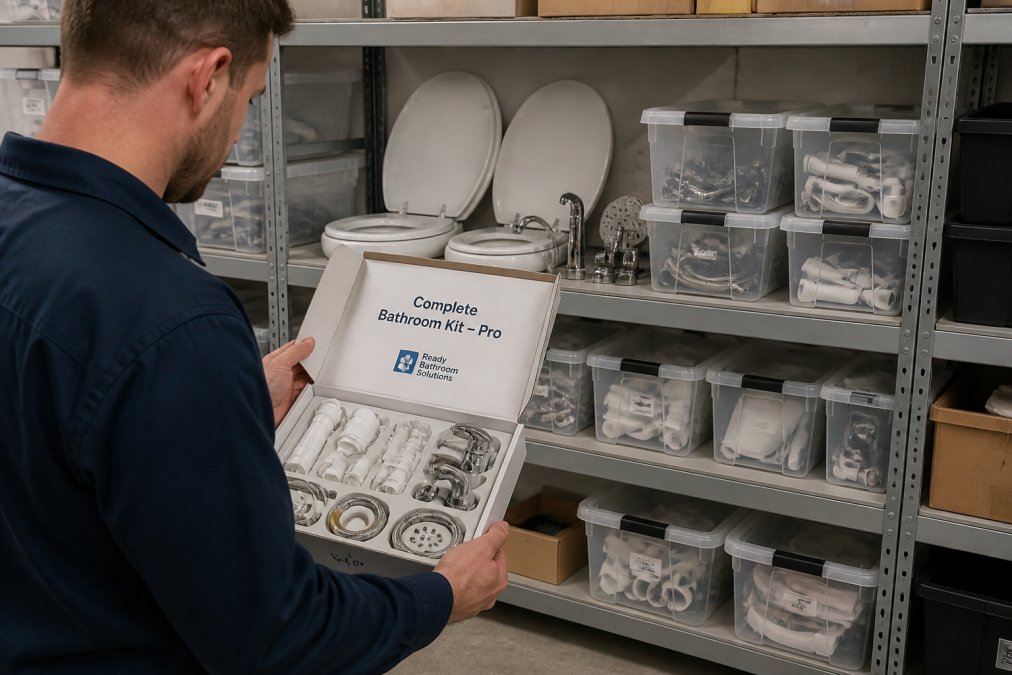
Order your first standardized kits. The COMPLETE BATHROOM KIT - PRO is an ideal starting point because it covers the three most common repair scenarios: toilet, sink, and shower. Introduce the kits to your maintenance team and walk through the contents. Track everything during this phase: repair times, callbacks, parts usage. This data becomes your baseline for measuring improvement.
Phase 2: Documentation and Training (Weeks 5-8)
Based on pilot data, create your standardized parts list and maintenance checklist. Create a simple one-page reference guide for each repair type. Your technicians should be able to reference these guides without thinking.
Document the cost savings from the pilot phase. This documentation becomes your business case for rolling out to the rest of your portfolio.
Phase 3: Phased Rollout (Weeks 9-16)
Roll out to your remaining properties in batches. If you manage 20 properties, roll out to four or five at a time. This prevents overwhelming your supply chain and allows you to learn from each batch.
Assign a "champion" at each property, usually your most experienced technician. This person becomes the local expert on the standardized approach and trains other technicians at their property. Maintain a shared spreadsheet tracking implementation status across all properties.
Phase 4: Optimization and Scaling (Weeks 17+)
After all properties are trained, shift focus to optimization. Review your data across the entire portfolio. Which parts are moving fast? Which are sitting in inventory? Use this data to refine your standardized kit contents.
Establish a quarterly review cadence. Bring together maintenance leaders from your properties to share data on repair times, callback rates, and inventory turnover. Use this forum to continuously improve your standardization approach.
Conclusion
Standardizing bathroom repair parts for hotels transforms maintenance from a reactive scramble into a predictable, efficient operation. You eliminate store runs, reduce callbacks, cut labor costs, improve guest satisfaction, and build institutional knowledge that doesn't depend on any single technician.
The implementation roadmap is straightforward: pilot with one property, document what works, train your team, roll out systematically, and optimize continuously. Start with pre-kitted solutions like Ready Bathroom Solutions' Complete Bathroom Kit Pro, which consolidates the parts you actually use into a single box. The bundle pricing reflects real savings of 15-20% off individual components, and the pre-curation saves your team from making wrong choices during repairs.
Your maintenance team will adapt quickly because standardized parts reduce cognitive load. They know what's in the kit and how to use it. That confidence translates directly to faster repairs, fewer callbacks, and staff retention. Get started with standardized bathroom repair parts and watch your operational efficiency improve.
Frequently Asked Questions
Q: Why is standardizing plumbing fixtures important for hotel maintenance?
A: Standardizing bathroom repair parts across your hotel portfolio eliminates confusion during repairs, reduces training time for maintenance staff, and ensures consistent quality across all guest rooms. When every property uses the same fixture brands and components, technicians can work faster because they're familiar with the parts, and you avoid ordering incompatible replacements. This approach also cuts maintenance downtime and prevents guest complaints from inconsistent bathroom experiences.
Q: How does part standardization reduce hotel maintenance costs?
A: Standardized parts lower costs through bulk purchasing power, reduced inventory waste, and fewer repeat maintenance visits. When you consolidate your plumbing fixture orders across multiple properties, suppliers offer volume discounts. You also eliminate the expense of keeping duplicate stock for different fixture brands. Pre-kitted solutions like the [Complete Bathroom Kit - Pro](https://readybathroomsolutions.com/products/complete-bathroom-kit-pro) bundle savings of 15-20% compared to buying individual components, and faster repairs mean lower labor costs per unit turn.
Q: What are the most common bathroom repair parts needed in hospitality?
A: Hotels most frequently replace valve cartridges, faucet aerators, toilet tank levers, drain assemblies, and trap primers. Shower systems, including diverters and cartridges, are also high-maintenance items due to heavy guest use. Standardizing around OEM-grade parts from brands like Moen, Delta, and BrassCraft ensures these components fit across your properties without compatibility issues. Stocking these core items in pre-kitted form reduces store runs and ensures repairs stay on schedule.
Q: How can standardized parts improve room turnaround time?
A: When maintenance teams have all necessary parts in one kit, they eliminate time-consuming trips to supply stores. This directly reduces the time between guest checkout and room readiness. Pre-kitted solutions also cut installation time because technicians aren't hunting for compatible components or dealing with mismatched tolerances. Faster repairs mean more rooms available for sale each day, directly improving your property's revenue per available room (RevPAR) and overall occupancy efficiency.
Q: How do I implement standardized parts across multiple hotel properties?
A: Start by auditing your current maintenance parts inventory across all properties to identify the most-used fixtures and components. Choose one standardized fixture brand and kit system to pilot at your highest-turnover property. Train your maintenance team on the new parts and processes, then measure callback rates and labor hours before rolling out to other properties. Use inventory management software to track stock levels and reorder automatically when supplies run low, ensuring consistent availability across your portfolio.
Q: What's the difference between standardized parts and premium commercial-grade hardware?
A: Commercial-grade hardware is built to withstand heavy use and meets stricter durability standards than residential fixtures. Standardized parts refer to using the same fixture brands and models across your properties for consistency and ease of maintenance. Premium commercial-grade parts are often part of a standardization strategy because they last longer, reducing replacement frequency. OEM-grade components from brands like Moen and Delta provide both the durability needed for hotels and the standardization benefit of consistent tolerances across all your units.
Q: Can standardized bathroom kits work across different hotel brands and unit layouts?
A: Yes, if you standardize around universal components. Most hotels use similar fixture types (single-handle faucets, two-piece toilets, standard shower valves), so pre-kitted solutions can work across properties with different layouts. However, confirm that your chosen kit includes parts compatible with your existing fixtures before committing. Ready Bathroom Solutions offers modular kits like the [Toilet Kit - Pro](https://readybathroomsolutions.com/products/toilet-kit-pro), [Sink Kit - Pro](https://readybathroomsolutions.com/products/sink-kit-pro), and [Shower Kit - Pro](https://readybathroomsolutions.com/products/shower-kit-pro), allowing you to standardize specific fixtures while maintaining flexibility across your portfolio's different bathroom configurations.
This article was written using GrandRanker