

Table of Contents
- What You'll Need Before Deploying Bulk Plumbing Kits
- Step 1: Standardize Your Kit Selection Across All Units
- Step 2: Configure Work Van Storage and Job Site Organization
- Step 3: Build SOPs for Bulk Kit Deployment
- Plumbing Inventory Management for Property Managers
- Best Bathroom Maintenance Kits for Hotels and Multifamily Properties
- Reducing Maintenance Repair Time With Pre-Kitted Solutions
- Common Mistakes to Avoid When Scaling Bulk Kit Programs
Last Updated: August 24, 2026
Implementing bulk plumbing kits efficiently is one of the highest-use operational improvements a property professional can make. At Ready Bathroom Solutions, we work with maintenance directors, facilities managers, and purchasing teams who manage dozens to hundreds of units. The biggest time losses happen before a technician ever touches a fixture. Below, we'll show you exactly how to build a bulk kit program that cuts job site time, eliminates dead stock, and scales across your entire portfolio.
What You'll Need Before Deploying Bulk Plumbing Kits
Deploying bulk plumbing kits without a proper audit first is the fastest way to end up with the wrong parts in the wrong place.
Audit Your Fixture Types and Unit Layouts
Before ordering anything, document every fixture type across your portfolio. Walk each property type and record:
- Toilet flush valve and fill valve brands (and whether they're 2-inch or 3-inch flush valves)
- Sink supply line configurations (3/8-inch compression, 1/2-inch IPS, braided vs. corrugated)
- Shower valve brands and cartridge models
- Drain line diameters and P-trap configurations
This audit is the foundation of your plumbing inventory management system. Without it, you're guessing, and guessing creates dead stock.
Set Par Levels by Property Size
Par levels define the minimum quantity of each kit you keep on hand before reordering. For a multifamily property with 100 units, many maintenance teams find that keeping 10-15 toilet kits, 8-12 sink kits, and 6-10 shower kits on hand covers routine turnover plus a reasonable emergency margin.
Step 1: Standardize Your Kit Selection Across All Units
Standardization is the single most impactful decision in any bulk plumbing kit program. For most multifamily and hospitality portfolios, three kit categories handle the vast majority of work: toilet, sink, and shower. Ready Bathroom Solutions offers the Toilet Kit - Pro, Sink Kit - Pro, and Shower Kit - Pro as purpose-built bundles that include OEM-grade components from brands like Moen, Delta, and BrassCraft.


| Kit Type | Primary Components | Best For |
|---|---|---|
| Toilet Kit - Pro | Fill valve, flush valve, supply line, wax ring | Unit turns, routine callbacks, emergency repairs |
| Sink Kit - Pro | Supply lines, P-trap, drain assembly, escutcheons | Sink replacements, leak callbacks, renovation punch-out |
| Shower Kit - Pro | Cartridge, diverter, supply lines, trim | Shower valve service, cartridge replacements, room turns |
A PTFE pipe thread tape pack, such as the ProSelect 3/4 in. x 520 in. roll, belongs in every service bag. Threaded connections leak when this step is skipped, and leak callbacks are one of the most avoidable costs in residential plumbing maintenance.
Step 2: Configure Work Van Storage and Job Site Organization
Work van layout is where bulk kit efficiency either gets realized or lost. A technician who spends four minutes locating the right kit on a disorganized van loses significant time over a week.
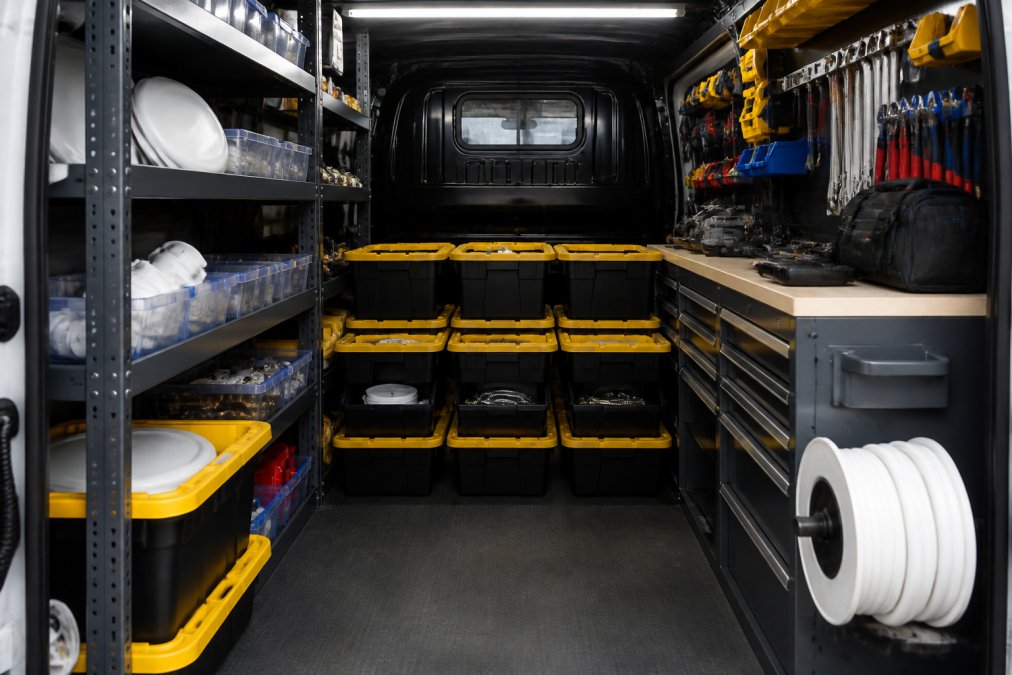
The most effective van configurations follow a zone-based layout:
- Zone 1 (rear doors, immediate access): Active job kits for today's scheduled work
- Zone 2 (driver-side shelving): Bulk kit inventory in labeled bins by category (toilet, sink, shower)
- Zone 3 (passenger-side shelving): Tools, sealants, and consumables including PTFE tape, caulk, and drain cleaning supplies
- Zone 4 (floor bins): Overflow stock and less frequently used plumbing hardware
Label every bin with printed, laminated labels that match your inventory management system. When a technician replaces a kit, they scan the bin label, not the box. This makes inventory tracking automatic rather than manual.
According to OSHA's ergonomics guidelines for material handling, repeated lifting from low positions contributes significantly to musculoskeletal strain in service workers. Store your heaviest kits at mid-shelf height (roughly waist to chest level) to reduce injury risk and speed up material handling.
Step 3: Build SOPs for Bulk Kit Deployment
Standard Operating Procedures for bulk kit deployment convert your kit program from "a good idea" into a repeatable system that works consistently across your team.
A functional bulk kit deployment SOP covers five areas:
- Pre-job kit pull: Technician confirms kit type against work order before leaving the shop or van
- On-site verification: Check fixture brand and model against kit contents before opening the box
- Installation sequence: Defined order of operations for each kit type (supply lines before drain, sealant on all threaded connections)
- Post-installation check: Pressure test, visual inspection, and documentation in the work order system
- Kit consumption recording: Scan or log the used kit immediately after job completion, triggering inventory replenishment
Write these as one-page laminated cards that live in each van. Digital versions in your work order system are useful, but the physical card is what gets used when a technician is under a sink.
Emergency Repair Kit Protocols
Emergency plumbing repairs follow a different logic than scheduled maintenance. Your emergency repair kit should be a separate, dedicated bag that never gets cannibalized for routine work. A standard emergency kit typically includes one of each kit type (toilet, sink, shower), a PTFE tape pack, an adjustable wrench, and a slip-joint pliers set. This bag stays stocked at all times.
As documented in EPA WaterSense program guidance on fixture repair and water efficiency, prompt fixture repair directly reduces water waste, which matters both for utility costs and for properties pursuing sustainability certifications.
Plumbing Inventory Management for Property Managers
Plumbing inventory management for property managers is fundamentally different from contractor inventory management. Your inventory system needs to track consumption by property, not just by SKU. Knowing you used 20 toilet kits last month tells you almost nothing. Knowing that Building C consumed 14 of those 20 tells you Building C has a fixture problem worth investigating.
Tracking Systems That Prevent Dead Stock
Dead stock is the most common objection property managers raise about bulk kit programs. Three tracking approaches work well at different scales:
- Spreadsheet-based (under 50 units): A simple Google Sheet with columns for property, kit type, quantity on hand, date of last use, and reorder trigger. Manual but effective when team size is small.
- Work order system integration (50-300 units): Most property management platforms allow parts tracking within work orders. Attach kit consumption to each closed work order and run monthly reports by property.
- Barcode/QR scan system (300+ units): Print QR codes for each bin location. Technicians scan when pulling a kit, and the system updates inventory automatically.
The right system is the one your team will actually use. According to National Apartment Association guidance on maintenance operations, standardized parts programs consistently reduce maintenance labor time and callback rates across multifamily portfolios.
Best Bathroom Maintenance Kits for Hotels and Multifamily Properties
The best bathroom maintenance kits for hotels and multifamily properties share three characteristics: OEM-grade components, all-in-one packaging, and compatibility with the fixture brands most common in commercial installations.
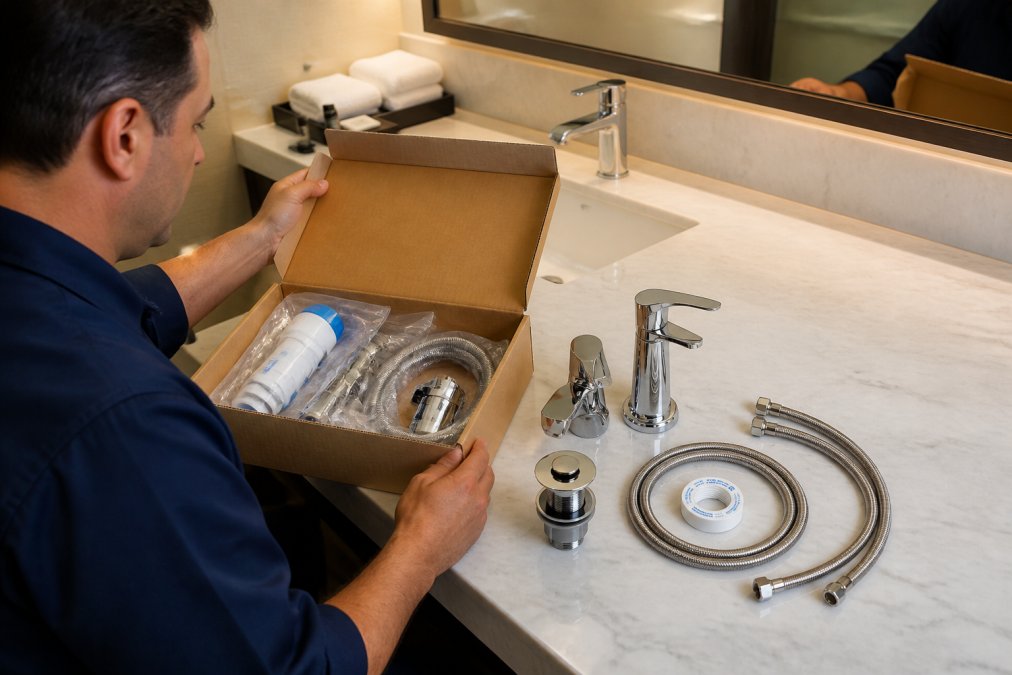
For hospitality properties, room turn speed is the critical metric. A kit that requires a technician to sort through loose components before installing costs time that directly affects room availability. For multifamily properties, the priority shifts toward consistency. Residents notice when repairs don't match the original fixture finish or when a replacement part fails within months. OEM-grade parts from brands like Moen and Delta carry the same tolerances as the original installed fixtures, which means fewer callbacks and longer service intervals.
Reducing Maintenance Repair Time With Pre-Kitted Solutions
Reducing maintenance repair time is the headline benefit of any bulk plumbing kit program. Time is lost in three places during a typical plumbing service call: sourcing parts, diagnosing which parts are needed, and installing. Pre-kitted solutions eliminate the first and reduce the second.
Once the diagnosis is made, the kit removes every subsequent decision point. If a team of four technicians each saves 30-45 minutes per job by not making a supply run, and each technician runs three jobs per day, the weekly time recovery across the team is substantial. Pre-kitting also reduces the risk of incomplete repairs. A technician who sources parts individually may substitute a non-OEM component when the correct part isn't available locally. That substitution often works initially and fails within 6-12 months, generating a callback. A pre-kitted box with OEM components eliminates that substitution entirely.
Cost-Benefit Analysis: Bulk Kits vs. Individual Components
Bulk kit pricing typically reflects bundle savings relative to purchasing the same components individually. Ready Bathroom Solutions builds 15-20% bundle savings into its kit pricing compared to sourcing equivalent OEM-grade components separately.
The full cost comparison should include labor time for sourcing, callback costs from non-OEM substitutions, carrying costs of fragmented inventory, and emergency premiums. As noted in Building Owners and Managers Association operational efficiency resources, standardized procurement programs consistently outperform reactive purchasing on total cost of ownership when analyzed across a full fiscal year.
Common Mistakes to Avoid When Scaling Bulk Kit Programs
Scaling a bulk kit program from one property to a portfolio introduces failure points that don't exist at small scale.
Ordering the same kit mix for every property. A 200-unit garden-style apartment complex and a 150-room limited-service hotel have very different fixture profiles and service call patterns. Kit selection should follow your property-level fixture audit, not a one-size-fits-all assumption.
Skipping the SOP rollout. Dropping boxes of kits into a storage room without a deployment protocol produces inconsistent results. Technicians default to their existing habits, which often means opening the kit and leaving the rest unused.
Setting par levels once and never revisiting them. Seasonal occupancy changes, renovation cycles, and fixture aging all shift your consumption patterns. Review par levels quarterly for the first year, then semi-annually once your data is stable.
Treating bulk procurement as a one-time cost reduction. The real value of a bulk kit program is operational: faster turns, fewer callbacks, consistent quality. Teams that optimize purely for purchase price often underorder and end up with the same emergency sourcing problem they started with.
Ignoring ergonomic considerations. Heavy kit boxes stored on floor-level shelving create repetitive strain risk. Mid-shelf storage for the heaviest items and appropriate material handling equipment for bulk deliveries are worth the setup investment.
The teams that scale bulk plumbing kit programs successfully treat it as a systems implementation, not a purchasing decision. The kit is the product. The SOP, the van layout, the inventory tracking, and the par level discipline are the system.
Frequently Asked Questions
What are the benefits of using pre-kitted plumbing supplies?
Pre-kitted plumbing supplies eliminate store runs, reduce the chance of missing parts mid-job, and ensure every technician installs the same OEM-grade components. For property managers overseeing multiple units, that consistency cuts callbacks and speeds up unit turns. Bulk plumbing kits with pre-measured packaging also reduce material waste and give purchasing managers a predictable per-unit cost, making budget forecasting more accurate across a full portfolio.
How do bulk plumbing kits reduce maintenance callbacks?
Callbacks most often happen when a repair uses mismatched or substandard parts that fail within weeks. Bulk plumbing kits sourced from OEM-grade brands like Moen, Delta, and BrassCraft ensure every installation meets the same specification. Because all required components arrive in one box, technicians are less likely to skip a part or substitute an inferior alternative, which directly reduces the repeat visits that drive up labor costs across multifamily and hospitality properties.
How can property managers optimize their inventory for plumbing repairs?
Start by auditing your fixture types across all units and grouping properties by layout. Set par levels based on your average monthly repair volume, then order bulk plumbing kits to match those levels rather than individual components. Track consumption by property using a simple spreadsheet or CMMS software. Pre-kitted solutions simplify this because one SKU covers an entire repair scenario, making reorder triggers straightforward and reducing the risk of stockpiling parts you rarely use.
Are OEM-grade parts necessary for routine bathroom maintenance?
For routine repairs in commercial and multifamily properties, OEM-grade parts matter more than they do in a one-time residential fix. Facilities managers and chief engineers need parts that meet the original fixture's tolerances to avoid premature wear. Using OEM-grade components from established brands also protects against warranty disputes and ensures compliance with manufacturer specifications, which can be relevant when properties are subject to inspection or insurance requirements.
Scaling a bathroom maintenance program across multiple properties is genuinely hard, the logistics, the fixture variability, and the team coordination all compound. Ready Bathroom Solutions was built specifically for this challenge: pre-kitted, OEM-grade bathroom repair sets that consolidate every component into a single box, eliminating store runs and reducing callbacks across your portfolio. Shop all bathroom kits and get your units back in service faster.
This article was written using GrandRanker