

Last Updated: October 31, 2026
Quick Summary
Bulk plumbing kits usually stay usable for a few years when stored well, but each part ages at a different rate. Rubber washers, gaskets and flexible supply lines wear out fastest, while metal and pipe last longer if kept dry and clean. Store kits indoors, out of sunlight, and rotate stock oldest first.
- Rubber parts are the shortest-lived, and washers can fail without visible signs.
- Flexible supply lines are the component most likely to fail in storage.
- Heat, humidity and direct sunlight shorten the life of rubber and plastic parts.
- Store kits indoors on shelving, away from heaters and concrete floors.
- Label each box with its purchase date and use the oldest stock first.
Table of Contents
- Supply lines and flexible connectors
- Factors That Shorten Plumbing Parts Shelf Life
- How to Store Plumbing Supplies So Kits Stay Usable
- How to Inspect a Stored Kit Before Installing It
- Managing Bulk Kit Inventory to Avoid Dead Stock
- Stocking Your Next Bathroom Repair Kits Without the Waste
- Frequently Asked Questions
Bulk plumbing kits can sit on a shelf for years, but not every part in the box ages at the same rate. Pre-kitted sets that combine supply lines, washers, gaskets and pipe have a shelf life that depends on their weakest component. Knowing how long each part keeps lets you buy in the right quantities and avoid pulling perished parts during a turn.
A short answer: most kits stay usable for a few years when stored well. Rubber parts age fastest. Metal and pipe usually last longer, provided they stay dry and clean. Read the sections below to see how each component behaves.
Supply lines and flexible connectors
Flexible supply lines are the component most likely to fail in storage. The braided or rubber liner can harden, crack or lose its seal over time, even when the part looks fine. Many manufacturers print a date code or recommend replacement after a set period, so check the packaging before you install.
If a supply line has been in a box for several years, treat it as suspect. Inspect the rubber, the fittings and the crimp before using it.
Rubber washers, gaskets and O-rings
Rubber is the shortest-lived part in most kits. Washers, gaskets and O-rings can dry out, flatten or crack, and they often fail without any visible sign until they are installed under pressure. Heat, light and ozone all speed this process.
A washer that looks intact can still leak once tightened, so do not assume an older rubber part will seal.
Copper, PVC and other pipe
Pipe lasts longer than rubber, but it is not immune to damage. Copper stored outdoors can corrode or pick up dents. PVC is sensitive to sunlight and can become brittle or sag if it is not supported. Keep pipe straight, covered and off the ground to protect it.
Factors That Shorten Plumbing Parts Shelf Life
Storage conditions matter more than the calendar. Heat, humidity, direct sunlight and temperature swings all shorten the life of rubber and plastic parts. A kit kept in a climate-controlled room will outlast the same kit left in a hot garage.
Physical damage is another common cause of failure. Crushed boxes, stacked weight and moisture from leaks can ruin parts that would otherwise be fine.
How to Store Plumbing Supplies So Kits Stay Usable
Store plumbing kits indoors, in a dry room with stable temperature. Keep them out of direct sunlight, away from heaters and off concrete floors. Stack boxes on shelving rather than on each other, so the bottom layers do not get crushed.
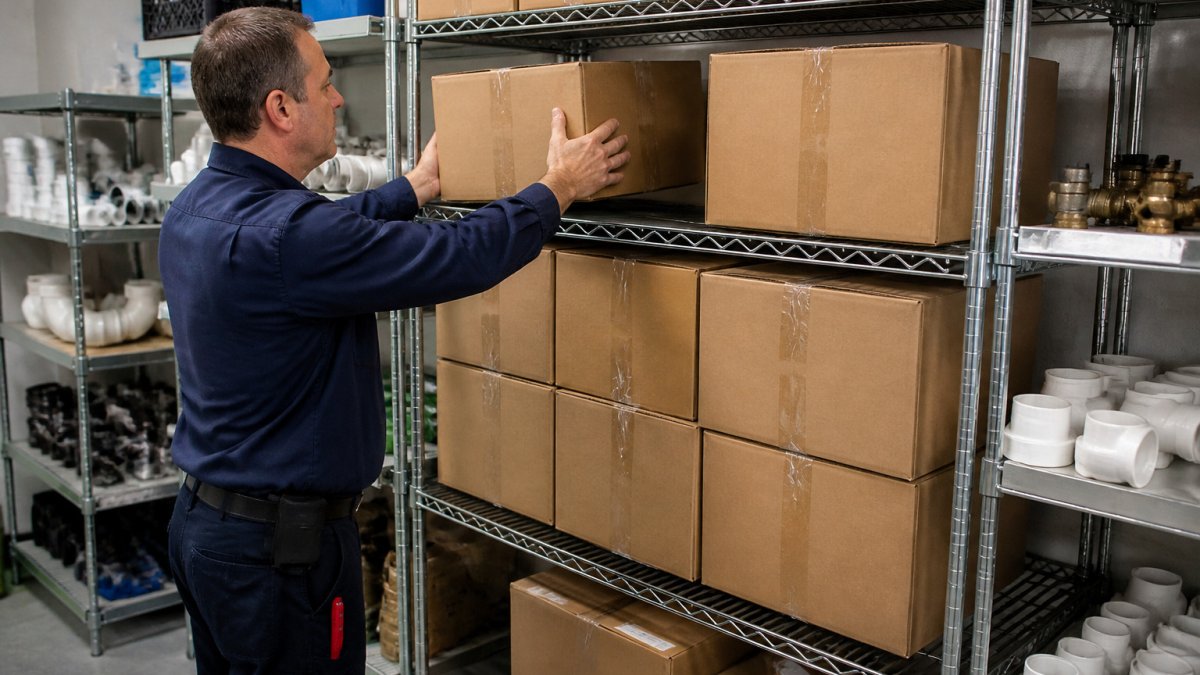
Label each box with its purchase date. This makes rotation simple: use the oldest stock first.
The article's storage guidance comes down to a few practical points:
| Storage factor | Recommended practice | Why it matters |
|---|---|---|
| Location | Indoors, dry, stable temperature | Heat and humidity shorten part life |
| Light | Keep out of direct sunlight | Sunlight degrades rubber and PVC |
| Floor | Shelving, not concrete floors | Avoids moisture and crushing |
| Stacking | Stack on shelves, not on each other | Prevents crushed bottom boxes |
| Labeling | Write purchase date on each box | Enables first-in, first-out use |
How to Inspect a Stored Kit Before Installing It
A stored kit can look fine and still fail on first use, so inspection needs to be component-specific and tied to a clear use-or-discard decision. Work through the kit in the order below, and treat any failed check as a reason to replace that part rather than install it.
1. Check the packaging and labels first. Look for crushed corners, water stains, or tears that let dust and moisture in. Find the manufacturer's date code, batch code, or "use by" marking. If the label is missing or unreadable, treat the kit as older than you think and inspect every component more strictly. Manufacturer guidance on the label or technical data sheet overrides any general estimate, including the ones in this article.
2. Rubber washers, gaskets, and O-rings. Squeeze each rubber part gently. A healthy washer or O-ring flexes and springs back; an aged one feels hard, waxy, or leaves a permanent flat spot. Look for hairline cracks at the inner and outer edges, a chalky surface bloom, or a sticky residue. Any of those signs means the part has aged out, replace it. Do not install a stiff or cracked rubber part just because it is the right size.
3. Flexible supply lines and braided connectors. Run your hand along the full length of the line and flex it gently. Reject any line with a bulge, a kink that does not relax, frayed braid, rust at the crimp collars, or a liner that feels stiff rather than supple. Check the threaded fittings for cross-threading or corrosion. A supply line that has sat for several years is the highest-risk item in most kits; when in doubt, replace it rather than risk a leak behind a wall or cabinet.
4. Rigid pipe, copper, PVC, and PEX. Sight down the length of each pipe for dents, ovality, or a bend that will not straighten. Copper should be free of green or white corrosion and should not show pitting; a light surface patina is normal, but chalky white or bright green deposits are not. PVC should be uniform in color with no chalky fade, no cracks at the bell end, and no warping. PEX should be free of kinks, abrasion, and UV discoloration.
Sink Supply Lines (Pair) - PROFLO® Sink 1/2 in x 3/8 in. Supply Kit →
5. Adhesives, primers, and lubricants. Check the container for a manufacture date and a shelf-life statement. Solvent cement that has thickened, gelled, or skinned over is past its useful life, discard it. Silicone grease and O-ring lubricant should be smooth and free of separation or grit. Never top off an old container with fresh product; use the oldest sealed container first and discard anything past its stated shelf life.
6. Metal fittings, valves, and fasteners. Look for rust, white corrosion on zinc or brass, stripped threads, and stiff valve handles. A valve that will not turn freely by hand is a liability; replace it rather than force it.
Decision rule. If a component passes every check and the kit's date code is within the manufacturer's stated shelf life, it is reasonable to install it. If any component fails, replace that component, do not discard the whole kit unless the failure suggests widespread moisture or heat damage. If the kit has no date code and has been stored in an uncontrolled space for more than a few years, replace all rubber and flexible components before installation and inspect the rigid parts closely.
Managing Bulk Kit Inventory to Avoid Dead Stock
Bulk buying only pays off when the oldest stock gets used first and the fastest-aging components do not sit behind slower-moving ones. Treat shelf life as an inventory variable, not just a storage one.
Label at receiving, not at use. Write the receipt date on every box and on every inner bag the moment it arrives. If the manufacturer printed a date code or a "use by" date, copy it onto the outside of the box in large marker so no one has to open the kit to check it. A simple two-date label, received and expires, is enough.
Rotate first-in, first-out. Stock shelves so the oldest kits are at the front and the newest at the back, and pull from the front. When a new shipment arrives, move the older boxes forward rather than stacking the new ones in front. This single habit prevents most dead stock.
Separate the short-life components. Rubber washers, gaskets, O-rings, and flexible supply lines age faster than rigid pipe and metal fittings, so store them separately from long-life components where possible. That way an aged washer does not force you to scrap an otherwise good kit.
Set a reorder point tied to usage, not to shelf space. Track how many kits your team installs per month or per quarter, then set a reorder point that covers lead time plus a safety margin. Ordering to a usage rate rather than to a full shelf keeps inventory turning and reduces the chance that rubber parts reach their shelf-life limit before installation.
Quarantine suspect stock. When a kit fails inspection or passes its labeled shelf life, move it to a clearly marked quarantine area rather than leaving it in the pickable stock. Review quarantined kits periodically: salvage the rigid components, discard the aged rubber and consumables, and record what was lost so future order quantities reflect it.
Keep a simple usage and discard log. A spreadsheet with three columns, kits received, kits installed, components discarded, is enough. After a few months, the log shows which kit types move slowly and which components expire most often, and that is the data you need to right-size the next order.
For cost data to guide your order quantities, see our Bulk Bathroom Maintenance Cost Analysis: 2026 Data, which helps you decide how many kits to buy versus how many risk aging unused.
Stocking Your Next Bathroom Repair Kits Without the Waste
Start with a smaller order, track usage, then scale up. Keep a simple log of what gets installed and what gets discarded. Over time, that log shows you which components need more frequent restocking.
When you are ready to place your next order, our guide to bulk order bathroom repair parts walks through how to buy in quantities that match your actual usage.
Frequently Asked Questions
How long do plumbing repair parts last in storage?
Most sealed plumbing parts stay usable for years when stored properly. Metal components generally hold up longer than rubber and elastomer components such as washers, gaskets and O-rings, which are usually the first to degrade. Keeping kits sealed, dry and out of direct sunlight extends life considerably. Because manufacturers rarely publish a fixed shelf life, check the packaging for a date code and inspect any kit that has sat for more than a few years before installing it.
Do rubber plumbing washers and seals expire?
Yes, rubber washers and seals do degrade over time, even when unused. Heat, ozone, UV light and oils speed up hardening, cracking and loss of flexibility. A gasket that bends without cracking and springs back is usually still good. One that is stiff, chalky, cracked or flattened should be replaced, regardless of how long it has been in the box. When in doubt, replace the rubber components in a kit before installing it, since they are inexpensive compared to a callback.
How should plumbing kits be stored to prevent damage?
Store kits indoors in a dry, temperature-stable room away from direct sunlight, heaters and moisture. Keep them in their packaging, off concrete floors, and on shelves rather than piled under heavy boxes that can crush supply lines or deform fittings. Label stock with its receiving date so older stock ships out first. Avoid unheated garages and outdoor sheds, where freezing and humidity swings can damage both rubber and metal components.
How often should maintenance teams inspect bulk plumbing inventory?
Inspect stored kits at least once a year and before any kit older than about three years is installed. Check packaging for damage, look for moisture or corrosion on metal fittings, and flex rubber components to test for cracking. Record findings on a simple log tied to each kit's receiving date. Tracking this turns inventory into a managed resource rather than a set of boxes whose condition nobody knows.
Ready Bathroom Solutions supplies pre-kitted bathroom repair sets built for property teams. Our sink supply lines and toilet supply lines come in standard sizes, and if you find perished washers or O-rings during an inventory check, you can replace them with a faucet repair part.


