

Table of Contents
- What an All-in-One Kit Toilet Repair Bundle Actually Contains
- Toilet Kit Comparison: Bundles vs Individual Parts
- Toilet Repair Kit Components: Seats, Supply Lines, and What Fits
- How to Install a Toilet Repair Kit in a Turned Unit
- Best Practices for Toilet Maintenance Across a Portfolio
- Where All-in-One Kit Toilets Pay Off vs Cost More
- Frequently Asked Questions
Last Updated: September 25, 2026
What an All-in-One Kit Toilet Repair Bundle Actually Contains
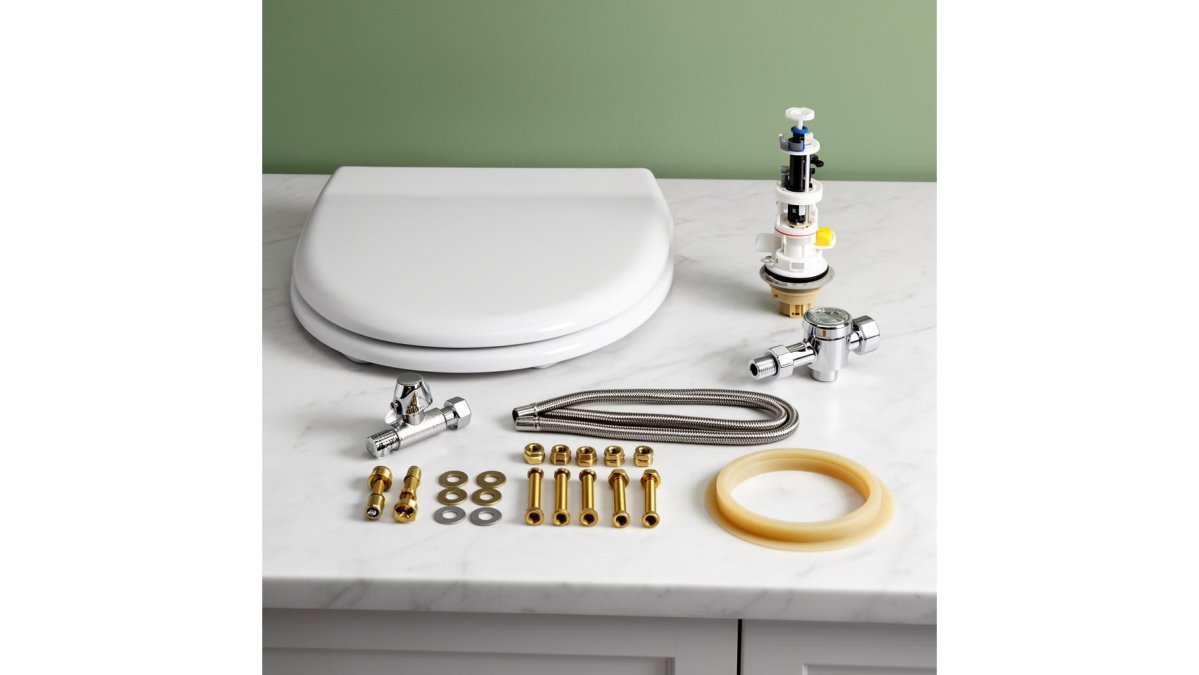
An all-in-one kit toilet repair bundle is a single box containing every part needed to restore one toilet to working order: seat, supply line, fill and flush components, and the small hardware that usually triggers a second trip to the store. For property teams, that single box is the difference between a one-visit turn and a callback.
This guide from Ready Bathroom Solutions breaks down what belongs in a kit, how bundle pricing compares with buying parts individually, and where all-in-one kit toilets genuinely save money on a portfolio. We manage kits built around OEM-grade components.
Here's the pattern that matters most: maintenance teams rarely lose time on the repair itself. They lose it on the missing piece. A technician arrives, finds a cracked supply line, drives to a supplier, waits at the counter, and returns two hours later. All-in-one kit toilets exist to delete that middle step.
Toilet Kit Comparison: Bundles vs Individual Parts
Bundles win on time and consistency; individual parts win only when you need one odd component. If your team replaces seats, lines, and internal parts on a regular turnover schedule, a kit is the cheaper path once labor is counted.

For a direct comparison, the EPA WaterSense program guidance on efficient fixtures is a useful reference point for why standardized replacement parts matter in multifamily and hospitality settings.
| Option | What's Included | Best For | Trade-Off |
|---|---|---|---|
| Toilet Kit - Pro | Core toilet repair components in one box | Standard unit turns | Covers toilet only |
| Complete Kit - Pro | Broader bathroom repair coverage | Full bathroom refreshes | Higher upfront cost |
| Individual parts | One component at a time | Single odd failures | Repeated store runs |
Toilet Kit - Pro
The Toilet Kit - Pro is the workhorse for routine turns. It consolidates the parts a technician actually replaces during a standard toilet refresh, which means one pick from the warehouse shelf instead of four.
Where it falls short: it covers the toilet, not the whole bathroom. If your turn also involves a vanity or tub issue, you'll need a second kit.
Complete Kit - Pro
The Complete Kit - Pro widens the scope to the full bathroom. For teams turning entire units between guests or residents, this is the version that prevents a second trip for a sink or tub component.
The honest drawback is cost. If most of your turns are toilet-only, the broader kit is more coverage than the job requires.
Toilet Repair Kit Components: Seats, Supply Lines, and What Fits
Toilet repair kit components fall into three groups: the seat, the water supply connection, and the internal fill and flush parts. Getting the sizing right on the supply line is where most ordering mistakes happen.
Seats come in elongated and round profiles, and the mounting spread differs by manufacturer. Measure the bowl before ordering, not after the old seat is in the trash. All-in-one kit toilets solve this by pre-matching the seat to common bowl profiles.
Supply lines are the second trap. A 5/8 in x 3/8 in compression kit and a 1/2 in sweat kit are not interchangeable, and a flexible connector solves a different problem than a rigid supply kit.
Options from the catalog:
- TOTO SoftClose Elongated Closed Front Seat ($71.05): soft-close hinge, cotton finish, 14 in. W x 18-1/2 in. L
- American Standard Elongated Open Front Seat ($25.90): open front design, 14-3/8 in. W x 18-9/16 in. L
- KOHLER Hyten Elevated Quiet-Close Seat ($64.72): elevated profile, 14-7/16 in. W x 18-3/16 in. L
- PROFLO Tizer Elongated Closed Front Seat ($20.34): durable plastic, 14 in. W x 18-7/8 in. L
- KOHLER Brevia Quiet-Close Seat ($30.95): closed front with cover, 14-3/16 in. W x 18 in. L
- PROFLO 5/8 in x 3/8 in Supply Kit ($20.04): compression ends, chrome plated
- PROFLO 1/2 in Supply Kit ($23.13): sweat ends, chrome plated
- PROFLO PFX146 Flexible Connector ($3.91): 3/8 in x 7/8 in, 12 in. long
How to Install a Toilet Repair Kit in a Turned Unit
Installing a toilet repair kit in a turned unit takes most technicians under 30 minutes when the kit is complete and the water is already off. The sequence below assumes an empty unit with the shut-off valve accessible.
What you'll need: the kit, an adjustable wrench, a bucket, a rag, and nitrile gloves.
- Shut off the supply valve and flush to drain the tank.
- Disconnect the old supply line and catch residual water in the bucket.
- Remove the seat by lifting the hinge caps and unscrewing the mounting bolts.
- Replace the fill and flush components per the kit instructions.
- Install the new supply line and hand-tighten, then a quarter turn with the wrench.
- Mount the new seat, centering it on the bowl before tightening.
- Turn the water on, check for leaks, and flush twice.
Expected result: a fully functional toilet with no drips at the supply connection and a seat that sits flush on the bowl.
Best Practices for Toilet Maintenance Across a Portfolio
Best practices for toilet maintenance across a portfolio come down to standardization: same kit, same parts, same procedure, every unit. Consistency is what turns a repair task into a predictable line item.
A few habits separate teams with low callback rates from teams fighting the same failures repeatedly:
- Keep one kit type per floor plan, labeled by unit model
- Log every replacement part against the unit number
- Replace the supply line whenever you replace the seat, not later
- Train new technicians on one procedure, not a dozen variations
- Audit five units per property each quarter for loose seats and slow fills
The HUD guidance on property maintenance standards reinforces that documented, repeatable maintenance procedures support both compliance and resident satisfaction in multifamily housing.
Where All-in-One Kit Toilets Pay Off vs Cost More
All-in-one kit toilets pay off when labor is the expensive part of the repair, which is almost always true on a managed property. They cost more upfront than a single part pulled from a bin, and less than the labor hour you lose chasing that part.
Run the comparison honestly. A technician earning a loaded hourly rate who spends 45 minutes on a supply run has already spent more than the difference between a bundled kit and loose parts. Multiply that across a hundred turns a year and the math stops being close.
Where kits don't pay off: properties with very low turn volume, or teams that already hold deep local stock and never leave the site.
Frequently Asked Questions
What is included in an all-in-one toilet installation kit?
A complete toilet kit typically bundles the parts that fail most often during a unit turn: a toilet seat, a supply line, and the fill and flush components. Ready Bathroom Solutions' Toilet Kit - Pro ships these as one box, while the Complete Kit - Pro adds the wider bathroom repair items. Because every part arrives together, a technician can finish the repair in one visit instead of making a supply run mid-job.
Are all-in-one toilet repair kits compatible with all toilet models?
Most kits are built around standard residential dimensions rather than a single brand. Elongated seats in the catalog run roughly 18 to 18-7/8 in. long, and supply lines come in 5/8 in x 3/8 in, 1/2 in, and 3/8 in x 7/8 in configurations to match common shut-off valves. Check your rough-in and valve size before ordering, and confirm whether the seat is open front or closed front for the fixture already in the unit.
Is it better to buy individual parts or an all-in-one toilet kit?
Individual parts make sense for one-off repairs where you already know the exact failure. Kits win when you are turning units on a schedule and want a predictable per-unit cost. Buying the seat, supply line, and internal parts separately also multiplies the chances of a wrong-size return. A single kit removes that guesswork and keeps your storeroom stocked with parts that already fit your standard fixtures.
How do all-in-one kits reduce maintenance callback times?
Callbacks usually happen because a technician installed the one part they had on the truck and left a second worn component in place. A kit puts every likely failure point in the technician's hands at the same time, so the seat, supply line, and internals get replaced in one trip. Fewer return visits means the unit goes back on the market sooner and your labor hours go toward the next turn instead of a repeat call.
What tools are required to install an all-in-one toilet kit?
For most kits you need an adjustable wrench, a screwdriver, a bucket or towel for residual water, and gloves. Supply line swaps may call for a basin wrench if the shut-off valve sits tight against the wall. Seats install by hand with the included hardware. No specialty tools are required, which is why these kits work well for maintenance teams with mixed experience levels across multiple properties.