

Table of Contents
- Multifamily Bathroom Repair Bundle Pricing 2026: What Changed
- How Bundle Pricing Works Across a Multifamily Portfolio
- Best Bathroom Maintenance Kits for Hotels and Apartments
- Bathroom Repair Labor Cost Estimates 2026
- Multifamily Unit Turnover Cost Reduction: The ROI Math
- Supply Chain and Lead Time Management for 2026
- Matching Kits to Your Existing Fixture Brands and Layouts
- Conclusion: Building a Bundle Strategy That Holds Up
- Frequently Asked Questions
Last Updated: September 13, 2026
Multifamily Bathroom Repair Bundle Pricing 2026: What Changed
Multifamily bathroom repair bundle pricing in 2026 is built around volume tiers, standardized parts, and fewer supply house trips. Maintenance teams have moved from one-off part orders to pre-kitted bundles that consolidate every repair component into a single box. Labor, not parts, drives most of the cost of a unit turn.
Bundle pricing quotes a group of related repair parts as one unit price instead of charging per component, one SKU covering a faucet, supply lines, drain assembly, and seals rather than five line items.
How Bundle Pricing Works Across a Multifamily Portfolio
Bundle pricing scales with unit count, not property count. A 200-unit complex and a 40-unit complex pay different per-unit rates for the same kit because the supplier amortizes procurement and packing across a larger order. Some suppliers use tier bands: the more kits you commit to per quarter, the lower the per-unit rate.
Per-Unit vs. Per-Bundle Cost Math
Per-unit pricing is what you pay buying components individually; per-bundle pricing is what you pay when they ship together as a kit. The gap is where your savings live.
| Purchase Model | What You Pay For | Labor Impact | Best For |
|---|---|---|---|
| Per-unit components | Each part, each trip | High, 2-4 store runs per turn | One-off emergency repairs |
| Per-bundle kits | One price, one box | Low, single pull from stock | Scheduled unit turns |
| Volume-tier bundles | Reduced per-unit rate | Lowest, predictable staging | Portfolio-wide maintenance |
Volume Tiers and Bulk Material Discounts
Volume tiers reward commitment: 1-25 kits at list, 26-100 at a modest discount, 101-500 at a deeper discount, and 500+ at negotiated rates. Bulk material discounts can pass through when you commit to a predictable order cadence.
Best Bathroom Maintenance Kits for Hotels and Apartments
The best bathroom maintenance kits for hotels and apartments are pre-kitted sets covering a complete repair in one box, with OEM-grade parts from recognizable brands. The right kit depends on what usually fails in your units: toilets, sinks, showers, or all three.
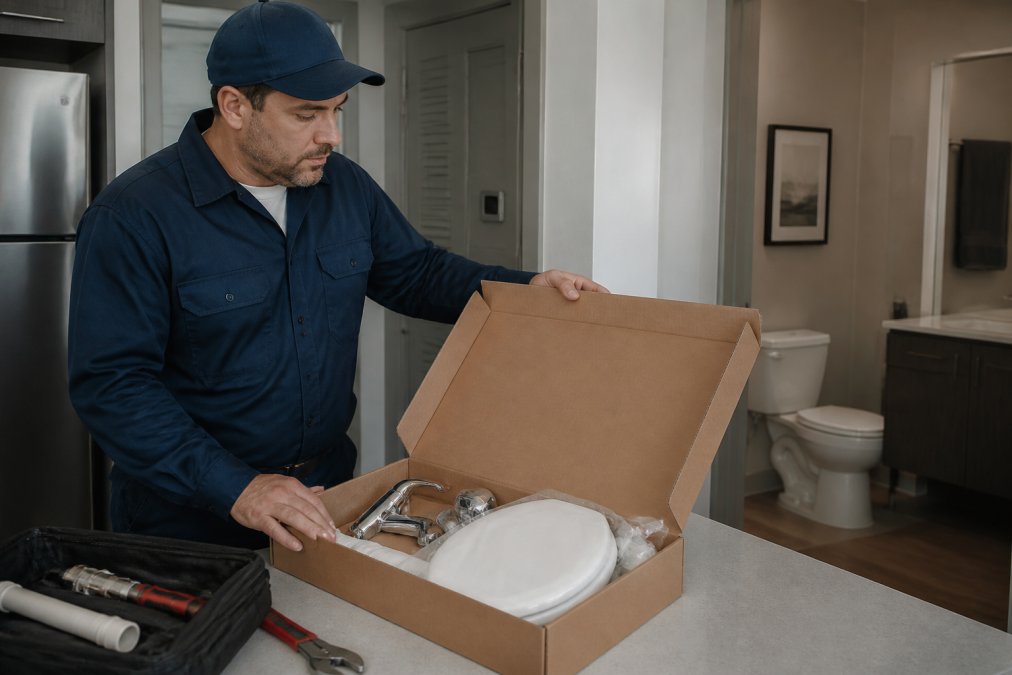
Complete Kit - Pro: Full Bathroom Turnover in One Box
The Complete Kit - Pro is the flagship bundle for teams wanting one SKU for an entire bathroom turnover, consolidating the components most often replaced during a unit turn so your technician pulls one box and finishes without a second trip.

Toilet, Sink, and Shower Kits - Pro: Targeted Repairs
Not every turn needs a full refresh. When the failure is isolated, targeted kits save money and stock space.
- Toilet Kit - Pro: covers the toilet-side components that fail most often, including the seat and internal parts.
- Sink Kit - Pro: faucet, drain assembly, and supply connections in one box.
- Shower Kit - Pro: showerhead, valve trim, and tub spout components matched to common rough-in layouts.
Individual components are also available when you need to restock a single item. The PROFLO 5 in. Integrated Diverter Tub Spout at $11.48 handles slip-fit installations on 1/2 in. pipe with no tools required. The Delta Faucet Classic Diverter Tub Spout at $71.08 is the OEM match when a Delta rough-in is already in the wall. For vanity replacements, the PROFLO Two Handle Centerset Faucet at $52.39 fits standard 3-hole configurations, while the Delta Ara Single Handle Monoblock Faucet at $260.38 suits higher-tier finishes. The TOTO SoftClose Elongated Toilet Seat at $71.05 rounds out the toilet-side catalog.


Bathroom Repair Labor Cost Estimates 2026
Bathroom repair labor cost estimates in 2026 depend less on the posted hourly rate than on how many billable hours a job consumes. The hidden cost is the time between work order and rent-ready unit, and in a multifamily portfolio, that time multiplies across every door you turn.
The Burdened Rate, Not the Hourly Rate
When you budget labor for a unit turn, the number that matters is the burdened rate: base wage plus payroll taxes, workers' compensation, benefits, and truck, tool, and dispatch overhead. A technician earning $22-$28 an hour can cost a portfolio $35-$45 an hour fully burdened; a third-party plumbing contractor can run $95-$150 an hour in most metro markets, plus a minimum trip charge (bls.gov).
That distinction changes the math. If a bundle saves 45 minutes of sourcing per turn, it can recover loaded labor per door, before counting the value of the earlier rent-ready date.
Where Labor Hours Actually Go on a Multifamily Unit Turn
A typical unit turn can break down closer to this:
- Diagnosis and inspection: 20-30 minutes
- Parts sourcing (store run or warehouse pull): 30-90 minutes
- Actual repair work: 45-90 minutes
- Cleanup and verification: 15-30 minutes
- Callback risk if the wrong part was pulled: 60+ minutes
The store run is a controllable block, and one a bundle kit can directly remove from the technician's day.
Per-Door Labor Cost by Turn Type
Labor cost per door varies sharply by repair scope:
| Turn Type | Typical Labor Hours | Burdened Cost at $40/hr |
|---|---|---|
| Faucet or spout swap only | 0.5-1.0 | $20-$40 |
| Toilet rebuild (fill valve, flapper, seat) | 1.0-1.5 | $40-$60 |
| Sink and drain assembly replacement | 1.5-2.0 | $60-$80 |
| Full bathroom turnover (all three fixtures) | 3.0-4.5 | $120-$180 |
Add the sourcing block to any row and the per-door cost climbs by $20-$60.
Why Multifamily Labor Math Differs From Single-Family
A single-family remodel prices labor per project; a multifamily portfolio prices it per door, per turn, per year. The difference is repetition. A 200-unit property turning 40% of its doors annually runs 80 turns a year. Shaving 45 minutes of sourcing off each can recover 60 hours, roughly a week and a half of a full-time technician, without changing a single hourly rate.
A 15-20% parts discount on a $60 kit is $9-$12; the same kit that removes a store run can be worth $20-$60 in loaded labor.
When to Use In-House Labor vs. a Contractor
Routine fixture swaps, toilet rebuilds, and seat replacements can be kept in-house, because the parts are standardized and the work repeatable. Anything touching the rough-in, valve replacement behind the wall, drain line work, or a tub-to-shower conversion, can be routed to a licensed contractor. Bundle kits are built for the first category, where the volume and repeatable labor savings live.
Multifamily Unit Turnover Cost Reduction: The ROI Math
Multifamily unit turnover cost reduction can come from three levers: fewer store runs, fewer callbacks, and faster room restoration. A bundle can address all three by removing the sourcing step and standardizing parts so the first pull is the right pull, and the ROI can run beyond labor hours to rent, vacancy loss, and property value.
The Three Cost Buckets a Turn Creates
Every unit turn carries costs, and some portfolios track only the first:
- Direct repair cost, parts plus labor for the fixtures being replaced.
- Vacancy loss, the rent you do not collect for every day the door sits empty.
- Turnover friction, the leasing cost of re-renting, plus the risk of a prospect walking because the unit was not ready.
The bundle kit can address bucket one directly and bucket two indirectly, because a faster turn can mean fewer vacant days.
Vacancy Loss Is the Number That Dominates
Run the math on a single door. A unit renting for $1,500 a month can lose roughly $50 a day while vacant, so a turn taking 10 days instead of 7 can cost about $150 in vacancy alone, more than the entire parts cost of a standard bathroom bundle (hud.gov).
Now scale it. A 200-unit property turning 80 doors a year, where a bundle shaves two days off each turn, can recover 160 door-days of rent, $8,000 annually at $50 a day, from a change costing nothing beyond the kit you were already buying.
Recovered Labor Hours, Priced Properly
Take turns per month, multiply by average labor hours per turn, and separate wrench work from sourcing and travel. The sourcing hours are your target: if a bundle cuts 45 minutes of sourcing per turn and you run 40 turns a month, that's 30 hours of technician time recovered monthly, roughly $1,200 a month in loaded labor at a $40 burdened rate.
That recovered time doesn't have to be a headcount reduction. Some portfolios redeploy it into preventive maintenance, reducing emergency calls and their premium rates.
Does a Bathroom Upgrade Raise Rent?
A bathroom refresh bringing a dated unit up to the building's prevailing standard can support a rent premium, because it removes an objection prospects use to negotiate down or walk. A refresh pushing a unit above the building's standard usually doesn't earn the premium back, because the comp set caps what the market will pay.
The practical framing: match the finish tier to the building, not the best unit in the portfolio. A standard chrome finish matching neighboring units supports the asking rent. A luxury finish in a mid-tier building is a cost you rarely recover.
The Cap Rate Connection
For an owner thinking about value, the ROI can run through net operating income. A bathroom bundle that reduces turn cost and shortens vacancy can raise NOI. At a market cap rate, a dollar of added NOI can be worth more than a dollar of one-time savings, because it's recurring.
A Simple ROI Worksheet
To build your own case, capture four numbers:
- Turns per year across the portfolio
- Average vacant days per turn
- Average monthly rent per unit
- Burdened labor rate
Multiply vacant days by daily rent by turns per year for vacancy loss. Multiply recovered sourcing minutes by turns per year by burdened rate for labor recovery. Add the two, subtract the bundle's incremental cost over à la carte parts, and you have a defensible ROI figure for an owner or asset manager.
Supply Chain and Lead Time Management for 2026
Supply chain discipline in 2026 means ordering kits ahead of the turn schedule, not after the work order is issued. Lead times on OEM-grade plumbing parts have stabilized, but popular SKUs can still go on backorder when demand spikes (census.gov).
Some property managers handle this with a two-tier stock model: a rolling buffer of complete kits at each property sized to one month of expected turns, plus a deeper central warehouse reserve for surge months. The buffer costs money in inventory, but less than a vacant unit waiting on a part.
Bulk orders also protect against price movement. Committing to a quarterly volume tier locks the per-unit rate for that period, making CapEx budgeting more predictable.
Matching Kits to Your Existing Fixture Brands and Layouts
Kit compatibility comes down to three variables: fixture brand, rough-in configuration, and finish tier. A kit matching all three installs in one pass; missing one creates a callback.
Before you standardize on any bundle, walk a sample of units and record the following for each bathroom:
- Faucet brand and model (Delta, Moen, PROFLO, BrassCraft, other)
- Sink hole configuration (1-hole monoblock vs. 3-hole centerset)
- Tub spout connection type (slip-fit vs. threaded IPS)
- Toilet seat shape (elongated vs. round)
- Finish (chrome, brushed nickel, other)
Once you have the inventory, match kit selection to the dominant configuration in each building. Properties with mixed fixture brands usually need two kit SKUs, not five, and standardizing on a single finish simplifies future orders and keeps replacement parts interchangeable between buildings.
Conclusion: Building a Bundle Strategy That Holds Up
The hard part of bundle pricing isn't picking a kit. It's committing to a stocking model that survives a busy turnover season without leaving you short on parts or long on dead inventory: matching kits to your actual fixture mix, sizing your buffer to real turn volume, and locking in volume tiers ahead of schedule.
Ready Bathroom Solutions provides pre-kitted, OEM-grade maintenance kits designed to streamline bathroom repairs for property professionals. By consolidating all necessary parts into a single box, our solution eliminates time-consuming store runs and reduces costly maintenance callbacks. Whether you manage hotels, apartments, or student housing, our standardized kits ensure consistent, high-quality installations that get your units back in service faster. Experience the efficiency of professional-grade maintenance with bundle savings that help you optimize your portfolio's operational costs. Get started with Ready Bathroom Solutions and turn your units faster with fewer callbacks.
Frequently Asked Questions
Are pre-kitted bathroom supplies more cost-effective than buying individual parts?
Pre-kitted bundles typically save 15-20% versus buying each part separately, because the supplier consolidates OEM-grade components from brands like Moen, Delta, and BrassCraft into one box. The bigger saving is labor: a technician no longer makes a store run mid-job, which eliminates 1-2 billable hours per repair. For a portfolio turning 40 units a month, that recovered time often outweighs the parts discount itself.
How do maintenance bundles impact unit turnover time?
Bundles cut turnover time by removing the parts-gathering step from each repair. When every kit contains the faucet, spout, seat, and fittings needed for a standard unit, the technician arrives with everything on the first visit. That reduces repeat trips for missing parts, which are a common cause of stalled turns. Properties using standardized kits report fewer callbacks because the same OEM-grade components go into every unit.
What is the 30% rule for renovations, and does it apply to maintenance bundles?
The 30% rule is a budgeting guideline for renovations, suggesting you reserve roughly 30% above your base estimate for surprises like hidden water damage or code issues. For bundle pricing, a benchmark is cost per unit turn, which you can track directly against your prior per-repair spend to see whether the bundle actually lowers your total.
How much should a bathroom remodel cost in 2026 for a multifamily unit?
A cosmetic refresh in a multifamily unit typically runs far less than a full gut remodel, since it skips demolition, plumbing rough-in, and tile installation. Property managers often use targeted repairs: vanity replacement, fixture upgrades, toilet seats, and tub spouts. Bundle pricing on those components is what keeps per-unit spend predictable across a portfolio, rather than quoting one-off remodel figures.
Will pre-kitted repair bundles work across properties with different fixture brands?
Kits are built around standard connections, so a slip-fit tub spout or a centerset faucet fits the common configurations found in most multifamily and hospitality units. The practical step is to inventory your buildings by fixture type before standardizing. If a property uses single-hole vanities, match it to the right faucet kit; if it uses three-hole, choose that variant. Standardizing on one or two kit types per property keeps stock simple.