

Table of Contents
- Quick Comparison: Top 5 Commercial Bathroom Maintenance Tools
- 1. Fluidmaster Pro Series Adjustable Fill Valve
- 2. Fluidmaster PRO57A 2 in. Adjustable Flush Valve with Flapper
- 3. Fluidmaster PerforMAX High Performance Toilet Tank Fill Valve
- 4. Fluidmaster Better Than Wax Rubber Toilet Seal
- 5. Jones Stephens 5/16 x 3 in. Brass Plated Closet Bolt Kit
- Building a Commercial Plumbing Maintenance Checklist
- Reducing Maintenance Callbacks with Standardized Parts
- Frequently Asked Questions
Last Updated: October 3, 2026
Quick Comparison: Top 5 Commercial Bathroom Maintenance Tools
The top 5 commercial bathroom maintenance tools for 2026 are the Fluidmaster Pro Series Adjustable Fill Valve, the Fluidmaster PRO57A Adjustable Flush Valve with Flapper, the Fluidmaster PerforMAX High Performance Fill Valve, the Fluidmaster Better Than Wax Rubber Toilet Seal, and the Jones Stephens Brass Plated Closet Bolt Kit.

At Ready Bathroom Solutions, we build pre-kitted, OEM-grade repair sets around exactly these components, so facility teams stop chasing individual parts and start closing work orders. A commercial bathroom maintenance program lives or dies on having the right part on the truck before the work order is written.
Here's the thing most guides miss: the parts below are inexpensive. The cost is in the labor hours and the second trip. Standardizing on a short list of proven components is what actually shortens unit turns.
| Tool | Part Type | Price | Best For |
|---|---|---|---|
| Fluidmaster Pro Series Adjustable Fill Valve | Fill valve | $10.82 | General tank refill repairs |
| Fluidmaster PRO57A Adjustable Flush Valve | Flush valve | $10.44 | Weak or inconsistent flushes |
| Fluidmaster PerforMAX Fill Valve | Fill valve | $16.55 | High-traffic restrooms |
| Fluidmaster Better Than Wax Rubber Seal | Toilet seal | $4.49 | Pull-and-reset jobs |
| Jones Stephens Brass Plated Closet Bolt Kit | Closet bolts | $8.58 | Loose or corroded bowls |
1. Fluidmaster Pro Series Adjustable Fill Valve
The Fluidmaster Pro Series Adjustable Fill Valve is the workhorse of commercial toilet repair. It refills the tank fast and quietly after every flush, and its height adjusts from 9 in. to 14 in. to fit many standard tank sizes.

That adjustability matters more than it sounds. Commercial properties rarely run one toilet model across every unit. A single fill valve that spans most tank heights means your technicians carry one SKU instead of three.
At $10.82, it's the part we reach for first on a running-toilet call. Replace the fill valve before you suspect anything else, because a worn fill valve is the most common cause of a toilet that won't stop running.
2. Fluidmaster PRO57A 2 in. Adjustable Flush Valve with Flapper
When a toilet flushes weakly or inconsistently, the flush valve is usually the culprit. The Fluidmaster PRO57A Pro Series 2 in. Adjustable Flush Valve with Flapper delivers consistent flush performance, and its adjustable design fits a variety of tank configurations.

This is the part that separates a one-flush fix from a repeat visit. A worn flapper lets water seep into the bowl between uses, which shows up as a running toilet and a higher water bill. Replacing the flush valve and flapper together costs $10.44 and takes minutes.
Pair it with the fill valve above on any toilet that's more than a few years old. Doing both at once is cheaper than two separate service calls.
3. Fluidmaster PerforMAX High Performance Toilet Tank Fill Valve
High-traffic restrooms punish standard parts. The Fluidmaster PerforMAX High Performance Toilet Tank Fill Valve is built for exactly that environment: fast, quiet tank refill with a fully adjustable height that fits most standard tank sizes. It runs $16.55.
We recommend the PerforMAX for lobbies, public restrooms, and any fixture seeing constant use. The extra cost over a standard fill valve is small next to the labor saved when a fixture stops cycling correctly during peak hours.
4. Fluidmaster Better Than Wax Rubber Toilet Seal
Any time you pull a toilet, you need a new seal. The Fluidmaster Better Than Wax Rubber Toilet Seal creates a watertight, odor-proof barrier between the toilet base and the floor flange, and the rubber construction resists compression and cracking over time. It fits both 3 in. and 4 in. waste lines and costs $4.49.
Rubber beats wax on commercial jobs for one practical reason: it tolerates a reset. If a bowl has to come up again, a wax ring is spent. The rubber seal holds its shape.
Keep one on every service vehicle. A seal is a small line item that turns a two-trip repair into a single visit.
5. Jones Stephens 5/16 x 3 in. Brass Plated Closet Bolt Kit
A rocking or loose toilet usually traces back to corroded closet bolts. The Jones Stephens 5/16 x 3 in. Brass Plated Tank Bolt Set with Wing Nut provides a strong, stable anchor for toilet-to-flange installation, sized for standard closet flanges, with all necessary fasteners included. It lists at $8.58.
Corroded bolts snap during removal more often than technicians expect. Carrying a spare kit means a snapped bolt doesn't turn a 20-minute job into a parts run. For lighter-duty resets, the PROFLO 1/4 x 2-1/4 in. Brass Plated Closet Bolts at $0.72 do the same job at a fraction of the cost.
Building a Commercial Plumbing Maintenance Checklist
A commercial plumbing maintenance checklist is a standardized, repeatable list of inspections and part replacements performed on a set schedule across every restroom in a portfolio.
Fill Valve / Flush Valve - Fluidmaster Pro Series™ Adjustable Fill Valve →
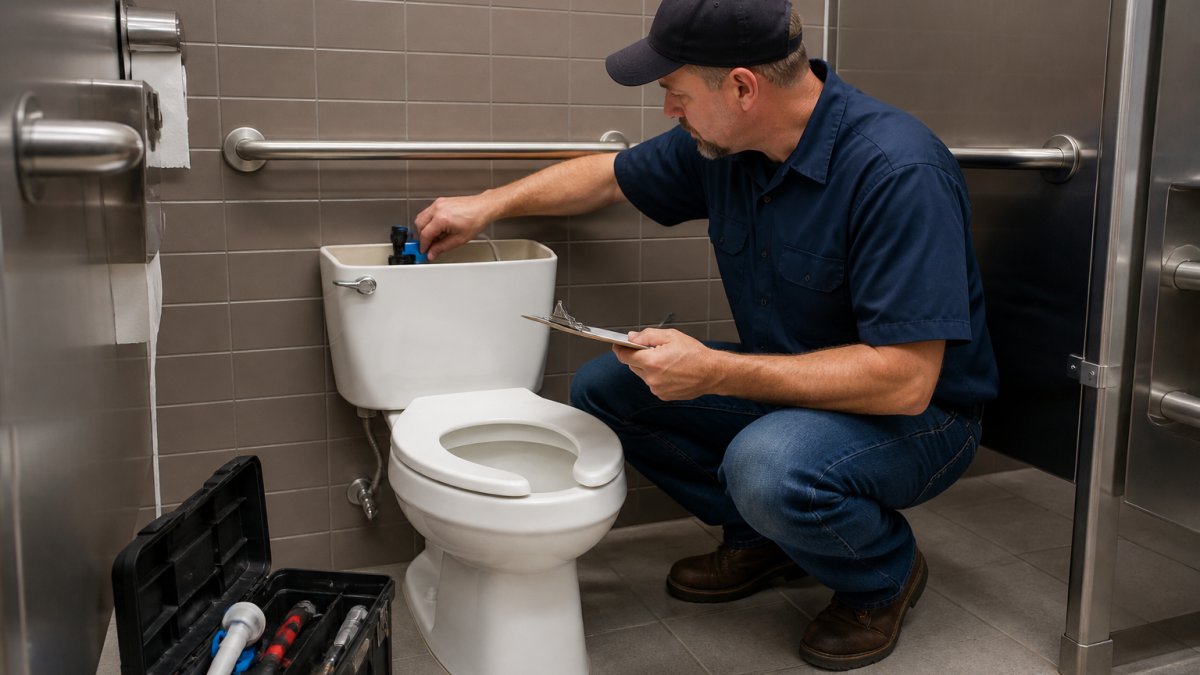
Build the schedule around fixture traffic, not the calendar. A restroom in a stadium, airport, or big-box store cycles a fill valve hundreds of times a day; a back-office restroom on a single shift cycles it a fraction of that. Same part, different wear curve. Set the cadence by traffic tier:
- High-traffic (public, 500+ flushes/day): Daily fixture sweep, weekly valve inspection, quarterly full rebuild of fill and flush valves, annual pull-and-reset with new seals.
- Medium-traffic (retail, restaurant, 100-500 flushes/day): Daily sweep, monthly valve inspection, semi-annual rebuild, annual pull-and-reset.
- Low-traffic (office, 100 or fewer flushes/day): Weekly sweep, quarterly valve inspection, annual rebuild, pull-and-reset on failure or every 24 months.
Now map each line item to the tool or part that resolves it. A checklist without a stocked part behind it is just a list of problems:
- Daily: Confirm every fixture flushes and drains; log running toilets, slow drains, and any bowl that rocks. Tool: flashlight and a log sheet. A rocking bowl is a closet-bolt problem, not a cleaning problem.
- Weekly (high-traffic) / monthly (medium): Listen for a hissing fill valve and watch the tank for phantom refills between uses. A flapper that seeps shows up as a toilet that tops itself off when no one is in the room. Tool: the fill valve and flush valve on your standard parts list.
- Monthly: Check supply lines and angle stop valves for weeping; test flush volume by timing the refill. Tool: adjustable wrench and replacement supply line.
- Quarterly: Inspect fill and flush valves for mineral scale and flapper deformation; check closet bolts for corrosion. Tool: replacement flapper, fill valve, and a spare closet bolt kit.
- Annually: Pull and reset fixtures with new seals; replace aging fill valves on a set cycle regardless of apparent function. Tool: rubber toilet seal and fill valve.
The quarterly tier is where most programs fall short. According to the U.S. Environmental Protection Agency's WaterSense program, a leaking toilet can waste a significant volume of water per day, and a failing flapper is the most common source.
Two scheduling rules keep the checklist honest. First, tie every recurring task to a specific part on the truck, if the task can't be completed on the first visit, it doesn't belong on the daily or weekly tier.
Reducing Maintenance Callbacks with Standardized Parts
Standardized parts are the fastest lever for reducing maintenance callbacks.
Run the numbers on a single callback. A technician dispatched to a running toilet typically burns travel time, diagnostic time, the repair itself, and a return trip if the wrong part is on the truck.
Cost-per-use makes the case sharper. A commercial-grade fill valve that survives years of high-cycle service has a lower cost-per-use than a cheaper residential-grade valve that fails in a fraction of the cycles, even though the sticker price is higher. The same logic applies across the tool set:
- Fill and flush valves: Commercial-grade units are built for higher cycle counts. On a high-traffic fixture, the cheaper valve is the more expensive choice because it fails sooner and pulls labor with it.
- Rubber toilet seals: A seal that tolerates a reset can be reused if a bowl has to come up again; a wax ring is spent on the first pull. On any job where a second reset is possible, the rubber seal wins on cost-per-use.
- Closet bolt kits: Brass-plated bolts resist corrosion longer than untreated hardware, which matters in restrooms with frequent cleaning and moisture. A snapped bolt during removal is the classic one-part, one-trip failure.
- Cleaning tools: Commercial-grade squeegees, scrubbers, and grout brushes hold up to daily chemical exposure and heavy use far longer than residential equivalents. A tool that survives a year of daily shifts beats three that fail in the same window.
This is where bulk maintenance supply management pays off. Ordering a known set of OEM-grade parts in kits removes the two biggest sources of repeat visits: the wrong part and the missing part.
According to the U.S. General Services Administration's guidance on facility maintenance, planned, standardized maintenance reduces unplanned failures compared with reactive repair. The same logic applies at the unit level: a stocked kit beats a store run every time.
There is a sustainability angle here too.
Ready Bathroom Solutions builds pre-kitted, OEM-grade repair sets around these exact components, consolidating everything a technician needs into one box.
Frequently Asked Questions
What tools are essential for commercial restroom maintenance?
The essentials fall into two groups: cleaning tools and repair parts. For cleaning, you need a cordless scrubber, squeegee, microfiber cloths, and a commercial-grade surface disinfectant. For repairs, carry fill valves, flush valves with flappers, wax rings or rubber toilet seals, closet bolt kits, and PTFE thread tape. Ready Bathroom Solutions offers pre-kitted sets that bundle these OEM-grade parts from brands like Fluidmaster, PROFLO, and Jones Stephens, so your team never makes an emergency supply run.
How can property managers reduce bathroom repair callbacks?
Callbacks usually happen when a repair uses the wrong part or an inferior one. Standardizing on OEM-grade components like Fluidmaster fill valves and PRO57A flush valves removes that guesswork. Pair standardization with a commercial plumbing maintenance checklist that covers fill valve height adjustment, flapper seating, and seal integrity. When every technician installs the same proven part the same way, reducing maintenance callbacks becomes a predictable outcome rather than a hope.
What is the best way to organize commercial plumbing maintenance supplies?
Use pre-kitted bundles organized by repair type: one kit for fill valve replacements, one for flush valve swaps, one for toilet reseating. Each kit should contain every part needed for that job, including the wax ring, closet bolts, and PTFE tape. This approach eliminates partial repairs caused by missing pieces. For bulk maintenance supply management, keep a par-level system where each property reorders when kit inventory drops below a set threshold.
Are pre-kitted maintenance solutions cost-effective for hotels?
Pre-kitted solutions cut two costs: parts and labor. Individual components from Ready Bathroom Solutions range from $0.72 for closet bolts to $16.55 for a PerforMAX fill valve, and bundle pricing saves 15 to 20 percent. The bigger savings come from labor. A kit that eliminates one store run per repair saves 30 to 60 minutes of technician time. Across a multi-property portfolio, that adds up to faster room turns and fewer after-hours emergency calls.
What are the most common commercial bathroom repair issues?
Running toilets from worn fill valves, weak flushes from degraded flappers, and leaking bases from compressed wax rings top the list. Scale buildup on flush valve seals and loose closet bolts round out the most frequent problems. Each of these has a straightforward fix with the right part: an adjustable fill valve, a 2 in. flush valve with flapper, a rubber or wax toilet seal, and a closet bolt kit. Keeping these five items stocked covers roughly 80 percent of routine calls.