

Last Updated: November 1, 2026
Quick Summary
In-house apartment maintenance gives you direct control over technicians, schedules, and quality but carries fixed payroll, benefits, and turnover costs. Outsourcing converts those costs to variable contract rates and adds specialized trades, but reduces day-to-day control. The right choice depends on portfolio size, unit age, labor availability, and work order volume.
- Compare loaded cost per productive hour and cost per unit per year, never wage versus contract rate.
- A single technician departure can push overtime and contractor spend above a second hire's cost for months.
- Run the cost model property by property, since a 300-unit property may justify two technicians and a 90-unit property none.
- Strong SLAs define priority tiers with clock-start rules, separate response from resolution, and attach fixed remedies.
- Many portfolios keep one in-house technician for routine work and outsource specialized and overflow jobs.
Table of Contents
- In-House vs Outsourced Apartment Maintenance: The Core Trade-Off
- Comparing In-House and Outsourced Maintenance at a Glance
- What In-House Maintenance Team Costs Really Look Like
- Pros and Cons of Each Staffing Model
- Apartment Maintenance Vendor Checklist for Evaluating Providers
- Property Maintenance Procurement Best Practices
- Building a Maintenance Service Level Agreement That Works
- Stocking Bathroom Repair Kits to Support Either Model
- Frequently Asked Questions
In-House vs Outsourced Apartment Maintenance: The Core Trade-Off
The in-house vs outsourced apartment maintenance decision comes down to one trade-off: control versus capacity. An in-house team gives you direct oversight of technicians, schedules, and quality, but you carry the full weight of recruiting, payroll, benefits, and turnover.
Neither model wins universally. The right answer depends on portfolio size, unit age, labor availability, and how much of your maintenance load is predictable bathroom and fixture work versus emergency repair.
Comparing In-House and Outsourced Maintenance at a Glance
Here is the short version before the detail. In-house maintenance is a fixed-cost staffing model you control directly. Outsourced maintenance is a variable-cost vendor model you manage through contracts and service level agreements.
| Factor | In-House Team | Outsourced Provider |
|---|---|---|
| Cost structure | Fixed payroll, benefits, overhead | Variable contract and hourly rates |
| Control and oversight | Direct, day-to-day | Indirect, through SLAs |
| Response time | Depends on staffing depth | Defined in contract terms |
| Hiring burden | Fully yours | Vendor's responsibility |
| Scalability | Slow, tied to headcount | Fast, tied to contract |
| Specialized skills | Limited to staff hired | Broader trade coverage |
| Resident experience | Familiar, consistent faces | Varies by vendor assignment |
The table hides the tension. Fixed costs feel safer in a stable portfolio and become a trap during vacancy dips. Variable costs feel flexible until an emergency after-hours call arrives with a premium attached.
What In-House Maintenance Team Costs Really Look Like
The biggest mistake property managers make is comparing an in-house technician's hourly wage to a contractor's hourly rate. The wage is only the visible slice of a much larger cost stack.
An in-house maintenance team costs include far more than base pay:
- Payroll taxes and workers' compensation
- Health insurance and retirement contributions
- Paid time off and holiday coverage
- Tools, equipment, and vehicle costs
- Training and certification
Build a fully loaded cost per technician that reflects all of these, then divide by billable maintenance hours.
A Per-Unit Cost Framework You Can Actually Run
Most comparisons stop at "loaded hourly rate," which still does not tell you what maintenance costs per unit per year, the number that belongs in your budget. Build the model in four layers:
- Fully loaded labor. Take base wage, add payroll taxes and workers' comp, benefits and PTO, training and certification, then a recruiting allowance for expected turnover. Divide by productive hours (total paid hours minus PTO, training, and travel) for your true cost per productive hour.
- Tools, vehicles, and equipment. Allocate vehicle lease or mileage, fuel, tool replacement, and diagnostic equipment across the team. A service van with fuel and insurance commonly runs several hundred dollars a month before any repair parts.
- Management and scheduling overhead. A maintenance supervisor's time, work order software seats, and dispatch coordination are real costs that rarely get assigned to the maintenance line item.
- Vacancy and overtime drag. When a technician leaves, you pay recruiting costs and overtime to cover the gap, which in tight labor markets can stretch for weeks. That downtime rarely appears in a simple cost comparison.
Sample Calculation: One Technician, One Property
Here is a transparent framework using round, illustrative figures, substitute your own market data:
- Base wage: $25/hour × 2,080 paid hours = $52,000
- Payroll taxes and workers' comp at roughly 20% = $10,400
- Health, retirement, and PTO at roughly 25% = $13,000
- Training, certification, and tools = $3,500
- Recruiting allowance for turnover = $2,500
Now divide by productive hours to find your true cost per productive hour, then divide the annual cost by the number of units the technician covers.
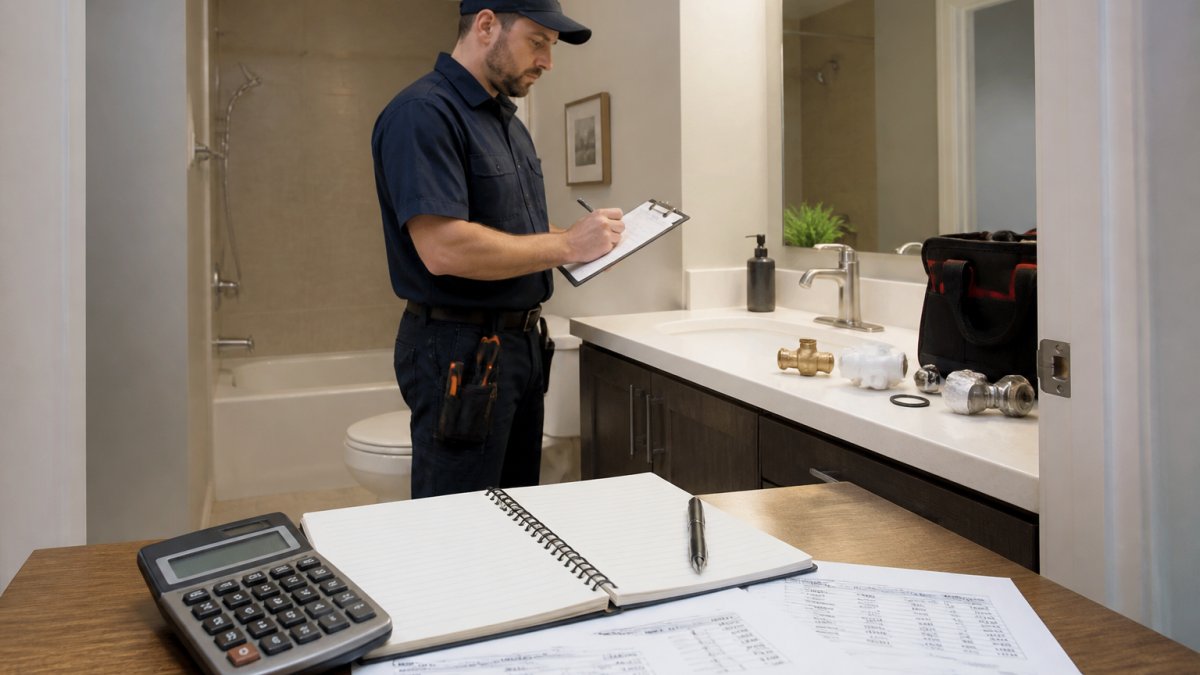
What the Model Reveals
The per-unit framework does two things a wage comparison cannot. First, it shows the break-even point: if your outsourced spend per unit per year is below your loaded in-house cost per unit, outsourcing is cheaper on pure dollars, before you weigh control and response time. Second, it exposes the vacancy trap.
Run the model property by property, not portfolio-wide. A 300-unit property with aging bathroom stock and heavy work order volume may justify two in-house technicians, while a 90-unit property a mile away may not justify one.
Pros and Cons of Each Staffing Model
Weighing the pros and cons means being honest about where each approach breaks, not just listing benefits.
In-house maintenance pros:
- Direct oversight of quality and scheduling
- Faster routine response when staff are on site
- Consistent faces for residents, which builds trust
- Full control over preventive maintenance calendars
In-house maintenance cons:
- Fixed labor costs regardless of work volume
- Recruiting and training burden falls entirely on you
- Limited specialized skills for complex trades
- Coverage gaps during vacation, illness, or turnover
Outsourced maintenance pros:
- Variable costs that scale with actual work
- Access to specialized trades and equipment
- No recruiting, benefits, or payroll overhead
- Contract terms can define response standards
Outsourced maintenance cons:
- Less day-to-day control over quality
- Contract rates bundle vendor margin into every job
- Response time depends on the vendor's other commitments
- Accountability requires active vendor management
The honest read: in-house wins on control and resident relationships, outsourcing wins on flexibility and specialized capability. Neither wins on cost without context.
Apartment Maintenance Vendor Checklist for Evaluating Providers
A vendor checklist is the tool that separates a good provider from a cheap one. Readers comparing maintenance vendors can also explore an alternative provider option for property maintenance. Use these criteria before signing anything.
- Licensed and insured, with certificates on file
- Defined response times for routine, urgent, and emergency calls
- After-hours coverage terms and premium rates in writing
- Documented work order and reporting process
- Named account manager and escalation path
The checklist matters more than the pitch.
Property Maintenance Procurement Best Practices
Procurement is a common area where maintenance costs can add up. Standardizing what you buy is one way to manage them.
Standardize parts across the portfolio. When every unit uses different fixture brands and cartridges, your team stocks dozens of variants.
Buy in kits, not one-offs. Pre-assembled repair kits can reduce store runs by consolidating the parts a technician needs into a single box.
Track cost per completed work order. This metric helps compare vendors on total cost rather than hourly rate.
Review vendor performance quarterly. Procurement decisions should follow data, not relationships. Readers sourcing maintenance supplies can consult a supplier review to inform procurement decisions.
Building a Maintenance Service Level Agreement That Works
A maintenance service level agreement is only useful if its standards are measurable. Vague language like "prompt response" protects no one, and in apartment operations a running toilet or failed water heater is a habitability issue, not a convenience.
Build the SLA around four measurable terms:
- Response time by priority. Define routine, urgent, and emergency separately, with clock-start rules. Common apartment frameworks set emergency, urgent, and routine response windows separately.
- Resolution targets. Response is not repair. Set separate targets for time to complete, and define what counts as complete, resident-confirmed, photo-documented, or inspected.
- After-hours standards. Specify coverage windows and premium rates. State whether after-hours calls route to a live dispatcher or a voicemail box.
- Reporting cadence. Require work order logs and performance summaries, with a defined data format so you can compare vendors side by side.
Apartment-Specific Terms Most SLAs Miss
General facilities SLAs rarely address the realities of occupied units. Add these clauses:
- Resident access and notice. Define how technicians request entry, what notice residents receive, and how failed access attempts are documented and recharged.
- Background checks and badging. Require background screening for any technician entering occupied units, and require badges or photo ID visible on site.
- Unit turn standards. Set a separate completion target for make-ready turns, since turn speed directly drives leasing revenue.
- Common area and grounds. Define response targets for common-area repairs separately from unit work orders, because resident perception of the property is shaped by shared spaces.
- Parts and sourcing. State whether the vendor may substitute non-OEM parts and who bears the cost of a callback caused by a failed part.
Escalation Paths and Remedies
An SLA without a remedy clause is a suggestion. Define the escalation ladder in writing: a first miss triggers written notice, repeated misses trigger a service credit or performance review, and sustained failure triggers termination rights. Specify the credit as a percentage of monthly contract value or a fixed per-incident amount so there is no negotiation at the moment of failure.
Measuring the SLA in Practice
Track three numbers monthly: percentage of work orders meeting response target, percentage meeting resolution target, and callback rate within 30 days. A vendor that hits response targets but generates frequent callbacks warrants closer review. Review these numbers quarterly with the vendor's named account manager, and tie renewal decisions to the trend, not the relationship.
Stocking Bathroom Repair Kits to Support Either Model
Bathroom repairs are a common source of work orders in apartment portfolios. Leaking faucets, running toilets, and worn cartridges are the repeat offenders, and the jobs that generate callbacks when the wrong part shows up.
Whether you run in-house or outsourced, pre-kitted bathroom repair sets can reduce mid-job supply runs by putting the parts for a job in one box. For guidance on OEM parts quality for maintenance work, see the Moen Pro review.
Our own bathroom repair kits consolidate OEM-grade parts from brands like Moen, Delta, and BrassCraft into one box.
The hybrid model deserves a mention.
The in-house vs outsourced apartment maintenance decision rarely has a single right answer, but the execution around it does.
Frequently Asked Questions
Is it cheaper to hire an in-house apartment maintenance team or outsource repairs?
It depends on unit count and call volume. In-house teams carry fixed costs: wages, benefits, tools, vehicles, and training. Outsourcing turns those into variable costs per work order. For small portfolios, vendors often cost less overall. For large communities with steady daily work, in-house staff can cost less per unit. Run a side-by-side budget using your actual work order history and local hourly rates before deciding.
Which apartment maintenance tasks should be handled in-house?
Keep tasks that require daily presence and resident trust in-house: emergency leaks, lockouts, safety inspections, and routine unit turns. These need fast response and familiarity with the property. Outsource specialized work like HVAC certification, elevator repair, and major plumbing. A hybrid model works well: in-house staff handle first response and small repairs, while licensed vendors cover code-sensitive or high-risk jobs.
How can property managers evaluate an apartment maintenance vendor?
Use a structured checklist: licensing and insurance, response time guarantees, after-hours coverage, technician credentials, work order tracking, and references from similar properties. Ask for sample reports and confirm how they handle resident communication. A vendor that cannot show measurable performance data on response time and callback rates is a risk. Compare at least three vendors against the same criteria.
What should a maintenance service level agreement include for an apartment property?
A strong maintenance service level agreement defines response and resolution times by priority, after-hours coverage, reporting frequency, and penalties for missed targets. Include scope of work, parts sourcing rules, and resident access protocols. Specify how emergencies are handled and who pays for repeat visits. Review the agreement quarterly against actual performance data to keep the vendor accountable.
