

Table of Contents
- Why Property Managers Look Beyond AlloraUSA
- Property Maintenance Procurement Best Practices
- How Pre-Kitted Solutions Compare to Buying Individual Parts
- Maintenance Kit Benefits for Property Managers
- Reducing Maintenance Callbacks in Multifamily Housing
- Total Cost of Ownership: The Math Behind Pre-Kitted Procurement
- Supply Chain Resilience and Material Longevity for Property Portfolios
- Conclusion
- Frequently Asked Questions
Last Updated: September 23, 2026
Why Property Managers Look Beyond AlloraUSA
Property managers searching for an AlloraUSA alternative for property maintenance usually aren't chasing a better faucet. They're chasing fewer trips, fewer callbacks, and predictable parts across dozens or hundreds of units. That's the real gap, and it's where Ready Bathroom Solutions built its business.
The problem is structural. When every unit gets repaired with whatever part is on the shelf that week, maintenance teams burn labor hours on store runs and rework. According to [the U.S.
Property Maintenance Procurement Best Practices
The best property maintenance procurement strategy standardizes what you buy, centralizes how you buy it, and measures cost per completed repair rather than cost per part. Most portfolios do the opposite: they negotiate hard on unit price and ignore the labor attached to every purchase.
Three practices separate efficient portfolios from chaotic ones:
- Standardize on a fixture specification so any technician can install any replacement without a second trip.
- Centralize purchasing so pricing and stock levels are visible across every property.
- Track callbacks as a procurement metric, not just a maintenance metric.
Centralized Purchasing and Fixture Standardization
Centralized purchasing means one team negotiates and controls supply across the portfolio. Fixture standardization means every bathroom in a given unit class uses the same compatible components. Together they turn maintenance from a reactive scramble into a scheduled process.
How Pre-Kitted Solutions Compare to Buying Individual Parts
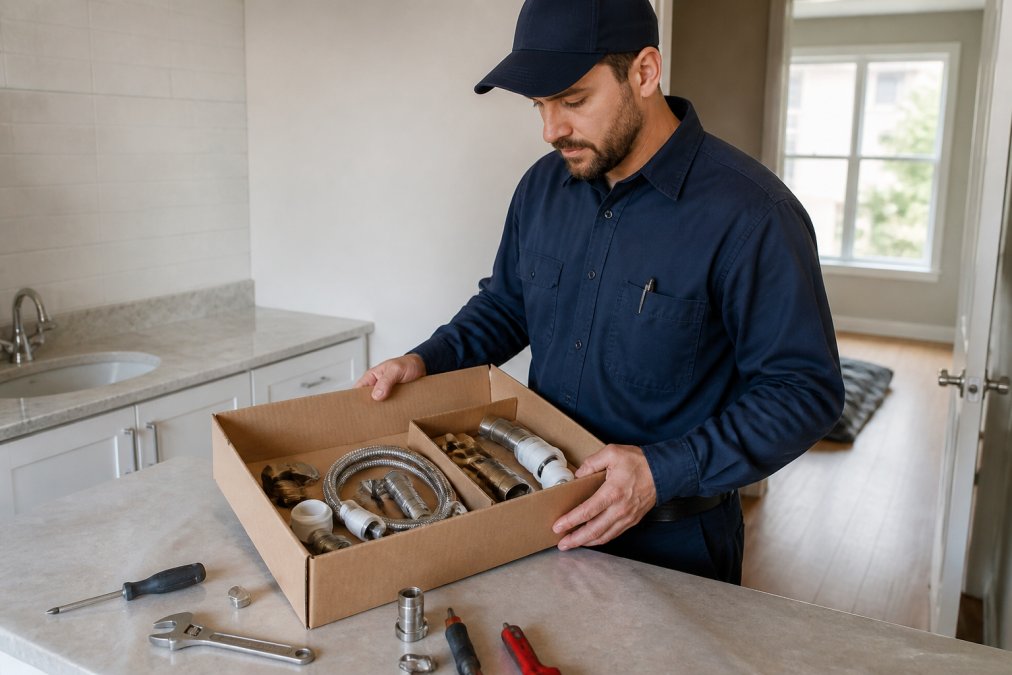
Pre-kitted solutions bundle every component a repair needs into one box, while individual part buying spreads the same job across several suppliers and store visits. The difference shows up in labor, not in the sticker price.
| Approach | Time to Complete Repair | Callback Risk | Stock Control |
|---|---|---|---|
| Individual parts, ad hoc | Multiple trips, variable | Higher, mismatched parts | Low visibility |
| Pre-kitted box | Single visit | Lower, matched components | Predictable |
Maintenance Kit Benefits for Property Managers
The core benefit of a maintenance kit is that it removes decisions from the technician's day. Everything needed for the job arrives together, matched and ready to install.
- Fewer store runs and less windshield time per work order
- Consistent parts across every property, which simplifies training
- Faster unit turns when a bathroom is the bottleneck
- Less after-hours emergency purchasing at retail prices
Reducing Maintenance Callbacks in Multifamily Housing
Callbacks in multifamily housing usually trace back to one of three causes: the wrong part, an incompatible part, or a rushed first visit. All three are procurement problems wearing a maintenance costume.
- Match handle count and deck hole spacing to the existing fixture
- Keep one kit type per unit class to avoid mix-ups
- Log every callback and trace it to the part that failed
Total Cost of Ownership: The Math Behind Pre-Kitted Procurement
Total cost of ownership (TCO) for a maintenance part is not the invoice price. It is the part, the labor to install it, the trips required to complete the job, the cost of the unit sitting out of service, and the probability the same job comes back inside the warranty window. Most procurement teams track only the first line, which is why the cheapest part on the shelf so often turns out to be the most expensive decision in the building.
A Four-Line TCO Model You Can Run This Week
Build the model on a per-completed-repair basis, not a per-part basis. Four lines do the work:
- Acquisition cost, unit price plus freight, plus the administrative cost of issuing the purchase order and receiving the shipment.
- Installation labor, technician hours at your loaded rate (wages, benefits, vehicle, dispatch overhead). A single-visit job and a two-visit job differ by far more than the second trip's drive time.
- Downtime cost, lost rent or lost room revenue per day the unit is out of service, multiplied by the days the work order stays open.
- Rework cost, the callback rate for that part class, multiplied by the fully loaded cost of a return visit.
Why Hardware Durability Drives Maintenance Frequency
TCO and material choice are the same conversation. A fixture that fails early does not just cost its replacement price, it re-triggers every line in the model above. Every additional failure cycle adds a work order, a dispatch, a technician hour, and a stretch of downtime. Over a multi-year hold period, the difference between a durable, spec-grade component and a bargain substitute compounds into a materially different cost per unit per year.
Bathroom Faucet - Delta Faucet Ara® →
The Bridge to Your Maintenance Software
Here is the angle most procurement guides miss. Your maintenance software is only as good as the data feeding it. If every unit is repaired with a different part, your work order history cannot tell you which component actually fails, how often, or at what cost. Standardize the hardware and the software suddenly produces a clean signal: one part class, one failure curve, one TCO number you can defend to ownership.
Supply Chain Resilience and Material Longevity for Property Portfolios
Supply chain resilience for property managers is not about surviving a global disruption. It is about whether the part you specified last quarter is still on the shelf when a work order lands next quarter, and whether the fixture you installed survives years of turnover without becoming a repeat line item. Fragmentation is the enemy on both fronts, because every unique part you stock is another line item that can go out of stock.
Lead Times, Stockouts, and the Cost of a Missing Part
A stockout does not just delay a repair. It forces a decision: wait for the part and leave the unit out of service, or substitute a different part and break your specification. Both outcomes are expensive. The wait burns downtime cost. The substitution reintroduces the exact variability that standardization was supposed to eliminate.
Material Longevity: What Actually Holds Up
On the metal side, the same logic applies to faucet bodies and trim. Solid brass construction resists corrosion and holds up under repeated disassembly.
Building Resilience Into the Specification
Resilience is designed, not purchased. Three practices make a portfolio harder to disrupt:
- Standardize on a small number of spec-grade components so volume concentrates and stock depth improves.
- Qualify a primary and a secondary source for each standardized part so a single supplier's stockout does not stall turns.
- Track availability as a procurement metric, the same way you track price, so a part that is chronically backordered gets flagged before it becomes a crisis.
Conclusion
The hard part of bathroom maintenance isn't fixing the faucet. It's keeping parts, labor, and scheduling aligned across every property you manage, and that's where most portfolios quietly lose money.
Frequently Asked Questions
What should property managers look for in a maintenance supply vendor?
Prioritize vendors that offer spec-grade fixtures, OEM-grade components from names like Moen, Delta, and BrassCraft, and pre-kitted solutions that bundle everything for a repair into one box. Check whether the vendor supports centralized purchasing across multiple properties, provides portfolio-wide fixture standardization, and can document how their kits reduce labor hours and callbacks. Ask for references from properties your size and confirm return policies for unused stock before committing to recurring orders.
How do pre-kitted maintenance solutions compare to buying individual parts?
Buying individual parts means a technician identifies the failure, drives to a supplier, waits in line, and returns to the unit, often losing two or more hours per repair. Pre-kitted solutions package every component for a specific repair in one box, so the technician grabs the kit and completes the job in a single visit. Kits also prevent the wrong-part callback, where a technician discovers mid-repair that a fitting or gasket is missing. The trade-off is committing to standardized fixtures rather than one-off purchases.
How can standardized maintenance kits reduce unit turnover time?
Turnover stalls when a bathroom repair sits half-finished waiting on a part. Standardized kits put the faucet, supply lines, drain assembly, and seals in the technician's hands before the unit is vacated. That removes the store run and the second trip for a missing piece, so the bathroom is restored in one scheduled visit. Faster bathroom completion means the unit clears inspection sooner and returns to the rent roll with less vacancy loss.
Are there US-based alternatives for bulk property maintenance supplies?
Yes. Ready Bathroom Solutions supplies pre-kitted, OEM-grade bathroom repair sets with parts from Moen, Delta, and BrassCraft, sold as bundles with 15 to 20 percent savings versus buying components separately. Kits are designed for portfolio-wide consistency across multifamily, hospitality, and student housing properties. Pricing is published per kit, so purchasing managers can model landed cost per unit turn against current vendor pricing before switching any volume over.
Will a pre-kitted system work across properties with different fixture brands?
It depends on fixture standardization. If your portfolio already runs a mix of brands and hole configurations, start by auditing what is installed, then standardize new installations on one or two spec-grade models per fixture type. Ready Bathroom Solutions kits include options such as the Delta Faucet Ara single handle monoblock for 1-hole sinks and Moen or PROFLO centerset models for 3-hole configurations, covering the layouts most commonly found in rental units.