

Table of Contents
- Accor FlowTite 1/2 x 3/8 in. Angle Stop Valve: Verdict and Rating
- Product Specifications and Dimensions
- Installation Instructions for the Accor FlowTite Angle Stop Valve
- How to Operate Push-Pull Valves and the Role of a Push-Pull Valve Removal Tool
- Removing and Replacing Existing Valves Without Damaging Pipe
- Plumbing Maintenance Best Practices for Property Managers
- Long-Term Durability vs. Traditional Compression Valves
- Code Compliance and Insurance Implications
- Frequently Asked Questions
Last Updated: September 24, 2026
Accor FlowTite 1/2 x 3/8 in. Angle Stop Valve: Verdict and Rating
The Accor FlowTite 1/2 x 3/8 in. Push x OD Compression Pull Angle Supply Stop Valve in White provides reliable shutoff control for sink and toilet supply lines. At $8.45 from Ready Bathroom Solutions, it combines push-to-connect inlet technology with a compression outlet and a pull-style shut-off mechanism, which means one technician can swap a failed angle stop valve in minutes rather than scheduling a plumber. This review from Ready Bathroom Solutions covers the specifications, installation steps, removal process, and the code and insurance questions that most product listings skip entirely.

Quick Verdict:
| Category | Score |
|---|---|
| Ease of Installation | 9/10 |
| Durability | 8/10 |
| Compatibility | 8.5/10 |
| Value | 9/10 |
| Overall | 8.5/10 |
Product Specifications and Dimensions
The Accor FlowTite valve measures 1/2 in. on the push-to-connect inlet and 3/8 in. on the OD compression outlet, sized to fit standard residential supply connections. The white finish matches typical escutcheon and fixture aesthetics in bathrooms and kitchenettes.
What you get in the box:
- One angle stop valve, white
- 1/2 in. push-to-connect inlet (fits copper, PEX, and CPVC)
- 3/8 in. OD compression outlet for the fixture supply line
- Pull-style shut-off mechanism
- Manufacturer part number AFPO53XC
Where most listings stop at a spec sheet, the practical detail matters more: the 1/2 x 3/8 sizing is the standard combination for toilet and sink supply lines, so this valve drops into the majority of residential units without adapters.
Materials and Corrosion Resistance
The valve body is built for lead-free potable water service, which matters because supply stop valves sit on drinking water lines and must meet lead-free requirements under federal law. Corrosion resistance comes from the construction.
What most guides miss is that the failure point on cheap angle stops is rarely the body. It is the packing and stem. A pull-style mechanism reduces the number of wear surfaces compared with a multi-turn compression stem.
Flow Control and Water Pressure Rating
Flow control on this valve is full-port when open, meaning it does not restrict volume to the fixture. The pull mechanism gives you a quick, positive shutoff for repairs or emergency isolation without cranking a handle through multiple turns.
For water pressure rating, defer to the manufacturer's published specification for the AFPO53XC rather than assuming a number. Residential supply systems typically operate well within the range these valves are rated for, but if you are working on a commercial system with elevated pressure, verify the rating against your system design before installation.
Installation Instructions for the Accor FlowTite Angle Stop Valve
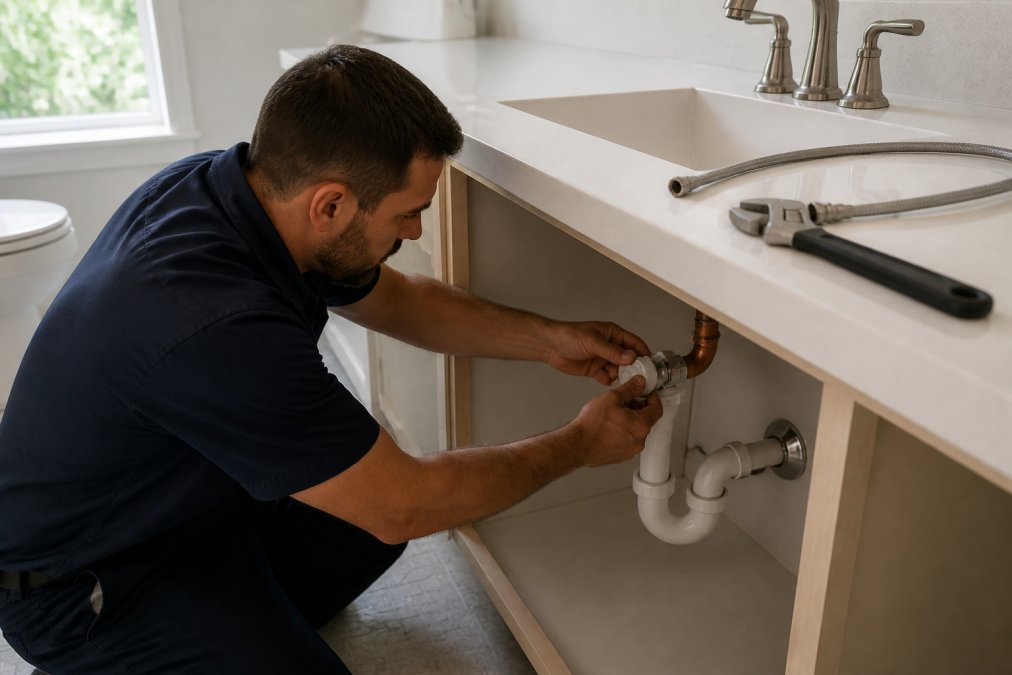
Installing this valve requires no soldering, no open flame, and no waiting for a joint to cool. The push-to-connect inlet slides onto prepared pipe and locks; the compression outlet threads onto the fixture supply line.
Tools Required for Installation
The installation tool list is short, which is the point:
- Tubing cutter or pipe cutter sized for the supply stub-out
- Deburring tool or fine abrasive pad
- Two adjustable wrenches (one to hold the valve body, one for the compression nut)
- Marker for depth reference
- Bucket and rag for residual water
Compatibility with Copper, PEX, and CPVC
Pipe compatibility is where push-fit technology earns its place in a maintenance kit. The 1/2 in. push inlet accepts copper tubing, PEX, and CPVC, so one part number covers the three supply materials you will actually encounter across a mixed portfolio.
| Pipe Material | Works With Push Inlet | Prep Required |
|---|---|---|
| Copper tubing | Yes | Cut square, deburr, no solder |
| PEX | Yes | Cut square, insert stiffener if required by fitting spec |
| CPVC | Yes | Cut square, chamfer cut edge |
How to Operate Push-Pull Valves and the Role of a Push-Pull Valve Removal Tool
Push-pull valves operate with a simple linear motion: pull the stem to shut off water, push it to restore flow. There are no multiple turns, no packing nut to tighten, and no handle to strip.
Angle Stop Valve - ACCOR TECHNOLOGY →
Operating sequence:
- Pull the stem outward to stop flow.
- Confirm shutoff by opening the downstream fixture.
- To restore service, push the stem fully inward until it seats.
- Check for weeping at the stem and both connections after restoring pressure.
Removing and Replacing Existing Valves Without Damaging Pipe
Removing an old valve without damaging the pipe is the step that separates a clean swap from an emergency repair. The copper stub-out is often the only pipe you have to work with, and a scored or crushed stub-out means opening the wall.
Step-by-step removal:
- Shut off the branch or building water supply and open the fixture to drain pressure.
- Place a bucket under the valve and crack the compression nut on the outlet side to drain residual water.
- Disconnect the fixture supply line from the 3/8 in. outlet.
- For the old inlet connection: if it is compression, hold the valve body with one wrench and back the nut off with the second. If it is a push-fit, slide the demounting tool onto the pipe, seat it against the fitting, and pull the valve free.
- Inspect the stub-out. Cut back and re-prep only if the pipe surface is scored, pitted, or out of round.
- Install the new valve, restore pressure, and check both connections.
Plumbing Maintenance Best Practices for Property Managers
Plumbing maintenance best practices for property managers come down to standardization: same valve, same procedure, same parts on every truck, so any technician can complete any unit turn without a supply run. That consistency is what shortens turnover time across a portfolio.
A working checklist for angle stop maintenance:
- Inspect every angle stop during unit turn, not just when it fails
- Test the shut-off mechanism by cycling it fully open and closed
- Look for corrosion, mineral buildup, or weeping at the stem
- Replace any valve that will not shut off completely on the first pull
- Standardize on one valve part number across all properties
- Stock valves in the maintenance shop, not at the supply house
- Log every replacement with unit number and date to spot repeat failures
Long-Term Durability vs. Traditional Compression Valves
Push-fit angle stops have fewer wear surfaces and no solder joint to fail compared to traditional compression valves. A compression valve relies on a brass ferrule crushed onto the pipe; over years of thermal cycling, that joint can weep. A push-to-connect fitting seals on an O-ring against a clean pipe surface and, done correctly, holds indefinitely.
Code Compliance and Insurance Implications
Code compliance and insurance implications are the two things property managers ask about last and should ask about first. Supply stop valves on potable water lines must be lead-free to comply with federal requirements for plumbing products in contact with drinking water, and push-fit fittings must be installed per the manufacturer's instructions to satisfy local plumbing code.
Frequently Asked Questions
What is the FlowTite push-pull valve?
The FlowTite push-pull valve is a type of angle stop valve that uses a push-to-connect fitting on one end and a compression fitting on the other. The Accor FlowTite 1/2 x 3/8 in. model connects to a 1/2-inch water supply line and a 3/8-inch OD compression tube. It controls water flow to fixtures like sinks and toilets, and its push-fit design allows installation without soldering or special tools.
How do I remove an Accor Flowtite valve?
To remove an Accor FlowTite valve, first shut off the main water supply and open the fixture to relieve pressure. Use a push-pull valve removal tool or a disconnect clip to release the push-fit connection. For the compression side, unscrew the nut with a wrench. Pull the valve away from the pipe. Inspect the pipe end for damage before installing a replacement. Always follow manufacturer instructions for your specific model.
What is the problem with plastic push-pull water valves?
Plastic push-pull water valves can crack over time, especially when exposed to high water pressure or temperature fluctuations. The internal O-rings may wear out, leading to leaks. Some older plastic models are not compatible with newer pipe materials. The Accor FlowTite valve is made from durable materials, but all valves require periodic inspection as part of plumbing maintenance best practices.
How to replace a push-pull water valve without special tools?
You can replace a push-pull water valve without special tools if you have an adjustable wrench and a disconnect clip. Shut off the water, disconnect the old valve using the clip, and clean the pipe end. Push the new Accor FlowTite valve onto the pipe until it clicks, then tighten the compression nut by hand plus a quarter turn. No soldering or pipe threading is needed. Always test for leaks after installation.
Are Accor FlowTite valves compatible with all pipe types?
Accor FlowTite valves are designed for compatibility with copper, PEX, and CPVC piping when the correct size and fitting type are used. The 1/2 x 3/8 in. model fits standard residential supply connections. However, not all push-fit valves work with every pipe material or diameter. Check the product specifications for your pipe type before purchase. If you are unsure, consult a licensed plumber.