

Table of Contents
- Why a Standardized Plumbing Maintenance Checklist Pays Off
- 1. Leak Detection and Under-Sink Inspection
- 2. Water Pressure Testing and the Pressure Reducing Valve
- 3. Supply Lines, Braided Hoses, and Shut-Off Valves
- 4. Toilet Maintenance: Flappers, Fill Valves, and Wax Rings
- 5. Drain and Sewer Line Maintenance
- 6. Water Heater Servicing and Sediment Buildup
- 7. Faucet and Fixture Repair, Aerators, and Gasket Wear
- Preventive Plumbing Maintenance Schedule for Property Managers
- How to Reduce Maintenance Callbacks in Apartments
- Tool Kit Requirements for Apartment Plumbing Checks
- Frequently Asked Questions
Last Updated: September 11, 2026
Why a Standardized Plumbing Maintenance Checklist Pays Off
Most apartment maintenance teams don't have a plumbing problem. They have a consistency problem. A plumbing maintenance checklist is a written, repeatable sequence of inspections and repairs that every technician follows on every unit, regardless of who's on shift. At Ready Bathroom Solutions, we've built our entire parts catalog around that idea, because a checklist only works when the right parts are already in the van.
The payoff: fewer emergency calls, faster turns, and fewer repeat visits. A technician who inspects a supply line today and replaces it tomorrow costs you two trips; one working from a checklist replaces it the first time.
1. Leak Detection and Under-Sink Inspection
Under-sink inspection is the highest-yield 90 seconds in apartment maintenance: empty the cabinet, dry the pipes, run both taps for two minutes, then recheck with a flashlight.
Water follows gravity and cabinet floors hide it well. Check the base for swelling, soft spots, or staining, moisture there usually means a slow drip running for weeks. Inspect the shut-off valves, supply connections, and drain trap; a dry cabinet after a two-minute run tells you more than any visual scan.
Common Reasons for Apartment Bathroom Leaks
The most common reasons for apartment bathroom leaks are worn supply line fittings, degraded gaskets at the trap and faucet base, loose compression nuts, and failed shut-off valves. Most fail slowly, which is why they get missed.
A common mistake is tightening a leaking compression nut instead of replacing the line: over-tightening crushes the ferrule and the leak returns within days. If the fitting is corroded or the hose shows swelling, replace the whole assembly.
2. Water Pressure Testing and the Pressure Reducing Valve
Water pressure testing takes one gauge and five minutes. Screw a gauge onto a hose bibb or sink faucet adapter and read the static pressure.
Residential plumbing is generally designed to operate below 80 psi, and many property managers aim for 50 to 60 psi (the EPA). If a unit reads high, the pressure reducing valve is the likely culprit, a failed one stresses every supply line, braided hose, and fixture at once.
3. Supply Lines, Braided Hoses, and Shut-Off Valves
Supply lines and braided hoses have a service life, and in a rental unit that life runs out faster than most managers assume. Inspect every line for corrosion at the fittings, kinks, and swelling under the braid.
Shut-off valves deserve the same attention. Test each by closing and reopening it with the water off at the main. A valve that won't close fully will fail during an emergency, replace it before it does.
A practical replacement for sink supply connections is a PROFLO Sink 1/2 in x 3/8 in. Supply Kit, which pairs the lines and fittings in one box so the technician isn't hunting for a matching part mid-job.
4. Toilet Maintenance: Flappers, Fill Valves, and Wax Rings
Toilet maintenance covers three failure points: the flapper valve, the fill valve, and the wax ring. A worn flapper leaks tank water into the bowl continuously, showing up as a running toilet and higher water bill. A failing fill valve causes weak or noisy refills, and a compromised wax ring lets sewer gases and moisture escape at the base.

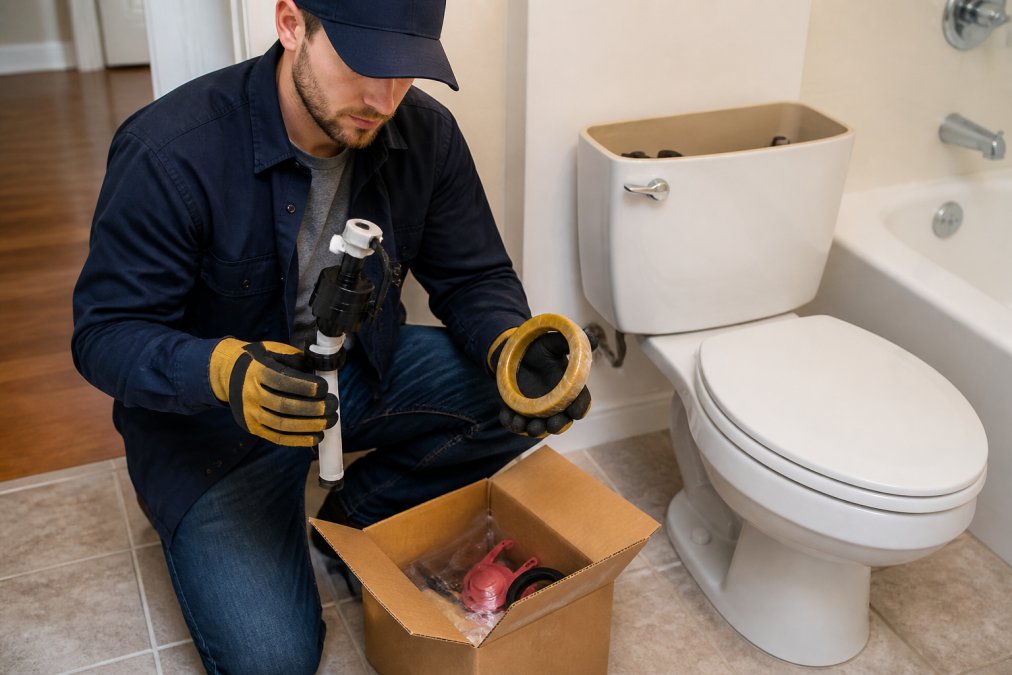
For fill valves, the Fluidmaster Pro Series Adjustable Fill Valve adjusts from 9 in. to 14 in., which covers most standard tank sizes. Pair it with a Fluidmaster Better Than Wax Rubber Toilet Seal for the base, since a rubber seal resists compression better than traditional wax over time.

5. Drain and Sewer Line Maintenance
Drain cleaning on a schedule beats drain cleaning on a complaint. Run hot water through every drain for a full minute, then check the trap for debris and gasket wear.
Clog prevention is mostly about what goes down the drain, so tenant-facing plumbing education matters. A short move-in note about grease, wipes, and hair prevents many blockages that become sewage backup calls.
Sewer laterals are the property's responsibility, not the unit's. Scope them on a set cycle rather than waiting for a backup, since a lateral failure affects every unit on the line.
6. Water Heater Servicing and Sediment Buildup
Water heater servicing starts with flushing the tank. Sediment settles at the bottom, insulates the burner from the water, and drives up energy use while shortening the tank's life.
Drain a few gallons from the bottom valve every six months and check the anode rod annually (energy.gov). Test the temperature and pressure relief valve by lifting the lever and letting it snap back; if it drips or won't reseat, replace it (homedepot.com). Check pipe insulation on the hot and cold lines too, since missing insulation wastes heat.
7. Faucet and Fixture Repair, Aerators, and Gasket Wear
Faucet aerators clog faster than any other fixture component, and they're the cheapest thing on this list to fix. Unscrew the aerator, soak it in vinegar, and clear the screen. A weak stream that isn't a pressure problem is almost always an aerator problem.
Gasket wear at the faucet base shows up as water pooling around the handle or spout. Replace the gasket rather than reseating the cartridge and hoping. Check the shower valve and tub spout at the same time, and listen for water hammer on quick shutoff, banging usually means a loose pipe strap or failing valve.
For threaded connections during any of these repairs, a roll of PROSELECT PTFE Pipe Thread Tape belongs in every kit.
Preventive Plumbing Maintenance Schedule for Property Managers
A preventive plumbing maintenance schedule for property managers is not a calendar. It is a decision rule for what gets inspected on a route, what gets replaced on a clock, and what only gets touched when a resident reports it. The schedule below splits work into four cadences, turnover, quarterly, annual, and seasonal, and assigns each checklist item to the cadence where it actually fails.
| Cadence | Checklist Items | Frequency | Typical Trigger |
|---|---|---|---|
| Turnover | Leak detection, under-sink inspection, supply lines, toilet rebuild, aerators | Every unit turn | Vacancy |
| Quarterly | Water pressure testing, drain cleaning, faucet and fixture check | Every 90 days | Scheduled route |
| Annual | Water heater flush, sewer lateral scope, shut-off valve test | Once per year | Calendar |
| Seasonal | Pipe insulation check, exterior line prep, humidity and mold check | Before first freeze and at start of cooling season | Weather |
Proactive vs. Reactive: Where the Money Actually Goes
The framework that separates a working schedule from a decorative one is the split between proactive and reactive work. Proactive items are inspections and part swaps done on a clock, pressure testing, aerator cleaning, flapper replacement, anode rod checks. Reactive items are repairs triggered by a resident call.
Most apartment portfolios run reactive-heavy because reactive work is visible and proactive work is invisible until it fails. The target is to shift most plumbing labor into the proactive column, since a proactive part swap costs one visit and a reactive failure costs two. The schedule above moves items into the proactive column wherever the failure mode is predictable.
Seasonal Plumbing Preparation
Seasonal preparation is the cadence most apartment schedules skip, and it prevents the largest single-event losses.
Before the first freeze: Walk every line through an exterior wall, unheated crawlspace, or uninsulated garage ceiling. Confirm pipe insulation is intact and seated, not just present, and that shut-off valves on those lines actually close, a valve unexercised for years may not seat when you need it. On any unit with a hose bibb, confirm the exterior valve is drained or frost-free. A single split supply line in an unheated wall can displace a resident and trigger mold remediation that dwarfs the cost of the insulation.
At the start of the cooling season: Shift attention to humidity and mold. Check under-sink cabinets and toilet bases for persistent moisture, and confirm bathroom exhaust fans actually move air, a fan that spins but doesn't exhaust keeps humidity high enough to support mold growth on cabinet backs and drywall. A hygrometer left in a unit for a day tells you more than a visual scan.
Tenant-Facing Plumbing Education as a Schedule Input
A schedule only holds if residents cooperate. The cheapest way to protect the quarterly and annual cadences is a short, plain-language note at move-in and lease renewal telling residents what to report and what not to put down a drain. Grease, wipes, and hair cause many blockages that become sewage backup calls, and a resident who reports a slow drain before it stops draining saves an emergency visit. Pair the note with a one-page card listing the unit's shut-off locations so a resident can stop water at the source while waiting for a technician.
Logging and Reviewing the Schedule
A schedule without a log is a guess. Track every proactive inspection and reactive call by unit number, and review quarterly. Patterns cluster around specific buildings, fixture vintages, and riser stacks far more often than around specific technicians. When a unit generates a second plumbing call within 90 days, the first visit likely addressed the symptom rather than the cause, route that unit to the top of the next proactive cycle.
How to Reduce Maintenance Callbacks in Apartments
How to reduce maintenance callbacks in apartments comes down to one rule: fix the cause, not the symptom. A callback almost always means the first visit addressed what the resident reported rather than what caused it. The sections below turn that rule into a repeatable process, covering a gap most plumbing checklists miss, the resident side of the equation.
1. Replace Wear Parts in Sets, Not One at a Time
Wear parts fail on similar timelines. A flapper and fill valve installed the same day tend to reach end of life within months of each other, so replacing one and leaving the other guarantees a second visit. The same applies to supply lines and shut-off valves on the same fixture, and to aerators and faucet gaskets on the same sink. When a technician opens a fixture, the default should be to replace every wear part past its service window, not just the one that failed.

2. Standardize the Parts the Team Carries
A callback is often a parts problem disguised as a skill problem. If two technicians carry different fill valves, the same repair produces two outcomes and two failure timelines. Standardizing on a small set of OEM-grade components, one fill valve model, one flapper style, one supply line length per common application, makes repairs consistent across every unit and technician, and makes inventory predictable so the van is stocked before the route starts.
3. Log Every Repair by Unit, Not by Technician
Track callbacks by unit number, not by technician. Patterns cluster around specific fixtures and buildings far more often than around specific people. A unit generating a second plumbing call within 90 days is telling you something about the fixture, riser, or water pressure at that address. Review the log quarterly and route repeat-offender units to the top of the next proactive cycle.
4. Give Residents a Reporting Path That Prevents Emergencies
This is the step most checklists skip, and it cuts the largest share of emergency calls. Residents are the property's first sensor: one who reports a slow drain, a faint hiss under the sink, or a toilet that runs between flushes gives the maintenance team a proactive window instead of a reactive one.
A short, plain-language note at move-in and lease renewal should cover three things: what to report immediately (any water where it shouldn't be, a toilet that won't stop running, a noticeably slowed drain), what to never put down a drain (grease, wipes, hair, anything marketed as flushable), and where the unit's shut-off valves are. A one-page card with those locations lets a resident stop water at the source while waiting for a technician, the difference between a mop-up and a water-damage claim.
5. Close the Loop After Every Repair
A callback is not always a failed repair, sometimes it's a repair the resident didn't understand. A two-line note after the visit, covering what was replaced and what to watch for, reduces calls that come from uncertainty rather than a new failure, and gives the resident a reason to report a genuine recurrence early, while it's still a small job.
What to Measure
The two numbers worth tracking are callback rate by unit and the ratio of proactive to reactive plumbing work. A falling callback rate with a rising proactive share means the schedule is working; a rising callback rate with a rising proactive share usually means proactive work is logged but not actually completed, a paperwork problem, not a plumbing one.
Tool Kit Requirements for Apartment Plumbing Checks
Tool kit requirements for apartment plumbing checks are modest, but the kit has to be complete before the technician leaves the shop. A partial kit means a store run, and a store run means a lost hour.
- Adjustable wrenches in two sizes
- Basin wrench for under-sink work
- Pressure gauge with faucet adapter
- Flashlight and inspection mirror
- PTFE thread tape and a spare roll
- Replacement supply lines in the two most common lengths
- Spare fill valves, flappers, and wax or rubber seals
- Rags, bucket, and a moisture meter
- Gloves and eye protection
Eco-friendly plumbing upgrades also belong in the conversation, since low-flow aerators and efficient fill valves reduce water use without changing the repair workflow. The fastest payback is usually the aerator swap, a two-minute job during a visit you're already making.
Apartment plumbing maintenance fails when parts, people, and schedules aren't aligned. Ready Bathroom Solutions builds pre-kitted, OEM-grade maintenance sets with parts from Moen, Delta, and BrassCraft, consolidating everything a technician needs into a single box so no visit starts with a store run. Standardized components keep repairs consistent across every unit, and bundle savings of 15-20% help offset the cost of doing the work on schedule instead of on an emergency call. Shop All Bathroom Kits and put the checklist to work.
Frequently Asked Questions
What should be included in an apartment plumbing maintenance checklist?
A working checklist covers ten items: leak detection and under-sink inspection, water pressure testing, supply lines and shut-off valves, toilet flappers and fill valves, drain and sewer line maintenance, water heater servicing, faucet aerators and gasket wear, seasonal pipe insulation, eco-friendly fixture upgrades, and tenant education with a basic tool kit. Each item needs a pass/fail condition and a parts list, so a technician can finish the check in one visit instead of scheduling a second trip for a $4.49 wax ring or a $10.82 fill valve.
How often should apartment plumbing systems be inspected for preventive maintenance?
Run a full inspection at every unit turnover, then add a quick visual check annually for occupied units. High-traffic fixtures like toilets and shower valves benefit from a check every six months. The turnover inspection matters most because it is the only time the unit is empty and a technician can open the tank, test the shut-off valves, and look under the sink without scheduling around a resident. Properties that skip the turnover inspection usually meet the same failure later as an after-hours emergency call.
What are the most common reasons for apartment bathroom leaks?
Four failures cause most apartment bathroom leaks: a worn flapper or fill valve that lets the tank run, a corroded supply line or braided hose that bursts at the ferrule, a failed wax ring or toilet seal that seeps at the base, and a clogged or cracked drain trap. Water hammer from a failing pressure reducing valve also stresses joints until they weep. Most of these show visible warning signs, which is why under-sink inspection and a toilet tank check belong on every turnover checklist.
How can standardized maintenance kits reduce plumbing repair callbacks?
Callbacks usually happen because the first visit used the wrong part or a worn one. A standardized kit puts the correct OEM-grade fill valve, wax ring, supply lines, and PTFE tape in the technician's hands before the unit is opened, so the repair finishes on the first trip. Ready Bathroom Solutions bundles these parts with 15 to 20 percent bundle savings, which also removes the store run that adds an hour of labor to a job that should take twenty minutes.
What are the top 10 preventive maintenance tasks for apartment managers?
The ten tasks are: check for leaks under every sink, test water pressure and the pressure reducing valve, inspect supply lines and shut-off valves, rebuild toilet tanks with new flappers and fill valves, clear drain traps and sewer laterals, flush the water heater to remove sediment, clean faucet aerators and replace worn gaskets, insulate pipes before the first freeze, install low-flow fixtures, and give tenants a simple guide plus a basic tool kit. Assign each task a frequency and log the completion date.