

Table of Contents
- Why Bathroom Repair Parts Inventory Breaks Down
- Step 1: Categorize Every Bathroom Repair Part by Failure Rate
- Step 2: Set Min-Max Levels and Reorder Points That Match Your Lead Time
- Step 3: Organize the Storeroom and Truck Stock for Small Parts
- Step 4: Build Bathroom-Specific Part Kits Instead of Loose Stock
- Plumbing Inventory Management Best Practices That Hold Up
- Reducing Maintenance Callbacks With Data-Driven Replenishment
- Maintenance Supply Chain Efficiency: Audits, Cycle Counts, and Project History
- Frequently Asked Questions
Last Updated: September 12, 2026
Why Bathroom Repair Parts Inventory Breaks Down
Managing inventory for bathroom repair parts fails for one reason: the parts are small, cheap individually, and catastrophic when missing. A single absent flapper or supply line turns a 30-minute work order into a second truck roll, and the second visit costs more than the part ever did. This guide from Ready Bathroom Solutions breaks the problem into four steps: categorize by failure rate, set min-max levels against real lead times, organize storeroom and truck stock, and build pre-assembled kits. The EPA's WaterSense program guidance on fixture repair makes the stakes clear: a leaking toilet alone can waste hundreds of gallons per day, so a delayed repair is a water bill problem, not just a scheduling one.
Most storerooms aren't disorganized. They're organized around the wrong question.
Step 1: Categorize Every Bathroom Repair Part by Failure Rate
Categorization is the foundation of bathroom repair parts inventory control. Instead of sorting by fixture type or supplier, group parts by how often they actually fail. That single change tells you what to stock deep and what to stock thin.
The High-Failure Tier: Cartridges, Flappers, and Supply Lines
Cartridges, flappers, and supply lines are the parts technicians replace most often. A common mistake is treating these as order-on-demand items. They aren't. Stock them at every storeroom and on every truck, because a technician without a replacement cartridge on hand will either make a supply house run or reschedule the unit.
The Low-Failure Tier: Escutcheons, Trim, and Discontinued Parts
Escutcheons, trim pieces, and discontinued parts fail rarely, but they're the hardest to source when they do. Keep a small buffer of these and flag any SKU tied to a fixture line the manufacturer has retired. When a discontinued part runs out, the whole fixture becomes a replacement job, which is a budget conversation nobody wants mid-turn.
Step 2: Set Min-Max Levels and Reorder Points That Match Your Lead Time
Min-max inventory only works when the minimum reflects real lead time. Set your reorder point as lead time demand plus a safety buffer, then let the maximum cover one full replenishment cycle. A part with a two-week lead time needs a deeper minimum than one available at a local supply house the same morning (sba.gov).
A simple formula works for most properties:
- Reorder point = (average weekly usage × lead time in weeks) + safety stock
- Max level = reorder point + one replenishment cycle of usage
- Safety stock = roughly one week of usage for high-failure parts, less for slow movers
Review these numbers quarterly. Usage patterns shift with season, occupancy, and renovation schedules, and a min-max set once and forgotten drifts out of alignment within two cycles.
Step 3: Organize the Storeroom and Truck Stock for Small Parts
Storeroom organization for small parts comes down to bin location discipline. Every SKU gets a labeled bin, every bin gets a fixed address, and every address gets recorded in your inventory control system. Barcode scanning at the bin closes the loop: the system knows what left the shelf before the technician reaches the elevator.
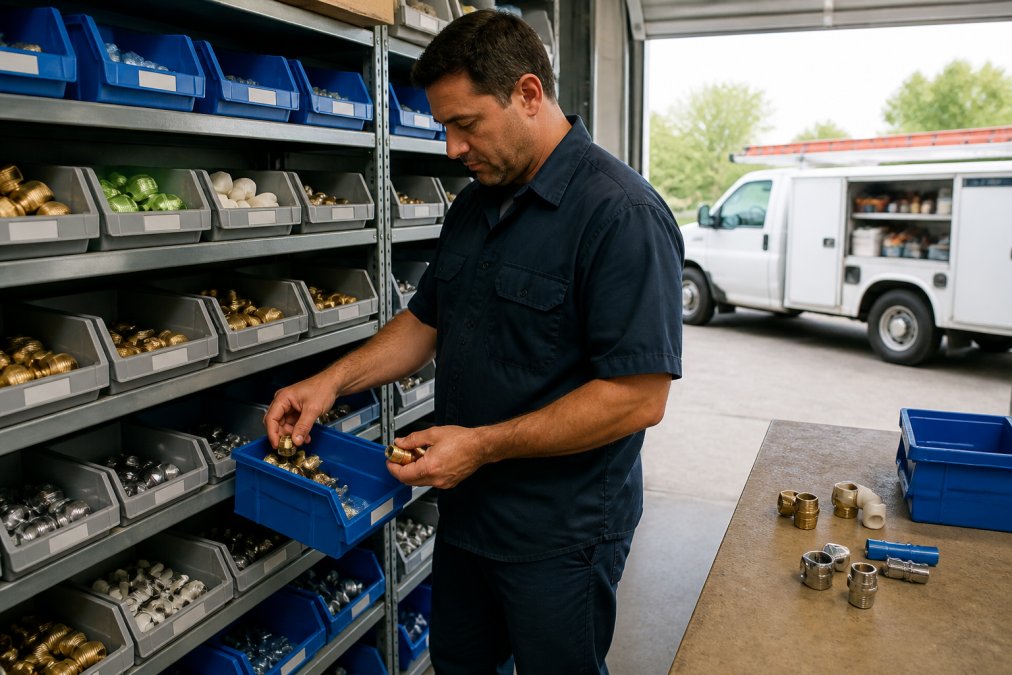
Physical Storage Solutions Built for Small Parts
Most generic plumbing inventory advice stops at "use bins." The problem is that bathroom repair parts are unusually small and unusually varied: a toilet flapper, a faucet cartridge, a supply line, and a set of O-rings are four different shapes that do not share a shelf footprint. A storage system that ignores that variety produces the same result as no system at all.
A workable architecture for a bathroom parts storeroom usually combines four layers:
- Shelf bins for high-failure SKUs. Open-front plastic shelf bins (roughly 4 to 6 inches wide) hold flappers, cartridges, and supply lines in quantities that match one replenishment cycle. Clear fronts let a technician confirm stock without pulling the bin.
- Divided drawer cabinets for tiny components. Washers, O-rings, snap rings, and trim screws disappear in open bins. A divided drawer cabinet with adjustable dividers keeps each size isolated and labeled, which is the only reliable way to keep a 1/2-inch washer from migrating into the 5/8-inch drawer.
- Bulk shelving for boxed and bagged stock. Larger items like wax rings, escutcheons, and trim kits sit on standard industrial shelving, still bin-located but not drawer-organized.
- Mobile storage for the truck. Truck stock should mirror the storeroom's logic at smaller scale. A van shelf-and-bin insert, or a rolling parts cart for larger properties, keeps the same SKU in the same relative position on every truck so a technician can find a flapper in ten seconds on any vehicle, not just their usual one.
Labeling is the layer that holds the rest together. A bin label should carry the SKU, the bin address, and the reorder point, so a technician who pulls the last cartridge can flag it without opening the inventory system. Color-coding by fixture type (toilets, sinks, showers) is a common pattern that lets a technician scan a shelf and know which zone they are in before reading a single label.
Truck Stock: The Same Logic, Smaller Footprint
Truck stock follows the same logic at smaller scale. The parts most likely to end a call early belong in a fixed, labeled location on the truck, not loose in a tote. A technician who can find a flapper in ten seconds finishes the call; one who digs through a bin for five minutes is already behind on the next work order.
The practical test for truck stock is simple: if a part is not in a labeled, fixed location, it is not really stocked. It is just present. Loose totes and unlabeled drawers are where callbacks are born, because the technician cannot verify what they have before leaving the shop.
Step 4: Build Bathroom-Specific Part Kits Instead of Loose Stock
Bathroom-specific part kits replace loose stock with a single box containing everything a standard repair needs. This is where most inventory advice stops short. Kitting changes the unit of inventory from individual SKUs to a complete job, which removes the decision point where technicians guess what to grab.
Ready Bathroom Solutions builds pre-kitted, OEM-grade sets around exactly this model, including the Toilet Kit - Pro, Sink Kit - Pro, Shower Kit - Pro, and Complete Kit - Pro. Each kit consolidates the parts for one repair into one box, which eliminates the store run and the callback that follows a missing component.


| Approach | Stocking Unit | Typical Failure Mode | Labor Impact |
|---|---|---|---|
| Loose SKU stock | Individual part | Missing part mid-job | Second truck roll |
| Min-max bins only | Individual part | Stockout on high-failure item | Supply house run |
| Pre-kitted repair sets | Complete job | None if kit is stocked | Single visit completion |
Kit stock should be counted as a single SKU, not by component. Counting a kit as one unit keeps cycle counts fast and makes stockouts visible immediately, which is the entire point of kitting.
Plumbing Inventory Management Best Practices That Hold Up
The best plumbing inventory management best practices share one trait: they assume the technician is busy and the storeroom is not. Audit inventory on a fixed cycle, use cycle counts instead of annual full counts, and track project history so you know which parts a renovation consumed versus which failed on their own. That distinction is what makes replenishment data-driven rather than reactive.
Carrying costs matter here too. Excess stock ties up capital and shelf space, and slow-moving parts can sit for months. The U.S. Small Business Administration guidance on inventory management frames the trade-off plainly: too little stock risks stockouts, too much ties up cash. For bathroom parts, the answer is depth on high-failure items and thin coverage on everything else.
Reducing Maintenance Callbacks With Data-Driven Replenishment
Reducing maintenance callbacks starts with tracking why the callback happened. If the cause was a missing part, that's an inventory failure, not a technician failure. Log it that way and the pattern shows up fast: the same three or four SKUs cause most repeat visits.
Data-driven replenishment closes the gap. Instead of reordering on gut feel, pull usage from your inventory control system and let reorder points trigger automatically. Properties that run this way catch stockouts before they become callbacks, and technicians stop improvising with whatever is on the shelf. Ready Bathroom Solutions designed its kits around this principle: standardized components mean the same repair uses the same parts across every unit, so usage data stays clean and comparable across the portfolio.
Maintenance Supply Chain Efficiency: Audits, Cycle Counts, and Project History
Maintenance supply chain efficiency depends on three disciplines working together: audits, cycle counts, and project history. Audits verify that what the system says is on the shelf is actually there. Cycle counts spread that verification across the year so no single count day shuts down the storeroom. Project history ties usage to specific jobs, which separates genuine consumption from shrinkage or misplacement.
The mechanics matter more than the labels. A cycle count that counts the same fast-moving SKUs every week and the slow movers once a quarter catches drift where it actually happens. Project history only works if parts are issued against a work order rather than signed out on a clipboard, because a clipboard entry tells you a part left the shelf but not which job consumed it. When usage is tied to a work order, you can compare parts consumed against parts the job should have needed, and the difference is your shrinkage, misplacement, or over-issue signal.
Field Service Integration: The Piece Most Teams Miss
Field service integration is the piece most teams miss. When your inventory control system connects to your field service platform, parts consumed on a work order decrement stock automatically and replenishment triggers without a manual step. That connection is what turns a storeroom from a cost center into a scheduling advantage, because technicians arrive with the right parts the first time.
The integration usually works through a few concrete data flows:
- Work order to parts issue. The technician closes the work order on a mobile device, selects the parts used, and the inventory system decrements those SKUs in real time. No end-of-day reconciliation, no clipboard.
- Parts availability to scheduling. When a dispatcher schedules a job, the field service platform can check whether the required kit or SKU is in stock at the assigned truck or storeroom, and flag the job before the technician is dispatched.
- Replenishment to purchasing. When a kit or high-failure SKU crosses its reorder point, the inventory system generates a purchase request without waiting for a human to notice the empty bin.
- Usage to billing. Parts consumed on a work order flow into the invoice or cost record for that job, so the same data that drives replenishment also drives job costing.
The trade-off is setup cost. Integration requires that SKUs, kit definitions, and truck assignments be consistent across both systems, and that consistency has to be maintained as parts are added or retired. Teams that skip that discipline end up with an integration that reports the wrong stock, which is worse than no integration because it is trusted.
The properties with the fewest callbacks aren't the ones with the biggest storerooms. They're the ones where the inventory control system, the truck stock, and the field service platform all agree on what's available.
Frequently Asked Questions
What is the 80/20 rule in bathroom repair parts inventory?
Roughly 20% of your SKUs drive about 80% of repair volume. In bathrooms, that small group is usually toilet flappers, fill valves, faucet cartridges, supply lines, and shower valve stems. Track which parts you pull most often over a 90-day window, then set higher min-max levels and a faster reorder point for that group. Keep the slow movers stocked thin so carrying costs stay low without risking a stockout on the parts that actually turn units.
How do I organize bathroom repair parts to reduce maintenance downtime?
Group parts by fixture, not by vendor. One bin or shelf for toilets, one for sinks, one for showers, each labeled with bin locations your technicians can read at a glance. Small items like washers, O-rings, and escutcheon screws belong in divided trays, not loose drawers. Pair that with truck stock of your top ten parts so a technician can finish a standard repair without leaving the property. The goal is zero trips to a supply house mid-job.
What are the benefits of using pre-kitted parts for bathroom repairs?
A pre-kitted set puts every part for one repair in a single box, so the technician grabs it and goes. That removes the store run, cuts the chance of a missing component mid-install, and standardizes what gets installed across every unit. Ready Bathroom Solutions builds kits around OEM-grade components from Moen, Delta, and BrassCraft, covering toilets, sinks, showers, and full bathrooms. Standard kits also make it easier to train new technicians and keep quality consistent across a portfolio.
How do you minimize excess inventory in maintenance supply closets?
Audit before you buy. Run a cycle count on your top 20 SKUs every month and a full audit quarterly, then compare usage against what you ordered. Set maximum stock levels, not just minimums, so replenishment stops before shelves overflow. Parts tied to discontinued fixtures are the main source of dead inventory, so flag them and stop reordering once the remaining units are scheduled for replacement. Pre-kitted bundles help here too, since you order by repair type rather than guessing at individual quantities.
Bathroom repair inventory breaks down when parts are tracked individually and technicians guess what to grab. Ready Bathroom Solutions solves that with pre-kitted, OEM-grade sets built from brands like Moen, Delta, and BrassCraft, standardized components for portfolio-wide consistency, and bundle savings that cut both carrying costs and repeat visits. Get started with Ready Bathroom Solutions and turn your storeroom into a scheduling advantage instead of a bottleneck.