

Table of Contents
- Why Hotel Room Maintenance Efficiency Matters
- The Real Bottlenecks Slowing Down Your Team
- Build a Preventative Maintenance Schedule for Hotels
- How to Optimize Property Maintenance Budgets Without Sacrificing Quality
- Automate Work Orders and Track Progress in Real Time
- The Hotel Room Turnover Checklist Your Staff Will Actually Use
- Cut Labor Costs With Pre-Kitted Bathroom Repair Sets
- Conclusion
- Frequently Asked Questions
Last Updated: September 9, 2026
Why Hotel Room Maintenance Efficiency Matters
Hotel room maintenance is the silent engine of guest satisfaction and property profitability. When maintenance drags, rooms sit vacant, housekeeping schedules collapse, and guest reviews quietly erode your brand's reputation. The properties that win consistently treat maintenance not as a reactive chore but as a measurable driver of operational efficiency.
The core problem is rarely a lack of effort; it's a lack of system. Teams that coordinate repairs, cleaning, and inspections as one continuous process get rooms back in service faster than those treating each task as an isolated event.
Efficient hotel room maintenance directly controls your two biggest cost centers: labor hours and lost revenue from out-of-service rooms. Every hour saved on a repair is an hour redirected to guest-facing service. Every room turned faster is a room you can sell again tonight.
Below, we'll walk through the specific bottlenecks, schedules, and workflows that separate high-performing maintenance teams from the rest.
The Real Bottlenecks Slowing Down Your Team
Most maintenance delays are not caused by difficult repairs. They come from predictable, fixable friction points that compound across a busy day. Understanding these bottlenecks requires looking at the actual workflow, not just the symptoms.
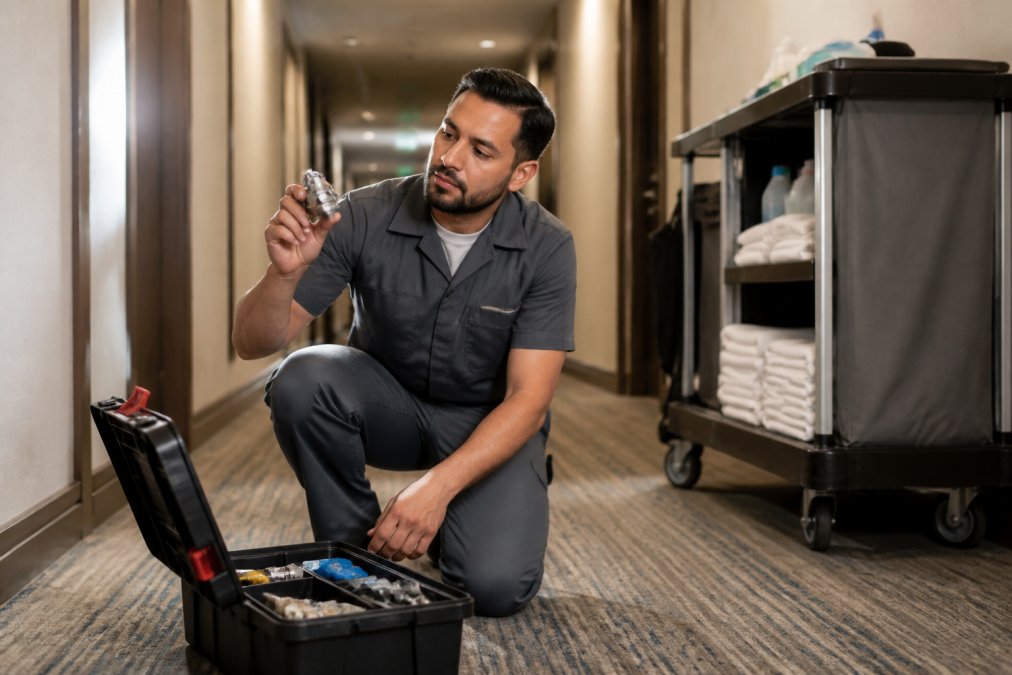
The biggest culprit is the parts run. A technician discovers a worn cartridge, leaves the property for a supply house, and loses 45 minutes of productive time. Multiply that by several callouts daily and you've lost a full labor shift each week. Standard operating procedures that require trips for common parts are costing you more than the parts themselves. The fix is not telling technicians to work faster; it is eliminating the trip entirely. Properties that maintain a par-level inventory of the top 20 most common repair components, cartridges, flappers, supply lines, and gaskets, cut these runs by over 80% (hbr.org).

The second bottleneck is unclear handoffs between departments. Housekeeping flags a leaky faucet, but the work order sits until a maintenance lead reviews it manually. Room status updates lag, so front desk staff unknowingly sell rooms that aren't ready. This breakdown in communication directly extends your room turnover time. The mechanism is often a time-stamped log that nobody checks in real time. A common pattern is a 30-to-60-minute delay between a housekeeper noting an issue and a technician seeing it. During peak checkout hours, that delay is the difference between selling the room that night and walking a guest.
Third is the repeat-visit trap. A technician applies a temporary fix to clear the room, only to return within weeks for the same issue. These callbacks inflate your maintenance backlog and frustrate guests who experience recurring problems. The fix is standardization, not speed. Track your first-time fix rate (FTFR) per technician and per issue type. If a specific repair has a callback rate above 10%, your process or your parts are the problem (isixsigma.com). Switching to OEM-grade components and requiring a photo of the completed repair can reduce callbacks.
Fourth is the inspection gap. Many properties only inspect a room when a guest complains or when housekeeping notices something obvious. This reactive posture misses slow-developing issues like a weeping supply line under a sink that stains a cabinet over weeks. A structured, zone-based inspection during scheduled maintenance catches these before they become emergency calls. Moving from complaint-driven to scheduled inspections can reduce after-hours emergency calls (facilitiesnet.com).
Fifth is the skill mismatch. Sending a generalist technician to a complex HVAC issue or a specialist to a simple caulk job wastes both time and talent. A simple triage system, categorizing work orders by skill level and estimated time, lets you assign the right person to the right job. This reduces the time a room stays out of service and keeps your higher-paid specialists on work that actually requires their expertise.
Addressing these five bottlenecks requires more than a checklist; it requires a workflow that connects housekeeping, front desk, and maintenance in a single loop. The sections below walk through the specific schedules and tools that make that loop work.
Build a Preventative Maintenance Schedule for Hotels
A preventative maintenance schedule for hotels is the single most effective tool for reducing emergency repairs and extending asset lifecycle. Rather than waiting for failures, you inspect and service fixtures on a set calendar.
Start by categorizing your room assets by failure risk and guest impact. Bathroom fixtures, HVAC units, and door hardware fail most often and cause the most disruption. Assign each category a frequency: quarterly inspections for high-use plumbing, annual servicing for major systems, and monthly checks for caulking and seals that prevent water damage.
A practical schedule looks like this:
| Maintenance Task | Frequency | Typical Time | Primary Benefit |
|---|---|---|---|
| Faucet cartridge inspection | Quarterly | 15 min/room | Prevents drips and scalding issues |
| Toilet flush mechanism check | Quarterly | 10 min/room | Avoids clogs and running water |
| Caulk and sealant review | Monthly | 20 min/room | Prevents costly water damage |
| Showerhead descaling | Semi-annually | 10 min/room | Maintains water pressure |
| Water heater flush | Annually | 60 min/unit | Extends equipment lifespan |
Document every inspection in a digital log. This creates a data trail that justifies budget requests and reveals which fixture brands fail most often in your portfolio. Over time, your preventive maintenance schedules become the backbone of your cost reduction strategy.
How to Optimize Property Maintenance Budgets Without Sacrificing Quality
Optimizing property maintenance budgets is about reducing the cost per completed repair, not simply buying cheaper parts. The math that matters is total cost of ownership, which includes labor, repeat visits, and downtime.
Audit your callback rate first. If a meaningful share of repairs needs a second visit, your parts quality or installation process is the problem. Replacing a faucet with an OEM-grade component can eliminate the labor cost of a second trip.
Standardize what you stock. When every property uses the same fixture models and repair parts, your team learns one installation process. This consistency reduces training time, simplifies inventory, and ensures brand consistency across your portfolio. Mixed fixture brands force your staff to troubleshoot different designs for the same repair.
Consolidate purchasing to capture savings. Buying individual parts as emergencies arise means paying retail prices and rush shipping. Bundling common repair components into standardized kits lets you negotiate better volume pricing and keeps technicians stocked for the jobs they see most.
Automate Work Orders and Track Progress in Real Time
Work order management is where technology delivers the fastest efficiency gains. Manual systems, paper tickets, and verbal handoffs create delays at every step. Automation removes the friction between identifying a problem and resolving it.
A practical automation workflow follows this sequence:
- Housekeeping or front desk logs an issue through a mobile app.
- The system assigns the work order to the next available technician with the right skill set.
- The technician receives the room number, issue description, and required parts list.
- The technician updates the status when the repair is complete.
- Housekeeping is notified automatically that the room is ready for cleaning.
Real-time tracking gives your maintenance manager visibility into the entire pipeline. You can spot a growing maintenance backlog before it becomes a crisis, reassign staff to urgent tasks, and generate KPI reports on average repair time and first-time fix rates.
The data from these systems also feeds your preventive maintenance schedules. If a specific faucet model generates repeated work orders, you have evidence to justify replacing it property-wide rather than continuing to patch individual failures.
The Hotel Room Turnover Checklist Your Staff Will Actually Use
A hotel room turnover checklist is only valuable if it reflects the real sequence of work and prevents steps from being skipped. Generic checklists fail because they don't match your property's specific layout and fixture types.
Build your checklist around zones rather than a single linear pass. This lets housekeeping and maintenance work in parallel without colliding:
- Entry and bathroom: Inspect faucet operation, check for leaks under the sink, verify toilet flush, examine caulk condition, confirm shower pressure.
- Sleeping area: Test all light switches, check HVAC operation, inspect door locks and hinges, look for water stains on ceilings.
- Amenities: Verify TV and remote function, check mini-fridge temperature, test outlets and USB ports.
Make the checklist digital and require photo evidence for completed repairs. This creates accountability and gives your maintenance manager a record of what was inspected. Standard operating procedures become enforceable when staff know their work is verified.
The checklist should also include a clear escalation path. Define which issues a housekeeper can resolve on the spot and which must trigger a work order. This prevents minor problems from being hidden to meet turnover deadlines.
Cut Labor Costs With Pre-Kitted Bathroom Repair Sets
The most expensive part of any bathroom repair is often the time spent gathering parts, not the repair itself. Pre-kitted repair sets eliminate this waste by bundling every component needed for a specific job into a single box.
Ready Bathroom Solutions builds pre-kitted, OEM-grade maintenance kits that consolidate all necessary parts for common bathroom repairs. Instead of sending a technician to a supply house for a cartridge, a seal, and a handle, you hand them one box with everything included. This approach eliminates store runs, reduces labor costs, and gets your units back in service faster.
The standardization benefit extends across your entire portfolio. When you use the same OEM-grade parts from brands like Moen, Delta, and BrassCraft in every property, your team master's one installation process. This consistency reduces maintenance callbacks and ensures service quality is identical whether a room is in a downtown property or a roadside motel.
Bundling also creates cost advantages. Ready Bathroom Solutions offers bundle savings on its kits, helping property managers optimize operational costs without sacrificing component quality. The all-in-one box design prevents the costly delays of after-hours emergencies when supply houses are closed and a room must be ready by morning.
Conclusion
Efficient hotel room maintenance comes down to removing friction: friction in parts sourcing, in work order handoffs, and in the gap between spotting a problem and fixing it. Start with a documented preventive maintenance schedule, automate your work order tracking, and give your team the standardized tools they need to complete repairs on the first visit.
The properties that turn rooms fastest treat maintenance as a system, not a series of reactions. Ready Bathroom Solutions supports that system with pre-kitted, OEM-grade bathroom repair sets that eliminate store runs and reduce callbacks. With standardized components from trusted brands and bundle savings that lower your per-repair cost, our kits help you restore rooms to service faster and maintain consistent quality across your entire portfolio. Get started with Ready Bathroom Solutions and put your maintenance team back where they belong: fixing problems, not shopping for parts.
Frequently Asked Questions
How can standardized maintenance kits improve room turnover speed?
Standardized kits eliminate the time your maintenance staff spends driving to supply stores or searching for matching parts. When every bathroom repair uses a pre-kitted box with OEM-grade parts from brands like Moen or Kohler, technicians finish the job in one trip. This directly reduces room turnover time because the room returns to ready status faster, often on the same day the issue is reported.
What are the most common bottlenecks in hotel room maintenance?
The most common bottlenecks are waiting for parts, unclear work orders, and uncoordinated scheduling. A technician who arrives without the right cartridge or faucet wastes hours. Poor communication between front desk and maintenance creates duplicate visits. Use digital checklists and real-time room status updates so staff knows exactly which rooms need work and what parts are required before they arrive.
What should a preventative maintenance schedule for hotels include?
A solid preventative maintenance schedule for hotels should include quarterly inspections of bathroom faucets and seals, annual water heater checks, and monthly HVAC filter changes. Prioritize items that cause the most guest complaints, such as dripping faucets or low water pressure. Log every inspection in a work order system so you can track asset lifecycle and predict failures before they happen, reducing emergency callouts.
How do you reduce labor costs in hotel maintenance without cutting staff?
Reduce labor costs by eliminating wasted time. Store runs for a single replacement part can cost more in labor than the part itself. Pre-kitted repair sets, like those from Ready Bathroom Solutions, put every component in one box, reducing repair time. Standardizing parts across your property also means staff learn one installation process instead of troubleshooting multiple brands.