

Table of Contents
- Commercial vs Residential Faucet Durability: The Short Answer
- Commercial Grade Faucets vs Residential: Duty Cycle and Construction
- Residential Faucet Lifespan in High-Traffic Properties
- Commercial Faucet Maintenance: What Keeps Them Running
- Faucet Repair Parts and Total Cost of Ownership
- Commercial-Style Faucets in Home Kitchens: Pros and Cons
- Which Faucets Fit Your Property? A Buying Guide
- Conclusion
- Frequently Asked Questions
Last Updated: October 9, 2026
Commercial vs Residential Faucet Durability: The Short Answer
Commercial faucet vs residential faucet durability comes down to one thing: how many times a day the valve opens and closes.
At Ready Bathroom Solutions, we supply pre-kitted, OEM-grade repair sets to property teams replacing faucets across hundreds of units, so we see which models fail first and why.
The short answer: if a fixture sees more than roughly 20 activations a day, residential-grade construction will wear out years before its rated service life.
Commercial Grade Faucets vs Residential: Duty Cycle and Construction
Duty cycle is the number of on/off cycles a faucet handles over its service life. A residential faucet carries a lighter duty rating because it serves one household; a commercial-grade faucet is rated for continuous, high-frequency use. That rating drives every other design choice, but manufacturers rarely publish an apples-to-apples cycle number.
What the Ratings Actually Mean
No single federal cycle-count standard separates "residential" from "commercial" faucets. Durability claims trace back to a few benchmarks:
- ASME A112.18.1 / CSA B125.1 is the joint plumbing fixture standard for faucets sold in the U.S. It sets minimum performance and endurance requirements, including a valve cycle test. Passing it does not make a fixture "commercial-grade", it clears the floor.
- NSF/ANSI 61 governs materials in contact with drinking water; NSF/ANSI 372 covers lead content. Both apply to residential and commercial fixtures alike.
- ADA compliance (via ICC A117.1 and the ADA Standards for Accessible Design) matters for commercial installs because handle force and reach range are regulated, a durability spec that ignores ADA can fail inspection even if the valve is bulletproof.
Published cycle ratings cluster into two tiers: light-duty cartridges tested in the low tens of thousands of cycles, and heavy-duty ceramic disc or compression valves tested into the hundreds of thousands. That gap, not the marketing word "commercial", determines whether a fixture survives a hotel room.
Materials, Valves, and Cartridge Differences
The valve is where durability is won or lost. Commercial-grade faucets use ceramic disc cartridges or heavy-duty compression valves rated for far more cycles than residential equivalents, which often use lighter plastic-bodied cartridges that seal well initially but degrade faster under repeated use.
Look at the material spec sheet:
- Body: Commercial-grade fixtures favor solid brass or stainless steel; residential models may use thinner brass or zinc alloy. Wall thickness matters more than the alloy name, a thin brass body flexes at the mounting shank and loosens over time.
- Cartridge: Ceramic disc valves resist mineral buildup and last longer than rubber-seat designs. The sealing surfaces are the wear point; once they score, the fixture drips regardless of how thick the body is.
- Finish: Commercial finishes are often tested for abrasion and chemical resistance; residential finishes are cosmetic-first. A finish failure isn't functional, but drives premature replacement in guest-facing units.
Flow Rate, Pressure, and How They Shorten Life
Flow rate is regulated federally by the Energy Policy Act of 1992 and subsequent DOE rules. Lavatory faucets max out at 2.2 gpm at 60 psi; WaterSense-labeled models cap at 1.5 gpm (the EPA).
What changes between settings is operating pressure and duty, not the legal limit. A commercial restroom may run at 60-80 psi with hundreds of activations a day; a home kitchen runs at 40-60 psi with a few dozen.
For a bathroom fixture, a metal-handle model like the Moen Gibson Two Handle Centerset Bathroom Sink Faucet at $119.66 is a reasonable middle ground for guest bathrooms: metal handles, a 1.2 gpm flow rate, and a 4-inch deck hole fit.

Residential Faucet Lifespan in High-Traffic Properties
Residential faucet lifespan shrinks fast in a high-traffic setting. A faucet rated for a single household may be cycled a few thousand times a year; the same fixture in a hotel room or student apartment can hit that in a few months.
In practice, a residential-grade faucet in a rental unit often needs its first cartridge replacement well before the manufacturer's estimate. The failure follows a predictable order, so stock the parts that fail first.
Component-by-Component Failure Points
The cartridge is almost always first to go: mineral deposits and constant handle travel wear the sealing surfaces, causing drips and stiff handles. Next comes the aerator, which clogs with sediment and drops flow rate, followed by the spray head and diverter on pull-down models, then the supply hose and O-rings.
- Cartridge: First to fail; causes drips and handle stiffness.
- Aerator: Clogs with scale; reduces flow and spray quality.
- Spray head/diverter: Wears on pull-down and pull-out models.
A common mistake is replacing the whole faucet when only the cartridge failed. On most OEM-grade fixtures the cartridge and seals are serviceable, which is why standardized repair parts matter portfolio-wide.
Commercial Faucet Maintenance: What Keeps Them Running
Commercial faucet maintenance is mostly about replacing wear parts on a schedule instead of waiting for failure. The longest-lasting fixtures are those where teams swap cartridges, aerators, and seals at set intervals rather than reacting to complaints.
A simple approach works: inspect every unit at turnover, replace the cartridge and aerator on a fixed cycle, and keep a standardized parts kit on hand so a technician never leaves mid-job.
Standardize on one or two faucet models per property type. When every unit uses the same cartridge and aerator, your team stocks one kit instead of ten, and turnover repairs stop depending on which model happens to be installed.
Bathroom Faucet - Delta Faucet Ara® Single Handle Monoblock Bathroom Sink Faucet →
Faucet Repair Parts and Total Cost of Ownership
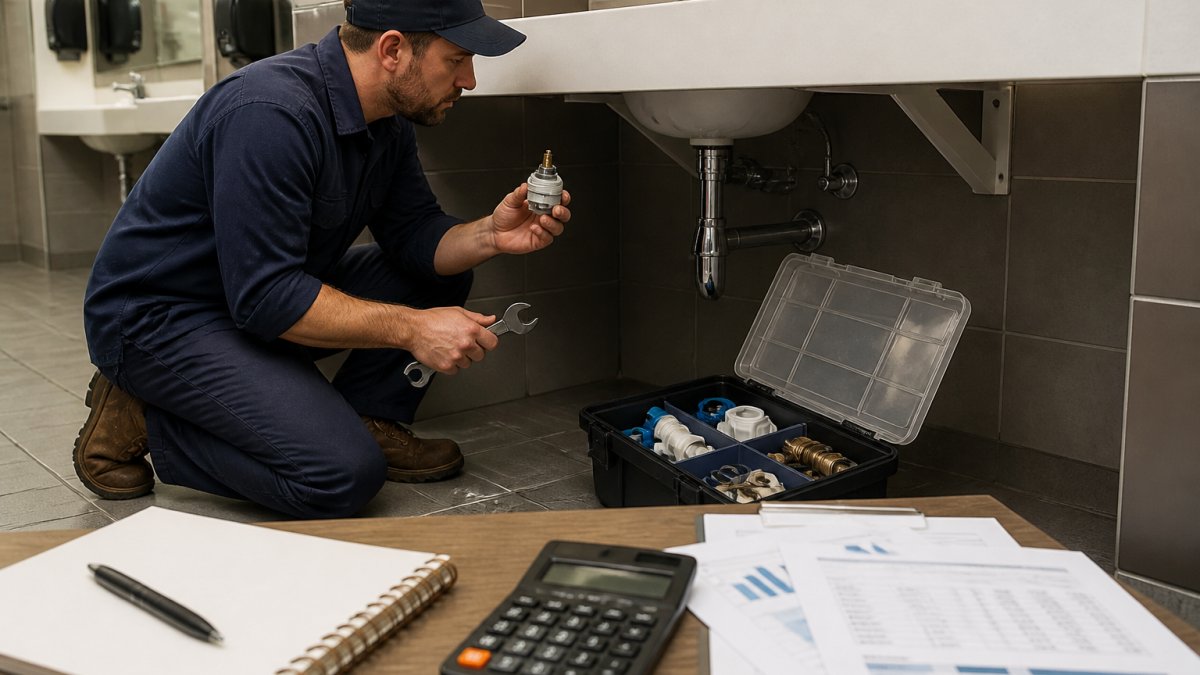
Faucet repair parts drive total cost of ownership more than purchase price does. A cheaper faucet that fails twice a year costs more in labor and callbacks than a pricier model that runs for years on one cartridge swap.
The Four Cost Buckets
Total cost of ownership over a faucet's service life is the sum of four things:
- Acquisition cost, purchase price plus any mounting hardware, supply lines, and drain assembly not in the box.
- Parts cost, cartridges, aerators, spray heads, diverters, O-rings, and seals replaced over the fixture's life; the body and handles usually outlast them.
- Labor cost, technician time per repair multiplied by the number of repairs. This is where the math usually flips toward the more expensive fixture.
- Downtime cost, revenue or occupancy lost while a unit is out of service. In hospitality and multifamily this is often the largest bucket and the most ignored.
Component-Level Failure Economics
Durability is the sum of how long each wear component lasts and what it costs to replace. The failure order is predictable:

- Cartridge: First to fail, causing drips and handle stiffness. On OEM-grade fixtures it is serviceable in place; on sealed-body imports it may not be, forcing a full replacement.
- Aerator: Clogs with scale and sediment. Cheap to replace, but often misdiagnosed as a valve failure, triggering an unnecessary callback.
- Spray head/diverter: Wears on pull-down and pull-out models; on commercial-style kitchen faucets it is frequently the second-most-common failure after the cartridge.
The key TCO insight: a fixture with a serviceable cartridge and standardized aerator runs for years on a small parts budget, while a sealed-body fixture with a proprietary cartridge turns every wear failure into a full replacement. That difference, not the sticker price, separates low-TCO from high-TCO fixtures.
Repair vs. Replace: When the Math Flips
In portfolio maintenance, the first cartridge replacement is almost always cheaper than a new fixture.
A practical rule of thumb many property teams use: if the fixture has had two or more repairs in a 24-month window, replace it rather than repair it again. The labor savings from a single avoided callback often covers the difference between a residential-grade and a commercial-grade replacement.
Why Standardized Parts Change the Equation
Parts availability is a durability variable, not just a logistics one. When every unit uses the same cartridge and aerator:
- The parts kit shrinks, so the technician carries the right part on the first visit.
- Store-run time disappears, removing the largest hidden labor cost in a callback.
- Wrong-part second visits drop, the most expensive failure mode in reactive maintenance.
Pre-kitted, OEM-grade parts from brands like Moen, Delta, and BrassCraft cut store-run time and reduce wrong-part second visits. Ready Bathroom Solutions bundles these into a single box with 15-20% bundle savings, which is where the real cost difference shows up across a portfolio.
| Cost Factor | Residential-Grade Fixture | Commercial-Grade Fixture |
|---|---|---|
| Upfront price | Lower | Higher |
| Cartridge life | Shorter under heavy use | Longer duty rating |
| Callback frequency | Higher in high-traffic units | Lower |
| Parts availability | Mixed | Standardized OEM parts |
| Labor per repair | Same | Same |
| Downtime exposure | Higher (more failures) | Lower (fewer failures) |
| Best for | Low-use units | High-traffic properties |
Commercial-Style Faucets in Home Kitchens: Pros and Cons
Commercial-style faucets in home kitchens are a design choice with real trade-offs. A spring-coil spout and pull-down spray head look professional and rinse well, but the exposed coil collects grease and the taller arc needs more sink clearance.
The pros are real: better rinsing, a high-arc spout that fits large pots, and a spray pattern that reaches the whole sink.
Which Faucets Fit Your Property? A Buying Guide
Match the fixture to the duty cycle, not the showroom. For low-use units, a residential-grade faucet with metal handles is enough. For guest rooms, student housing, and any fixture seeing heavy daily use, spec a commercial-grade valve and a standardized cartridge you can restock easily.
For bathroom sinks specifically, our OEM-grade options cover the common configurations:
- Delta Faucet Ara Single Handle Monoblock Bathroom Sink Faucet at $260.38: single-hole, 1.2 gpm, brass handles, 8-3/8 in. height.
- PROFLO Two Handle Centerset Bathroom Sink Faucet with Drain Assembly at $52.39: 3-hole, 1.2 gpm, includes drain assembly.
- PROFLO Single Handle Centerset Bathroom Sink Faucet at $62.48: 3-hole, 1.2 gpm, metal handle.
- Moen Chateau Two Handle Centerset Bathroom Sink Faucet at $108.47: 3-hole, 1.2 gpm, 4-inch deck hole.
Conclusion
The hardest part of faucet durability isn't choosing a fixture. It's keeping hundreds of them running without a store run every time a cartridge fails. Ready Bathroom Solutions builds pre-kitted, OEM-grade maintenance sets with standardized components, OEM parts from Moen, Delta, and BrassCraft, and 15-20% bundle savings, so your team can turn units faster and cut repeat callbacks. Get started with Ready Bathroom Solutions and keep every bathroom in your portfolio running on one standardized kit.

Frequently Asked Questions
Are commercial faucets more durable than residential faucets?
Commercial faucets are built for higher duty cycles, often tested to hundreds of thousands of on/off cycles, while residential faucets are designed for lighter daily use. That said, the durability gap narrows when a residential faucet uses solid brass construction and a quality cartridge. For high-traffic properties like hotels or student housing, commercial-grade fixtures generally outlast residential models because their valves, seals, and finishes are engineered for constant use.
How many years should a faucet last?
A residential faucet lifespan typically runs 10 to 15 years in a normal household, but in a high-traffic rental or hotel bathroom that can drop to 5 to 7 years. Commercial faucets often reach 15 to 20 years with regular maintenance and available repair parts. The biggest factors are water pressure, usage frequency, and whether replacement cartridges and seals stay in stock so small leaks get fixed before they damage the valve body.
What should property managers consider when choosing faucets for high-use bathrooms?
Focus on duty cycle rating, valve type, and parts availability. A faucet with a ceramic cartridge and solid brass body holds up better under heavy use than one with plastic internals. Check that replacement cartridges, aerators, and handles are easy to order, because a $10 part that arrives in two days prevents a full fixture swap. Standardizing on one or two models across a portfolio also simplifies maintenance and reduces callback rates.
Which faucet parts are most likely to need repair?
Cartridges, seals, O-rings, and aerators fail first. The cartridge wears from constant handle movement, seals dry out and leak, and aerators clog with mineral buildup. Handles and spray heads can crack if they are plastic. Choosing a faucet with a metal handle and a widely available cartridge means you can fix a drip in under 30 minutes instead of replacing the whole unit, which cuts both labor and material costs.
Are commercial-style faucets suitable for apartments or hotels?
Yes, but match the model to the setting. A true commercial faucet with a spring-coil spout or pre-rinse sprayer suits back-of-house kitchens, not guest bathrooms. For apartment and hotel bathrooms, a commercial-style faucet with a high-arc spout and ceramic cartridge gives you the durability benefits without an industrial look. Confirm sink clearance and deck hole configuration before ordering so installation does not require countertop modification.