

Table of Contents
- Why Student Housing Maintenance Breaks Under Pressure
- The Student Housing Unit Turn Checklist That Actually Works
- Prioritizing Work Orders Without Burning Out Your Team
- Bathroom Sink Repair Efficiency: The Hidden Time Drain
- Reducing Maintenance Callbacks in Student Housing With OEM-Grade Parts
- Preventative Maintenance and Predictive Maintenance for Student Housing
- Vendor Management, Procurement, and Legal Compliance
- Frequently Asked Questions
Last Updated: September 17, 2026
Why Student Housing Maintenance Breaks Under Pressure
Student housing maintenance keeps units safe, habitable, and rent-ready on a compressed academic calendar, with every unit turning in weeks, not months.
The Student Housing Unit Turn Checklist That Actually Works
A student housing unit turn checklist works when it standardizes inspections, sequences work by dependency, and closes each unit only after a verified re-inspection. Checklists fail when written as reminders rather than gates.
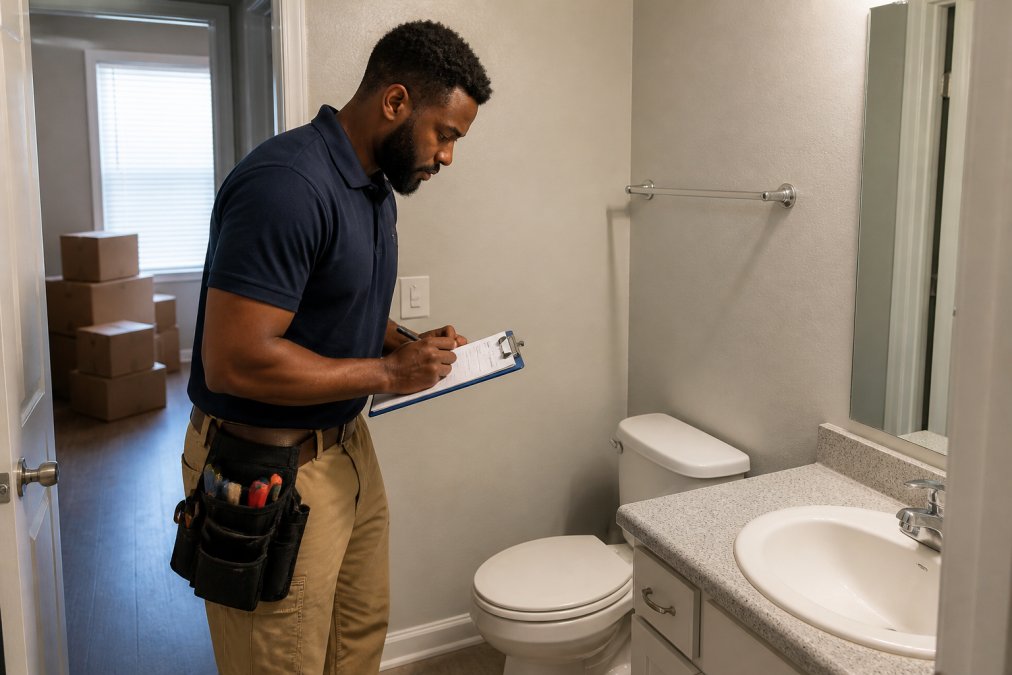
The turn process moves through four phases:
- Vacate inspection - document condition, photograph damage, log every deficiency into the work order system
- Scope and assign - group repairs by trade, batch identical jobs across units
- Execute - plumbing, surfaces, fixtures, then paint and flooring
- Re-inspect and release - verify against the same checklist used at vacate
Standardized Unit Inspections and Habitability Standards
Standardized inspections protect both the asset and the operator: habitability standards set the legal floor, and inspections prove the property meets it. Build one template per unit type and never vary it by inspector, consistency makes the data usable across a portfolio.
- Water pressure and drainage at every fixture
- Toilet flush cycle and seal integrity
- Caulk lines and grout condition
- Ventilation and moisture control
- Smoke and carbon monoxide detector function
- Lock, latch, and door hardware operation
Seasonal Turnover Process: Summer Turn Strategies
Summer turnover is a scheduling problem disguised as a maintenance problem: volume and window are fixed, so the only variables are sequencing and parts availability. Batch by building, not by work order, one technician replacing the same fill valve across forty units in one building takes a fraction of the time of forty separate trips. Pre-stage parts per building before the first unit is touched.

Prioritizing Work Orders Without Burning Out Your Team
Work order management is triage: clear the queue in the order that protects habitability, safety, and revenue, without letting the same small crew absorb every emergency until they quit.
| Tier | Examples | Target Response Time | Who Can Authorize |
|---|---|---|---|
| Emergency | No water, sewage backup, no heat, no AC in extreme heat, lock failure, active flooding | Same day, dispatch immediately | On-call tech, up to a set spend limit |
| Urgent | Single fixture out, contained leak, no hot water, refrigerator failure | 24-48 hours | Lead technician |
| Routine | Drip, slow drain, cosmetic damage, caulk failure, squeaky door | Scheduled batch, next turn window | Maintenance supervisor |
Repair Prioritization and Emergency Response Protocols
Emergency response protocols should be written before the emergency, naming who is called, in what order, what they can spend, and what they can promise the resident.
Mechanics that separate functional protocols from decorative ones:
- A single after-hours number routing to a rotating on-call tech, not a general office line. Residents who cannot reach anyone call the city, and a habitability complaint costs far more than a 2 a.m. dispatch.
- A written spend authority for the on-call tech, up to a set dollar limit without supervisor approval. Techs who must wake a manager for every $80 part stop dispatching, and the backlog shows up as move-in failures.
- A callback log that records every after-hours event with timestamp, unit, cause, and resolution. Review it weekly. Recurring causes get fixed on the preventative schedule, not on the emergency schedule.
- A resident-facing response standard, acknowledging a request within a few hours, even when the fix is scheduled for later, cuts repeat calls and escalations dramatically.
Protecting Maintenance Staffing From Burnout
Maintenance staffing collapses during turn season when the same people absorb every emergency, routine request, and inspection. Burnout is an operational risk: the technician who quits in July takes institutional knowledge of every unit's quirks with them, and the replacement learns it back one callback at a time.
The practical protections that most property teams find work:
- Cap consecutive after-hours rotations. A tech on call five nights in a row is a resignation letter with a delay. Rotate on-call weekly across a bench of at least three people.
- Rotate technicians off emergency duty after peak weeks. The two weeks after move-in are the highest-stress window of the year. Give the people who carried the turn a lighter schedule, not another surge.
- Publish the turn schedule in advance. Teams that know what is coming handle it better than teams surprised every June. A shared calendar with building-by-building turn dates converts anxiety into planning.
- Cross-train at least one person per trade. A single point of failure on HVAC or plumbing means that person never gets a day off during peak.
- Track overtime by person, not by department. Department-level overtime hides the individual who is carrying the load. Person-level tracking surfaces the burnout risk before the resignation does.
When to Escalate to a Vendor Instead of the In-House Team
Not every work order belongs to the in-house crew. The rule is capacity, not capability: if dispatching internally pushes a scheduled turn task past its deadline, send it to a vendor even if the team could technically do it.

Common candidates for vendor escalation during peak:
Fill Valve / Flush Valve - Fluidmaster →
- Specialty trades, HVAC refrigerant work, electrical panel issues, elevator service, fire system testing. These require licensing the in-house team usually does not carry.
- Volume overflow, painting, flooring, and deep cleaning during turn, when the in-house crew is fully committed to habitability and safety work.
- After-hours emergencies beyond the on-call tech's trade, a plumbing emergency at 1 a.m. is a vendor call, not a reason to wake the HVAC tech.
Bathroom Sink Repair Efficiency: The Hidden Time Drain
Bathroom sink repair efficiency is where turn schedules quietly die. A sink job looks small, so it gets scheduled loosely, then consumes an afternoon because the parts were not on the truck. The hidden cost is the trip: a technician who leaves to source a supply line, seal, or faucet cartridge loses the unit, the slot, and often the day.
Reducing Maintenance Callbacks in Student Housing With OEM-Grade Parts
Reducing maintenance callbacks in student housing comes down to part quality. A callback costs a second trip, a second labor charge, and a resident complaint, far more than the price difference between a generic part and an OEM-grade one. OEM-grade parts fit the fixture they were designed for; generic substitutes often require modification, and modified connections are where repeat failures cluster.
- Fluidmaster Pro Series Adjustable Fill Valve at $10.82, adjustable from 9 in. to 14 in. to fit most standard tanks
- Fluidmaster PRO57A Adjustable Flush Valve with Flapper at $10.44
- Fluidmaster Better Than Wax Rubber Toilet Seal at $4.49, compatible with 3 in. and 4 in. waste lines
- PROFLO Toilet Flexible Water Connector at $3.91
Preventative Maintenance and Predictive Maintenance for Student Housing
Preventative maintenance is scheduled work that prevents failure; predictive maintenance uses condition data to time that work more precisely. Both reduce the emergency load that destroys turn schedules and cost less than the emergency call they replace. For student housing, the highest-return tasks are tied to water, the most expensive and most predictable failure mode. A supply line that fails at year eight should never have reached year eight.

A workable preventative schedule for a typical student unit:
| Component | Interval | Action |
|---|---|---|
| Toilet fill and flush valves | Annual, at turn | Replace on schedule, not on failure |
| Supply lines and connectors | Every 5-7 years | Replace regardless of appearance |
| Shut-off valves | Annual | Exercise quarter-turn to prevent seizure |
| Smoke and CO detectors | Monthly test, annual battery | Test at every turn, replace batteries yearly |
| HVAC filters | Quarterly, monthly in peak | Replace on schedule |
| Caulk and grout | Annual, at turn | Re-caulk wet areas |
| Dryer vents | Annual | Clear lint, verify airflow |
| Water heater anode rod | Every 3-5 years | Inspect and replace |
Seasonal Maintenance Checklists and Asset Lifecycle Planning
Asset lifecycle planning tracks how long each component class lasts and replaces it on schedule rather than on failure. A fill valve that fails at year six should have been replaced at year five, during a scheduled turn, not on a Saturday in September with a resident standing in an inch of water. A scheduled replacement costs the part plus a few minutes of a technician already on site; the same failure as an emergency costs the part, an after-hours dispatch, water remediation, a complaint, and often temporary relocation.
- Spring: pre-turn inspection sweep, parts staging, vendor confirmation, HVAC cooling check, irrigation and exterior prep
- Summer: turn execution, re-inspection, move-in readiness, water heater and supply line replacements batched by building
- Fall: post-move-in follow-up, warranty tracking, callback review, heating system check, gutter and drainage clearing
- Winter: freeze protection on exposed pipes and vacant units, deferred maintenance backlog, capital planning for the next turn
Sustainability and Green Maintenance: The Angle Most Guides Skip
Most student housing maintenance guides focus on cost and speed, but sustainability is increasingly expected by universities, institutional owners, and residents. Green maintenance is not about expensive retrofits, it is about choosing components and practices that reduce water, energy, and waste over the life of the unit:
- Low-flow fixtures and aerators reduce water use in the highest-consumption rooms in the building. Bathrooms and showers drive most of a unit's water demand.
- Water-efficient toilets and fill valves cut per-flush volume without changing resident experience. Replacing a failed fill valve with a standard one is a missed opportunity; a water-efficient model pays back over the unit's life.
- LED lighting replacement at turn is the lowest-effort energy upgrade available. Fixtures that fail during a turn should be replaced with LED, not the same incandescent or fluorescent they replaced.
- Refrigerant-compliant HVAC service matters as refrigerant regulations tighten. Older systems require specific handling, and non-compliant service is a liability, not just an environmental issue.
- Waste diversion during turn, furniture, appliances, and fixtures pulled from units can often be donated or recycled rather than dumped. In markets with high disposal costs, diversion is also a cost play.
- Preventative replacement over reactive repair is itself a sustainability practice. A part that fails and floods a unit wastes water, materials, and remediation resources. Scheduled replacement prevents all three.
Predictive Maintenance in Practice
True predictive maintenance uses sensors and condition data, vibration, temperature, runtime, to time service before failure. Most portfolios are not there yet and do not need to be. The practical middle ground is condition-based maintenance: inspect on a schedule, replace based on observed condition, and log the data. After a few turn cycles, a portfolio knows which buildings fail first, which component classes fail earliest, and which vendors deliver parts that hold, data that makes the next turn schedule realistic instead of optimistic.
Vendor Management, Procurement, and Legal Compliance
Vendor management and procurement determine whether a turn schedule is realistic; a schedule built without confirmed vendor capacity is a wish, not a plan. Procurement discipline means consolidating parts purchasing so the same kit is used across every unit type, reducing training time and inventory variance and making spend forecastable.
Frequently Asked Questions
What are the most common maintenance issues in student housing?
Toilet fill valves and flush valves top the list, followed by running toilets, leaking supply lines, and failed wax rings. Bathroom sink drains and faucet connections come next. Because these parts wear out on a predictable cycle, keeping OEM-grade replacements on hand shortens response time and prevents small leaks from becoming water damage claims. Standardized parts also make repairs repeatable across every unit.
How do standardized maintenance kits improve bathroom sink repair efficiency?
A pre-kitted box puts the fill valve, seal, supply line, and bolts in one place, so a technician never leaves the unit to hunt for a part. That removes store runs and the second trip that usually follows. Kits also standardize what gets installed, which means fewer callbacks from mismatched or low-grade components and more consistent results across a whole portfolio.
How can property managers reduce maintenance callbacks in student housing?
Start with the parts, not the schedule. Installing OEM-grade components like a Fluidmaster fill valve or a rubber toilet seal instead of bargain replacements cuts repeat visits because the part lasts. Pair that with a photo requirement on every completed work order so a supervisor can confirm the repair before the unit is marked ready. Standardized kits make both steps easier to enforce.
What is the role of preventative maintenance in student housing?
Preventative maintenance replaces parts on a schedule instead of waiting for a failure. In student housing, that means flushing valves, checking supply lines, and inspecting seals before summer turnover, when every unit needs to be rent-ready at once. It shifts work out of the peak window, reduces emergency response calls, and extends the asset lifecycle of fixtures that would otherwise fail mid-lease.