

Table of Contents
- What Amtex Hotel Supply Actually Covers (and What It Doesn't)
- Hotel Maintenance Procurement Best Practices for Multi-Property Portfolios
- Bulk vs. Just-in-Time Ordering: A Cost-Benefit Breakdown
- Quality Grading Standards for Hospitality Textiles
- Reducing Maintenance Callbacks in Hospitality with Standardized Parts
- Bathroom Repair Kits for Property Managers: What Belongs in the Box
- Supply Chain Sustainability Reporting for Hospitality Procurement
- Conclusion
- Frequently Asked Questions
Last Updated: October 5, 2026
What Amtex Hotel Supply Actually Covers (and What It Doesn't)
Amtex hotel supply is the shorthand many property managers use when searching for a one-stop lodging vendor, but the term covers less than the name suggests.
At Ready Bathroom Solutions, we build pre-kitted, OEM-grade bathroom repair sets for exactly this problem.
Here's what a typical hospitality supply catalog covers, and where it stops:
| Category | Usually Stocked | Often Missing |
|---|---|---|
| Towels and bedding linens | Yes | High-GSM commercial bedding |
| Guest room amenities | Yes | Replacement fixture cartridges |
| Housekeeping equipment | Yes | Supply lines and shut-off valves |
| Bathroom repair hardware | Rarely | OEM-grade trim and valves |
Treat Amtex hotel supply as a starting point for soft goods, then source repair hardware separately. The rest of this guide covers how to do that without blowing your budget or maintenance schedule.
Hotel Maintenance Procurement Best Practices for Multi-Property Portfolios
Multi-property portfolios fail at procurement for one reason: every building buys on its own. Five properties means five purchase orders, five price points, and five faucet cartridges that almost fit. Standardization is the fix, and it starts before you request a quote.
The best-performing approach we see is a three-tier structure:
- Tier 1 (portfolio-wide): Consumables and repair parts used at every property, bought on one contract
- Tier 2 (regional): Items tied to specific fixture brands or building ages
- Tier 3 (property-level): One-off purchases under a set dollar threshold, no approval needed
Tier 1 is where the savings live: one price and one delivery schedule instead of five.
Build a Bid Package That Gets Comparable Quotes
Vendors quote what you ask for, so a vague request gets quotes you can't compare. A bid package fixes that: include the part number, manufacturer, quantity per property, and delivery window, and require vendors to quote the exact spec, not an "equivalent."
A workable bid package has four sections:
- Scope: What you're buying, by part number and quantity
- Specifications: OEM or OEM-equivalent, with the brand named
- Terms: Delivery schedule, return policy, and warranty
- Scoring: How you'll weigh price against lead time and fill rate
That last section is the one most teams skip. Price alone steers you toward a vendor who ships in three weeks; for a property turning rooms daily, faster lead time is often worth more than a lower unit cost.
Bulk vs. Just-in-Time Ordering: A Cost-Benefit Breakdown
Bulk ordering wins on unit price; just-in-time wins on cash flow and warehouse space. Neither is universally correct, the right answer depends on how predictable your repair volume is and what it costs to hold a part on a shelf.
Most procurement teams compare only invoice price. The real number is total cost of ownership per part per year, which combines four inputs:
- Unit price, what the vendor charges per piece
- Carrying cost, storage, insurance, shrinkage, and tied-up capital. A common planning assumption in hospitality maintenance is 15 to 25 percent of inventory value per year, though the right figure depends on your cost of capital and space costs
- Ordering cost, the labor hours to cut a PO, receive, and stock a shipment. Even a small order can consume an hour of a purchasing coordinator's time
- Stockout cost, the emergency retail run, the overtime labor, and the room-nights lost while a unit sits out of service
Here's how the two approaches compare on the factors that actually move your operating budget:
| Factor | Bulk Ordering | Just-in-Time |
|---|---|---|
| Unit cost | Lower per part | Higher per part |
| Cash tied up | High upfront | Low, pay as used |
| Storage needed | Significant | Minimal |
| Stockout risk | Low | High |
| Emergency purchases | Rare | Frequent |
| Ordering labor | One PO covers many months | Many small POs |
| Best for | Predictable, high-volume parts | Rare or model-specific parts |
The hidden cost in just-in-time is the emergency run: when a cartridge fails Friday night and nobody has one on the shelf, someone drives to a retail store and pays retail, plus labor.
How to Find Your Reorder Point
The decision isn't really "bulk or JIT", it's "what's my reorder point for each part?" A simple formula works for most properties:
Reorder point = (average daily usage × lead time in days) + safety stock
If a property replaces two faucet cartridges a week (about 0.29 per day) and lead time is 10 days, you need roughly 3 cartridges in transit plus a safety buffer.
Run that math for your top 20 parts and a pattern emerges fast: high daily usage and long lead times belong in bulk; low usage or short lead times can stay just-in-time.
Where Just-in-Time Earns Its Place
Slow-moving inventory is where JIT wins. Parts for a discontinued fixture model don't belong in bulk, you'll hold them for years, then throw them out when the last fixture is replaced. Buy those as needed, or accept replacing the fixture instead.
A middle path works for most portfolios: bulk-buy the parts you replace weekly, and keep a small just-in-time budget for everything else. That's the logic behind our pre-kitted sets, each box holds the parts a standard bathroom repair consumes, so you buy in bulk without guessing which components to stock.
Quality Grading Standards for Hospitality Textiles
Textile quality in lodging comes down to two numbers: GSM and thread count. GSM (grams per square meter) measures fabric density and better predicts how a towel holds up under commercial laundry. Thread count measures threads per square inch in bedding, though above a certain point it's marketing more than durability.
For commercial bedding and towels, durability beats initial softness every time. A plush towel that pills after twenty washes costs more per use than a denser one that survives a hundred cycles.
What the Numbers Actually Mean
Most hospitality buyers have never seen a spec sheet that explains the ranges. Here's a working reference for commercial-grade linens:
| Textile | Common Range | Commercial-Grade Target |
|---|---|---|
| Bath towels | 300-900 GSM | 500-700 GSM |
| Hand towels | 400-700 GSM | 450-600 GSM |
| Washcloths | 400-600 GSM | 450-550 GSM |
| Bed sheets | 200-400 thread count | 200-300 thread count, long-staple cotton or cotton-poly blend |
| Pillowcases | 200-400 thread count | 200-300 thread count, matching sheet spec |
A few notes on reading that table:
- Below 400 GSM, a towel is a light-duty product. It will feel thin after a few dozen commercial wash cycles and is usually a poor fit for a property turning rooms daily.
- Above 700 GSM, a towel feels plush but takes noticeably longer to dry, which raises dryer energy cost and slows laundry throughput. For most properties, the sweet spot is 500-700 GSM.
- Thread count above 300 is often achieved by counting plied yarns as multiple threads. A 600-thread-count sheet made from short-staple cotton can wear out faster than a 250-thread-count sheet made from long-staple cotton. Fiber length matters more than the count.
What to Check Before You Commit to a Linen Contract
Ask for these five data points in writing. A vendor who can't provide them hasn't tested the product.
- GSM range: Heavier towels resist wear but take longer to dry
- Thread count and fiber type: Moderate counts with longer staple fibers outperform inflated counts
- Shrinkage: Ask for the tested shrinkage rate after five wash cycles, not the marketing claim. Commercial laundries typically see 3-7 percent shrinkage on cotton goods; anything above that signals a construction problem
How to Spec a Linen Contract
A linen contract that doesn't name GSM, thread count, fiber type, and shrinkage tolerance is a contract you can't enforce. Write the spec into the PO, then require the vendor to certify delivered goods match it, with a right to reject non-conforming lots.
Quality grading standards for hospitality textiles aren't optional details. They're the difference between a linen budget that holds steady and one that spikes every time a property reorders.
Reducing Maintenance Callbacks in Hospitality with Standardized Parts
Callbacks are the quiet budget killer in lodging operations.
Standardizing on OEM-grade parts from known manufacturers solves most of it. When every property stocks the same Moen or Delta cartridge, the part fits the first time and the repair holds.
Three habits cut callbacks fast:
- Match the part to the fixture brand, never to what's on the shelf
- Replace the whole assembly, not just the failed component, when wear is visible
- Log every repair by part number so you can spot the parts that keep failing
That third habit is the one teams skip, and it's the one that tells you which parts to bulk-buy next quarter.
Bathroom Repair Kits for Property Managers: What Belongs in the Box
Bathroom repair kits for property managers should cover the repairs that take a room out of service most often: faucet drips, running toilets, and leaking supply lines.
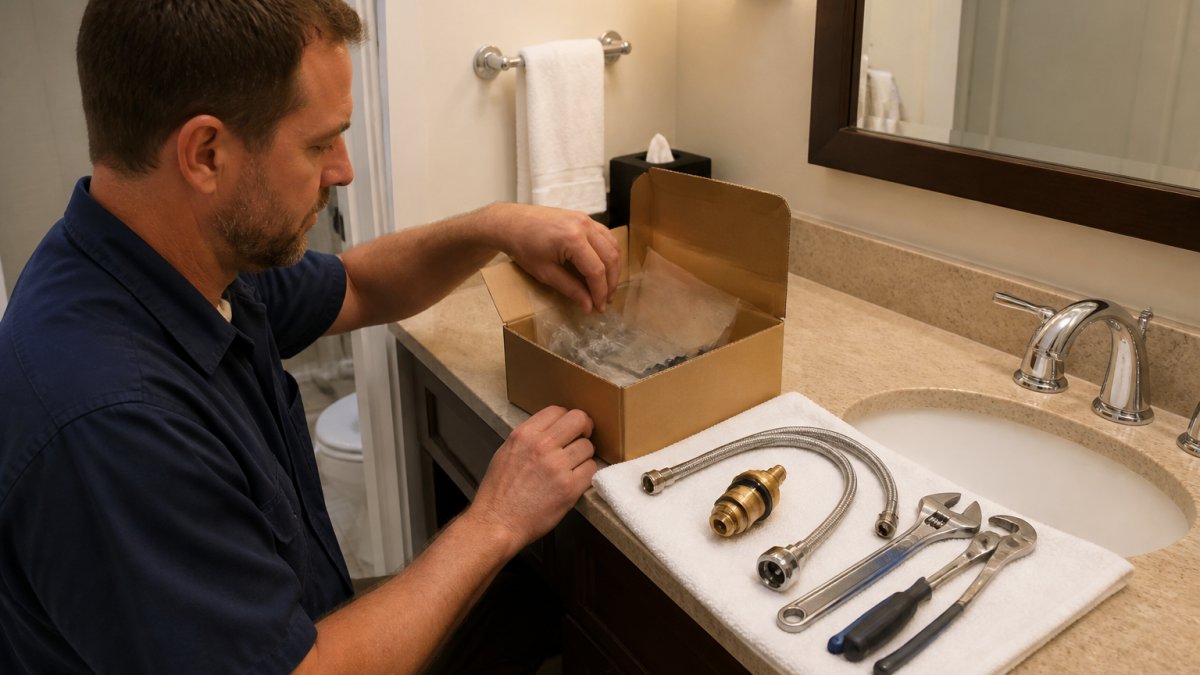
A complete kit typically includes:
- Faucet cartridges matched to the fixture brand
- Toilet fill and flush valves
- Braided supply lines and shut-off valves
The advantage of a pre-kitted box is that it removes the decision: your technician opens the box, takes the part that fits, and finishes the job, no store trip, no improvised substitute.
For multi-property portfolios, kits also enforce consistency: every unit gets the same OEM-grade install, which keeps guest satisfaction metrics from sliding when a repair is done at 11 p.m. by whoever is on call.
Supply Chain Sustainability Reporting for Hospitality Procurement
Sustainability reporting is moving from a nice-to-have to a line item in vendor scorecards. Procurement teams increasingly must document where parts come from, how they were packaged, and what happens at end of life.
Most hospitality supply vendors don't publish this yet. That's a gap worth pressing on in your bid process. Ask three questions:
- Does the vendor publish a sustainability or supply chain report?
- What's the packaging made of, and is it recyclable?
- Can the vendor document the country of origin for OEM parts?
You don't need perfect answers to start. You need vendors who can answer at all. Over time, the ones who can will win your Tier 1 contracts, and the ones who can't will fall out of the bid.
Conclusion
The hardest part of hospitality procurement isn't finding vendors. It's getting consistent, OEM-grade parts into every property without burning labor hours on store runs and repeat repairs.
Our pre-kitted bathroom repair sets consolidate OEM-grade parts from Moen, Delta, and BrassCraft into one box, with bundle savings of 15 to 20 percent and standardized components that keep every unit to the same spec.
Get started with Ready Bathroom Solutions and give your maintenance team the box that finishes the job the first time.
Frequently Asked Questions
What types of products does Amtex hotel supply typically cover?
Amtex hotel supply catalogs generally span lodging and hospitality supplies, including towels and bedding linens, guest room amenities, housekeeping equipment, and operational supplies and equipment (OS&E). For bathroom-specific repairs, most property managers source OEM-grade parts like faucet cartridges, supply lines, and shower valves separately, since general hospitality distributors often carry textiles and amenities rather than the fixture components your maintenance team needs for unit turns.
How do pre-kitted bathroom solutions compare to traditional supply vendors?
Traditional vendors sell individual parts, so a technician diagnosing a leaking faucet may need to visit a store or wait on a shipment before completing the repair. Pre-kitted solutions bundle the common components for a standard bathroom repair into one box. For property managers running room turns, that means fewer trips, fewer partial fixes, and more consistent results across units. Ready Bathroom Solutions builds kits around OEM-grade parts from brands like Moen, Delta, and BrassCraft, with bundle savings of 15-20% compared to buying components individually.
What are the best practices for hotel maintenance procurement?
Start by standardizing the fixture brands and models across your portfolio so parts are interchangeable between properties. Build a bid package that lists exact specifications, quantities, and delivery windows so vendors quote comparable line items. Then track callback rates by part type to see which components fail early. Hotel maintenance procurement best practices also include reviewing your supplier's fulfillment and logistics capabilities, since a lower unit price means little if a part takes two weeks to arrive during peak season.
How can property managers reduce maintenance callbacks?
Callbacks usually trace back to two causes: the wrong part was installed, or the part was low quality. Standardizing on OEM-grade components and pre-kitted repair sets addresses both. When every technician pulls from the same box with the same cartridge and supply line, there's less guesswork at the fixture. Reducing maintenance callbacks in hospitality also means logging the reason for each repeat visit, so you can identify whether a specific model, brand, or installation step is driving the pattern.